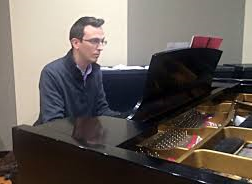
(This review was originally published, in a slightly shorter version, on Sit Down Listen Up: One Album.)
Now this is an interesting idea: the “whole wholume” of James Joyce’s “Finnegan’s Wake” set to music by various musicians, not as a set of songs or an opera but as a single day-long composition. I’ve listened to about two-thirds of it so far, and it promises to be something greater than the sum of its parts. It is available for free download or streaming audio at Waywords and Meansigns.
For those unfamiliar with the novel, FW is an epic (some would say impenetrable) stream-of-consciousness dream narrative with the barest thread of a plot. A man, H. C. Earwicker, or just HCE, is sleeping. In his dream, he becomes a landscape on which is reenacted the fall of man, symbolized by Humpty Dumpty’s fall and the fall of Tim Finnegan from a ladder. Later in the dream, Earwicker commits an uncertain crime, and is put on trial. Anna Livia, or ALP (probably Earwicker’s wife in his non-sleeping life), presents a letter which will maybe exonerate him; but the letter is either lost in a chicken coop or just unreadable, and is mocked instead. The dream then shifts to three other characters, either Earwicker’s children or fragments of his own psyche (or both): the lowlife Shem the Penman, the heroic Shaun the Postman (aka Juan and Yawn), and the flighty Issy (aka Izzy, Lizzy, and Tizzy). These three regress to their childhood – and while growing up again, Shaun proves to be Earwicker himself. The meaning of “wake” shifts from Tim Finnegan’s funeral to the idea of “waking up” or resurrection, and (though the last monologue is given to Anna), Earwicker awakens and the novel abruptly cuts off – or loops back around to the beginning.
This unresolved fragment is hardly a storyline for a novel. (To be fair, the book is actually much more complex and has literally hundreds of minor characters who float in and out of the dream.) But it isn’t really about plot; it’s not really “about” anything. The interest comes in Joyce’s use of language: the entire tome is a vast puzzle on wordplay, shifting (and very complex) symbolism, and dream imagery.
In this recorded version of chapter one, interest is also created by the music and the readings. Acoustic, Irish-tinged repetitive minimalism (mostly on a mandolin) accompanies the first part; this later gives way (during the “Mutt and Jute” conversation) to electronic hums and whistles, and then more subtle harpsichord and scratchy strings (for the Prankquean sequence), then “retro” synthesizers (in the Japanese pentatonic scale) and Indonesian kacape. Though James Joyce was Irish, the voices don’t have a particularly Irish accent but they do sound European – adding, perhaps, another international layer to the already multifaceted text and music.
This works well with FW, of course, with its fractured stream-of-(un)consciousness. The music becomes another layer of the dream. …But I could imagine this as a new type of literature, made for and disseminated on the internet. Musicians and authors could work together, producing words with music that are not “songs” but something closer to films (but without the visual element!). There are precedents, of course. John Cage’s “Indeterminacy” (with David Tudor) certainly counts. I myself have occasionally read a poem or a chapter of a book that I’d written, at the Hugo House (Seattle), with music that I had composed specifically for the background. (I am also still trying to gather musicians to make a recorded version of the “Shervanya Nocturnal Music” that appears in my novel “Tond”.) I had thought of this type of activity, however, as a continuation of the live improvised music accompanying “Beat” poetry and thus perhaps a form of non-rhyming rap – I hadn’t thought of producing an extended composition that goes with (or is part of) an entire novel.
The second section (Book 1 Chapter 2) didn’t at first seem to be “music” to me, but simply an actor reading an audiobook. My opinion changed about two-thirds of the way through, where the “Ballad of Persse O’Reilly” begins – ambient synthesizers trail in from somewhere, unnoticeable at first, and then other voices (all spoken by the same actor) appear. As the ballad itself proceeds, with music partially provided by Mr. Joyce (there is a page of “sheet music” in the novel), it becomes something of a commentary on a nonsensical Irish song sounding as if in the middle of a Broadway musical. The spoken section at the beginning was merely an extended introduction to this.
The trial scene (Book 1 Chapter 3) is accompanied by alt-rock and circus music – perhaps a confirmation of the parody in this scene. Joyce, like Lewis Carroll in “Alice’s Adventures Underground”, was pointing out the absurdity of the court system of the time.
The least satisfying part so far (to me) is the long chapter which contains the “Mookse and Gripes” sequence. This is one of my favorite parts of the book, with its captivating surrealist imagery ripped right from our subconscious: the weirdly macho, armor-encrusted Mookse; the scruffy Gripes (sitting in a tree, made of grapes, and apparently fermenting as the narrative proceeds); their enigmatic but weirdly perfect insults to each other (“Uskybeak! Ungulant! Uvuloid!”); the shimmering cloud-girl watching them from above (she rains into the river after they depart); the “tears of dusk”; the woman “of no appearance with chills at her feet”, and so on. All very interesting, but the problem occurs with the narrator. He renders the entire chapter as the Mookse might, in both a snooty “posh” accent and quasi-drunken slur (with crowd sounds in the background), and it’s difficult to distinguish the characters – the pompous, professorial poohbah who pontificates the parable is particularly problematic to pin down. This could be a meta-comment on the Wake itself; as in most dreams, characters morph and mutate into one another – but in this audio version, it’s simply less interesting.
More successful are the character sketch chapters. Book 1 Chapter 5, a satire on Anna’s letter becomes, at some point, satire on the Book of Kells (Medieval Irish calligraphy) and then Finnegans Wake itself. The music to this section is a series of drones, gradually becoming a Celtic “slow air” and then an Indian raga, and it is very beautiful. The description of Shem the Penman and his ramshackle mansion is likewise delivered over minimalist string quartet music that v e r y slowly emerges from seemingly endless drones. In this case the voice is electronically slowed (slightly) and lowered (considerably), fitting for the effect of the dream. The last chapter of Book 1 is gossip about Anna, accompanied again by alt rock and circus music (and some freeform improvisation); this is a lively and pointed commentary on the ubiquity but immorality of wagging tongues.
Book 2, chapter 1 is the central part of the novel, and the beginning of the densest dream-language. This is presented as a triptych. The opening and closing sections are almost hip-hop, with sections of a heavy beat and samples from pop and rock (“…another one bites the dust…”, “call me maybe…”) and the Ride of the Valkyries. The middle section is rendered as Beatnik poetry (with a slight “Punk” edge) over jazz improvisations and cross-cut with fragments from probably more than fifty recordings of various types of music. The dream has expanded its borders into other times and places. Other chapters of Book 2 are treated similarly except for the “Nightlessons”. This is forty-plus pages of the gobbledygook that the adult worlds of history and mathematics must seem like to children, with equally incomprehensible footnotes by the three kids, some of which (the footnotes) are supposed to sound “intelligent”. Most of this chapter is sung by a single female voice, a capella – a masterstroke by the musician, Liz Longo; one thinks of it as Anna singing the lessons to her children.
I have not heard all of the rest of it yet. Obviously, the extreme length is an impediment to sitting down and giving one’s full attention to listening to this for any particular amount of time. The question arises: to what extent is this an “album”? To what extent is this even “music”? My answer to first question is perhaps obvious: It’s an “album” in that it’s a set of musical “numbers” that occur in a particular order and were intended to be heard (at least once) together; and it is (like the greatest “albums”) more than the sum of its parts. Most “albums”, of course, are between thirty minutes and an hour, appear on one or more recorded media, and can be listened to at one sitting. But there are much longer examples. Double albums such as the Beatles’ “White Album” are of course a little longer but still can be listened to at one sitting if one makes the time. The same with symphonies – I hear these as “albums” intended to be played live (though of course they can be found recorded too); again, most are between thirty minutes and an hour, but some are much longer. The Mahler Third, Bruckner Fifth, and Shostakovich Seventh are all around ninety minutes in length. Operas and musicals are longer still (these, at least in performance, have a visual element, but are again found recorded – music only) – the Mother of All is Wagner’s “Ring” – and here the idea stretches as to what can be experienced at one time. Sound installations and conceptual pieces such as John Cage’s “To Be Played As Slowly As Possible” are the longest of all – these can last for months, or years, or even centuries. (I myself have done a two-month installation.) Of course no one can listen to the whole of one of these; they are more an immersive experience that one can be a part of for as long (or short) as one wishes. But they are “albums” in that they are (sets of, not necessarily) musical “numbers” that are intended to be played together and are greater than the sum of their parts.
The second question, “Is it music?”, is to me at least, more subjective. On one level it’s meta-music: “Finnegan’s Wake” (with the apostrophe) is the title of an Irish ballad, the story of Tim Finnegan’s fall (and resurrection) – referenced in Joyce’s novel. The novel contains other musical references as well. On another level, it’s a discussion of the differences and similarities between music and speech: because much of the fragmented style of writing is not understandable on a literal level, the reader sometimes has to be content to listen to its melody, almost as one listens to the sound of a foreign language as music.
Dismissing all naïve, cultural-based ideas such as “music has a beat and chords”, my music teacher when I was in middle school defined music as “organized sound expressing emotion”. I would change it slightly to “sound, other than speech, made on purpose, as expression”. By either definition, this rendition of Finnegans Wake is music as much as it a reading of the novel. It joins musical compositions basedon the Wake, by John Cage, Stephen Albert, Toru Takemitsu, Benjamin Boretz, Witold Lutoslawki, Harry Partch, Samuel Barber, and scores of others (including a musico-dramatic “work in progress” version by my friend Neal Kosaly-Meyer – reviewed last December in this blog). What else it is, is up to the individual listener.
An exploration of music and sound art in Seattle and surrounding areas, with an emphasis on the adventurous (along with some visual art, film, and other assorted variations on random themes)
Author Website: https://sites.google.com/view/stevenescribnerauthor
Music Website: https://sericscribner1.bandcamp.com/
Sunday, May 31, 2015
Wednesday, May 27, 2015
Concert Review: Harry Partch at the University of Washington, 5/26/2015
This was the second concert presented by the UW Harry Partch project (I missed the first). As I walked in, I saw the famous one-of-a-kind instruments on the stage. Some of them were a lot larger than I had expected (and one, the “surrogate kithara”, was a lot smaller). Other people came in and filled up the seats; unexpectedly for “experimental” music, the hall was full to capacity.
For those unfamiliar, Harry Partch (1901 - 1974) was an American musical iconoclast who invented a 43-pitch per octave microtonal scale (based on extensions of ancient Greek concepts), wrote music in it, and invented an “orchestra” of instruments to play it. Most of these instruments are either percussion or plectra (plucked strings). The collection of instruments has resided at various places in the U.S., and is now in the University of Washington, Seattle.
Charles Corey, director of the project, introduced the concert. He stated that there would be a short film first, of Harry Partch himself introducing his home-made instruments. Then there would be the concert itself, played mostly by UW students, then a round-table discussion with questions from the audience.
The film began. They projected it on a curtain (with obvious folds and flaws), not on a screen – and several times at the beginning it (the movie) froze or skipped around. Finally it went blank altogether. Pause for a couple of minutes, then reboot the computer (or boot up another one) and retry. This time it worked. Comment from the audience: “Hey, that theme (the fanfare the computer plays while turning on) isn’t Partch – it’s in a tempered scale!” In the movie, Mr. Partch talked about and played several of his instruments, then played random cuts from “Daphne of the Dunes”. The sound quality wasn’t particularly great, as a lot of early Partch recordings; but it was a suitable (if rather fragmented) intro to the music for those who weren’t familiar with it.
The concert began with the famous “Two Studies on Ancient Greek Scales”, for bass marimba (played by Kaley Eaton) and and harmonic canon (the latter is a variation on a koto, though with many more strings much closer together – played by Josh Archibald-Seiffer). The sound was much richer than it has been on recordings. The bass marimba is extremely resonant.
“Two Psalms” followed. “The Lord is My Shepherd (Psalm 23)” was, to me at least, just a voice intoning the text without a particularly interesting accompaniment; but “By the Rivers of Babylon (Psalm 137)” was a more extended chamber movement. The bass-baritone (Jeff Bowen) intoned the first few verses in the same manner as in “Psalm 23”, becoming progressively expressive as the Psalmist lamented the Hebrews’ captivity in Babylon. Coming to “How can I sing the Lord’s song?”, the instruments took over, building to a heart-rendering climax for the brief return of the vocalist. Instruments included the adapted viola, chromelodeon (adapted reed organ, played by Anna Stachurska) and kithara (played by Jeff Boven and then Jacob Sundstrom). The latter instrument is much larger than its ancient Greek prototype: the player has to stand on a riser behind it to play its several banks of strings arranged in chords.
Next, there was an excerpt from “And on the seventh day petals fell in Petaluma”. This is a high-spirited instrumental allegro, far different from the introspective “Psalms”. Huck Hodge and Greg Sinibaldi played it with aplomb on the diamond marimba and surrogate kithara (the latter is so named because it plays in the same manner of the kithara but is smaller and easier to play – it resembles a pedal-steel guitar with two banks of strings).
Back to the introspections. The three excerpts from “Eleven Intrusions” were written just after WWII, with memories of the Great Depression, and embody the despair and anxiety of those periods. “The Crane” is particularly mournful, while “The Waterfall” seems at first a happy little tune but soon takes on darker hues as the vocalist chastises crowds for seeking the “pool of oblivion”. Josh Archibald-Seiffer sang; Luke Morse played the adapted guitar (which has an extra brace on the back besides its adapted tuning) and Declan Sullivan played the diamond marimba.
Probably the most crowd-pleasing piece on the program, “O Frabjous Day!” is a setting of the great humorous poem “Jabberwocky” by Lewis Carroll. Kaley Eaton (harmonic cannon – seemingly amplified) and Isaac Anderson (bass marimba) accompanied with folk-like rhythmic drones and catchy, even rhythms, while Charles Corey sang the poem in a tuneful declamatory style. The humor of the nonsense poem was enhanced by Partch’s cheery setting.
The last piece also included humor, provided in part by the Mazda marimba played by Andrew Angeli. This is one of Partch’s zaniest instruments. The sight of a percussionist using mallets on what looks like a table full of light bulbs is in itself subtly hilarious, and when the timbre is added (it really sounds like percussive burps), all bets are off. The boos (as in “play the boos” – bamboo marimba, played by Declan Sullivan) – a stack of bamboo segments strapped together – is only slightly less madcap. The interesting thing is, though, that this second excerpt from “Petals fell in Petaluma” is perfectly serious music, though it is another happy allegro. As in several of Partch’s other works, the humor and the seriousness merged into a seamless whole.
Several members of Partch’s original ensemble were present for the round-table discussion. Some of their comments:
“What we saw at the beginning of the concert tonight (the film starting and restarting) wasn’t Partch – it was classic Cagean chance!”
“When we were rehearsing some of Partch’s music in his original ensemble, he would often say something to the effect of, ‘hey, you’re singing it wrong – it’s not a semitone, it’s supposed to be three-fourths of a semitone…!’”
“Symphony orchestra players play in just intonation. The ‘cellos and basses form the bass line, and then the other orchestra members have to subconsciously adjust, in microtones, to stay in tune.”
“Patch often composed in a way that was explored by Bach: continuous variation. He’d take one idea, spin it out as far as it would go, and then take another idea, and spin it out as far as it would go.” I commented that this was a similar technique (also) to Indian ragas.
“Partch’s music has three periods. First, he wrote art songs (like what was most of the program tonight). This was his lied-in period, pardon the pun. Then he wrote ‘Americana’ based on hobo trips and the like. Lastly, he wrote extended theater pieces.”
“Partch often said his music was ‘corporeal’ in that it involved graceful movements while playing. Also the players had to sing and dance – a very ancient concept.”
“Partch was looking to the future of music by looking into its deep past.”
“After practicing in one of Partch’s early ensembles, everything I heard on the way home – the wind, my car’s tires on the road – became music.”
“The fact that these students could learn this music in just a few weeks, and perform it so well, proves that Partch was a great composer – the music flows well, and just makes sense the way that good music does.”
For those unfamiliar, Harry Partch (1901 - 1974) was an American musical iconoclast who invented a 43-pitch per octave microtonal scale (based on extensions of ancient Greek concepts), wrote music in it, and invented an “orchestra” of instruments to play it. Most of these instruments are either percussion or plectra (plucked strings). The collection of instruments has resided at various places in the U.S., and is now in the University of Washington, Seattle.
Charles Corey, director of the project, introduced the concert. He stated that there would be a short film first, of Harry Partch himself introducing his home-made instruments. Then there would be the concert itself, played mostly by UW students, then a round-table discussion with questions from the audience.
The film began. They projected it on a curtain (with obvious folds and flaws), not on a screen – and several times at the beginning it (the movie) froze or skipped around. Finally it went blank altogether. Pause for a couple of minutes, then reboot the computer (or boot up another one) and retry. This time it worked. Comment from the audience: “Hey, that theme (the fanfare the computer plays while turning on) isn’t Partch – it’s in a tempered scale!” In the movie, Mr. Partch talked about and played several of his instruments, then played random cuts from “Daphne of the Dunes”. The sound quality wasn’t particularly great, as a lot of early Partch recordings; but it was a suitable (if rather fragmented) intro to the music for those who weren’t familiar with it.
The concert began with the famous “Two Studies on Ancient Greek Scales”, for bass marimba (played by Kaley Eaton) and and harmonic canon (the latter is a variation on a koto, though with many more strings much closer together – played by Josh Archibald-Seiffer). The sound was much richer than it has been on recordings. The bass marimba is extremely resonant.
“Two Psalms” followed. “The Lord is My Shepherd (Psalm 23)” was, to me at least, just a voice intoning the text without a particularly interesting accompaniment; but “By the Rivers of Babylon (Psalm 137)” was a more extended chamber movement. The bass-baritone (Jeff Bowen) intoned the first few verses in the same manner as in “Psalm 23”, becoming progressively expressive as the Psalmist lamented the Hebrews’ captivity in Babylon. Coming to “How can I sing the Lord’s song?”, the instruments took over, building to a heart-rendering climax for the brief return of the vocalist. Instruments included the adapted viola, chromelodeon (adapted reed organ, played by Anna Stachurska) and kithara (played by Jeff Boven and then Jacob Sundstrom). The latter instrument is much larger than its ancient Greek prototype: the player has to stand on a riser behind it to play its several banks of strings arranged in chords.
Next, there was an excerpt from “And on the seventh day petals fell in Petaluma”. This is a high-spirited instrumental allegro, far different from the introspective “Psalms”. Huck Hodge and Greg Sinibaldi played it with aplomb on the diamond marimba and surrogate kithara (the latter is so named because it plays in the same manner of the kithara but is smaller and easier to play – it resembles a pedal-steel guitar with two banks of strings).
Back to the introspections. The three excerpts from “Eleven Intrusions” were written just after WWII, with memories of the Great Depression, and embody the despair and anxiety of those periods. “The Crane” is particularly mournful, while “The Waterfall” seems at first a happy little tune but soon takes on darker hues as the vocalist chastises crowds for seeking the “pool of oblivion”. Josh Archibald-Seiffer sang; Luke Morse played the adapted guitar (which has an extra brace on the back besides its adapted tuning) and Declan Sullivan played the diamond marimba.
Probably the most crowd-pleasing piece on the program, “O Frabjous Day!” is a setting of the great humorous poem “Jabberwocky” by Lewis Carroll. Kaley Eaton (harmonic cannon – seemingly amplified) and Isaac Anderson (bass marimba) accompanied with folk-like rhythmic drones and catchy, even rhythms, while Charles Corey sang the poem in a tuneful declamatory style. The humor of the nonsense poem was enhanced by Partch’s cheery setting.
The last piece also included humor, provided in part by the Mazda marimba played by Andrew Angeli. This is one of Partch’s zaniest instruments. The sight of a percussionist using mallets on what looks like a table full of light bulbs is in itself subtly hilarious, and when the timbre is added (it really sounds like percussive burps), all bets are off. The boos (as in “play the boos” – bamboo marimba, played by Declan Sullivan) – a stack of bamboo segments strapped together – is only slightly less madcap. The interesting thing is, though, that this second excerpt from “Petals fell in Petaluma” is perfectly serious music, though it is another happy allegro. As in several of Partch’s other works, the humor and the seriousness merged into a seamless whole.
Several members of Partch’s original ensemble were present for the round-table discussion. Some of their comments:
“What we saw at the beginning of the concert tonight (the film starting and restarting) wasn’t Partch – it was classic Cagean chance!”
“When we were rehearsing some of Partch’s music in his original ensemble, he would often say something to the effect of, ‘hey, you’re singing it wrong – it’s not a semitone, it’s supposed to be three-fourths of a semitone…!’”
“Symphony orchestra players play in just intonation. The ‘cellos and basses form the bass line, and then the other orchestra members have to subconsciously adjust, in microtones, to stay in tune.”
“Patch often composed in a way that was explored by Bach: continuous variation. He’d take one idea, spin it out as far as it would go, and then take another idea, and spin it out as far as it would go.” I commented that this was a similar technique (also) to Indian ragas.
“Partch’s music has three periods. First, he wrote art songs (like what was most of the program tonight). This was his lied-in period, pardon the pun. Then he wrote ‘Americana’ based on hobo trips and the like. Lastly, he wrote extended theater pieces.”
“Partch often said his music was ‘corporeal’ in that it involved graceful movements while playing. Also the players had to sing and dance – a very ancient concept.”
“Partch was looking to the future of music by looking into its deep past.”
“After practicing in one of Partch’s early ensembles, everything I heard on the way home – the wind, my car’s tires on the road – became music.”
“The fact that these students could learn this music in just a few weeks, and perform it so well, proves that Partch was a great composer – the music flows well, and just makes sense the way that good music does.”
Saturday, May 23, 2015
The 12th Century in the 21st: Medieval Women's Choir perform Hildegard's "Ordo Virtutm" at St. James, Seattle
Their angelic voices echoed in the vast cathedral, while bells and mysterious instruments sounded, seemingly from everywhere at once. I could see them singing and playing there, in the intersection of the cross-shaped building – but I heard them from all directions. Such is the acoustics of St. James Cathedral in Seattle.
I had heard a performance of Hildegard von Bingen’s “Ordo Virtutum” once before, several decades ago, and at that time I’d bought the recording of the work by Sequentia (then on vinyl, now on CD and probably vinyl again). The recording had never had the same effect as the live performance, and at this concert last Friday I was able to discern why. Music such as this demands the ambient surround-sound delivered by yawning spaces in immense stone and wood buildings.
Ordo Virtutm is an example of an ancient genre of music known as, well, an “ordo”; somewhere between an opera and an extended morality lesson. Archetypal characters (representing Biblical personages or concepts such as “humility” and “an individual soul”) sing and chant as a bare story line leisurely unfolds. Hildegard’s Ordo is one of the earliest still-extant examples of the genre, and perhaps the closest to its roots in Gregorian chant – though there are some extreme differences in the music which place it as a thoroughly individual conception. The melodies flow, freeform, seemingly uninterested in either rhythm or conventional phrasing. Instruments (harps and early versions of violins) accompany, either heterophonically or as drones. Bells ring at key moments, sometimes multiplying into swarms of chiming tones (one instrument was a set of small hand bells strapped to a rotating wheel). Harmony actually appears at times, centuries before the concept of “chords” – Hildegard seems to have perceived it as a special effect, saved for the most dramatic moments.
The story is a simple one. A soul approaches heaven, guided forward by the Virtues (Knowledge of God, Faith, Fear of God, Hope, Obedience, Victory, Humility, Charity, Castity). A rough voice calls from behind her (not singing, and accompanied by rattling percussion); it is the devil, tempting her to abandon her journey. This she does, briefly, but finds her new direction unsatisfying, and lets the Virtues show her the way to heaven again. The devil vows to fight her, but Victory swoops down and binds him up, and the soul makes her way to heaven.
Such a simple story line, of course, is made more interesting (and dramatic) by the music. Exactly how it would have been performed during Hildegard’s time is not certain. This Seattle group did it with medieval costumes, though lighting effects enhanced both the celestial world of the Virtues and the demonic world of the devil. They played and sung the music enthusiastically, sweetly, and dramatically, despite two missed cues by the percussionists. The overall effect was beautiful, and the story still resonates – proving that this was not only a work for its time but for the ages.
I had heard a performance of Hildegard von Bingen’s “Ordo Virtutum” once before, several decades ago, and at that time I’d bought the recording of the work by Sequentia (then on vinyl, now on CD and probably vinyl again). The recording had never had the same effect as the live performance, and at this concert last Friday I was able to discern why. Music such as this demands the ambient surround-sound delivered by yawning spaces in immense stone and wood buildings.
Ordo Virtutm is an example of an ancient genre of music known as, well, an “ordo”; somewhere between an opera and an extended morality lesson. Archetypal characters (representing Biblical personages or concepts such as “humility” and “an individual soul”) sing and chant as a bare story line leisurely unfolds. Hildegard’s Ordo is one of the earliest still-extant examples of the genre, and perhaps the closest to its roots in Gregorian chant – though there are some extreme differences in the music which place it as a thoroughly individual conception. The melodies flow, freeform, seemingly uninterested in either rhythm or conventional phrasing. Instruments (harps and early versions of violins) accompany, either heterophonically or as drones. Bells ring at key moments, sometimes multiplying into swarms of chiming tones (one instrument was a set of small hand bells strapped to a rotating wheel). Harmony actually appears at times, centuries before the concept of “chords” – Hildegard seems to have perceived it as a special effect, saved for the most dramatic moments.
The story is a simple one. A soul approaches heaven, guided forward by the Virtues (Knowledge of God, Faith, Fear of God, Hope, Obedience, Victory, Humility, Charity, Castity). A rough voice calls from behind her (not singing, and accompanied by rattling percussion); it is the devil, tempting her to abandon her journey. This she does, briefly, but finds her new direction unsatisfying, and lets the Virtues show her the way to heaven again. The devil vows to fight her, but Victory swoops down and binds him up, and the soul makes her way to heaven.
Such a simple story line, of course, is made more interesting (and dramatic) by the music. Exactly how it would have been performed during Hildegard’s time is not certain. This Seattle group did it with medieval costumes, though lighting effects enhanced both the celestial world of the Virtues and the demonic world of the devil. They played and sung the music enthusiastically, sweetly, and dramatically, despite two missed cues by the percussionists. The overall effect was beautiful, and the story still resonates – proving that this was not only a work for its time but for the ages.
Wednesday, May 13, 2015
Seattle Composers Salon, 5/8/2015
"The Seattle Composers’ Salon fosters the development, performance and appreciation of new music by regional composers and performers. At bi-monthly, informal presentations, the Salon features finished works, previews, and works in progress."
First up: Centaurus X-3 by Matthew James Briggs. Violin (played by Candace Chin) and percussion (played by the composer) created this mysterious soundscape, over prerecorded ambient electronics (made of signals from the Centaurus pulsar and other NASA recordings, slightly scrambled). The violin was also electric; not particularly amplified but enhanced by an extremely long delay. As in much of Matthes’s music, there was an Indonesian influence in the middle, faster section. The interest, however, was mostly in the interactions between the instruments in the slower movements, particularly the slow build-up in the first movement. During the Q and A session after the performance, an audience member asked what the piece would have been like without the electronics. The composer’s comments agreed with my idea: it would be a different piece. Some of the same notes, yes, but definitely a different piece.
Second: Toad Song by Jessi Harvey. The text was by the composer’s sister, about a toad that had lived in the yard of the house they’d lived in as children. The song was from the point of view of the toad. “You have written a great children’s book, and the music is the illustrations,” commented an audience member. Musically, the piece was created from fragments of ascending chromatic scales (sung by the soprano) and amphibian sounds made by the ‘cello; these interacted with more conventional melodic fragments to create longer and more complex ideas.
Third: Two trios by Ian McKnight, both for two flutes and ‘cello. The first, with alto flute, described the life cycle of the mythical phoenix – dying in agony of flames, memorialized by a Gregorian-chant melody, and then returning to life and flying into the sky. I heard none of this in the actual music. The sounds of the alto flute was too pretty and the music was not dissonant enough to suggest something burning up while dying (or perhaps I just associate the alto flute too much with Paul Horn’s Taj Mahal music); the “Gregorian” melody didn’t sound particularly chantlike, and the end wasn’t particularly “happier” than the rest of it. None of these are negative comments, however – I like that the piece suggested the story in a more impressionistic manner, rather than in-your-face Hollywood-style obviousness. A second listening would probably reveal the understated emotions that I half-missed the first time. The second (much shorter) trio was an Irish jig with variations, playing on the 3 against 4 ambiguity suggested by the 6/8 meter.
Finally, two untitled piano pieces (with dancer) by Michael Owcharuk and Karin Stevens. Here, two art-forms fused. The composer and dancer (Karin) stated beforehand that they’d worked on the material together, and intended it to be a collaborative project. Either would have worked by itself, though together they created an audio/visual world based on two types of movement (of sounds, and gestures). The piano music was basically jazz but with a neoclassical feel, the dance was “modern” but again with hints of a classical tradition. There was no particular storyline other than the interest in movement.
First up: Centaurus X-3 by Matthew James Briggs. Violin (played by Candace Chin) and percussion (played by the composer) created this mysterious soundscape, over prerecorded ambient electronics (made of signals from the Centaurus pulsar and other NASA recordings, slightly scrambled). The violin was also electric; not particularly amplified but enhanced by an extremely long delay. As in much of Matthes’s music, there was an Indonesian influence in the middle, faster section. The interest, however, was mostly in the interactions between the instruments in the slower movements, particularly the slow build-up in the first movement. During the Q and A session after the performance, an audience member asked what the piece would have been like without the electronics. The composer’s comments agreed with my idea: it would be a different piece. Some of the same notes, yes, but definitely a different piece.
Second: Toad Song by Jessi Harvey. The text was by the composer’s sister, about a toad that had lived in the yard of the house they’d lived in as children. The song was from the point of view of the toad. “You have written a great children’s book, and the music is the illustrations,” commented an audience member. Musically, the piece was created from fragments of ascending chromatic scales (sung by the soprano) and amphibian sounds made by the ‘cello; these interacted with more conventional melodic fragments to create longer and more complex ideas.
Third: Two trios by Ian McKnight, both for two flutes and ‘cello. The first, with alto flute, described the life cycle of the mythical phoenix – dying in agony of flames, memorialized by a Gregorian-chant melody, and then returning to life and flying into the sky. I heard none of this in the actual music. The sounds of the alto flute was too pretty and the music was not dissonant enough to suggest something burning up while dying (or perhaps I just associate the alto flute too much with Paul Horn’s Taj Mahal music); the “Gregorian” melody didn’t sound particularly chantlike, and the end wasn’t particularly “happier” than the rest of it. None of these are negative comments, however – I like that the piece suggested the story in a more impressionistic manner, rather than in-your-face Hollywood-style obviousness. A second listening would probably reveal the understated emotions that I half-missed the first time. The second (much shorter) trio was an Irish jig with variations, playing on the 3 against 4 ambiguity suggested by the 6/8 meter.
Finally, two untitled piano pieces (with dancer) by Michael Owcharuk and Karin Stevens. Here, two art-forms fused. The composer and dancer (Karin) stated beforehand that they’d worked on the material together, and intended it to be a collaborative project. Either would have worked by itself, though together they created an audio/visual world based on two types of movement (of sounds, and gestures). The piano music was basically jazz but with a neoclassical feel, the dance was “modern” but again with hints of a classical tradition. There was no particular storyline other than the interest in movement.
Wednesday, April 29, 2015
CD Reviews: Where (we) Live and As:Is
These reviews of musical collaborations were originally published by SitDownListenUp on www.sitdownlistenup.com.
As:Is, As Is
Christine Abdelnour (saxophone), Bonnie Jones (electronics), and Andrea Neumann (inside piano) improvised this music, "As:Is", together. The cover art is a picture of their hair, which makes them appear anonymous – none of them sport particularly individualistic hairstyles.
That’s all. There is nothing else about this CD that in any way suggests that the performers might be humans, or that the music itself is even from this planet. Listening to it, however, is (at the risk of sounding trite) a journey to an exciting, or at least interesting, new world.
One could say that this album has no individual tracks. At least it has no “songs”, or “compositions”, or any other labels that divide sound into individual structures. …And yet, there are separate pieces with names. This is only to give the listeners some idea of where they are in the recording. The music itself is of no help.
The opening “number” has some sense of organization, which makes the listener complacent about what is coming. One might almost be able to follow it. Harmonics on the piano strings (sounding rather like an electric guitar) lead to a silence, then “chubbling” (chuckling/bubbling) sax noises, then a frightening build-up of electronic claxons. These subside, with small percussion clinks. Perhaps this has been an actual composition; after the intro (the piano harmonics) it moves from A to B to C (from the chubbling to the claxons to the percussion) in a seemingly logical manner. None of it has any connections to the traditional idea of “music”, but the overall effect is that we have heard music.
Even that effect is abandoned in the following tracks. There is no repetition, no development, no refrains, no chords, no rhythms, no reverb. We, the listeners, enter a new world of clicks, static, silence, squeals, hums, feedback, silence, dolphins, glitches, thumps, distorted voices from a radio, silence, piano as percussion, saxophone as percussion, microphones as percussion, silence, squirrels, scraping, buzzing, whirring, unidentifiable noises, and more silence. Technically it is the world of “microsounds”, but it is a world without a map. There is nothing familiar, no way to navigate these resonances. It is neither and both noise and music.
So why is it so fascinating? Why can I listen to it over and over without boredom?
I think the answer lies in its very rejection of all that is “music”. In this rejection, the players have become “free” to make whatever sounds (or no sounds) they feel are right at the time. And they truly play together; one sound leads to another, or not; but altogether it works as a single thought. Finally, as we, the listeners, settle into a quiet state of listening without preconceptions, we begin to understand it and hear its beauty.
And there are moments of exquisite beauty. In “Ganzfeld” (track 4), a saxophone drone with recurring, evolving, cyclic white noise leads to deeper static and then crumpling paper. We hear it as soft rain.
In “Despair” (track 5), the return of the piano bass harmonics (a “classical” recapitulation?) generates a loud sax buzz with very quiet feedback over the top. We hear it as a multiphonic “chord”, a word spoken by some new cosmic yet strangely intimate instrument. It is both “out there” in space and right here inside the listeners’ head. The bass harmonics mix in and out.
In “And Transport” (track 6) sounds actually are being transported by other sounds, as scrapes and high harmonic whistles gradually build up with a rolling motion. This leads into the distance, and each iteration of sound or silence becomes longer. This process continues into the last track, “Hair Idioms” – the title is possibly a reference to the CD’s cover; the only link on the album to anything remotely familiar.
In the end, what have we heard? Was it music? Yes. No. Was it noise? Yes. No. Was it fascinating? Absolutely. Would I recommend it? Absolutely. Would I play it for a friend? Absolutely, if only to watch another listener proceed from incredulity to understanding, and finally to perception of an alternate beauty – the same journey that I made the first time I heard this the first time.
(A disclaimer – it may take a listener more than one hearing to make the journey. I was somewhat primed for it because I’d heard “microsounds” before, and saw Ms. Jones and Ms. Neumann play in a similar style at the Seattle Improvised Music Festival in 2013, where I bought this CD.)
Indie-Rock, Sō Not As Usual
The album is "Where (We) Live" by Grey McMurray and Sō Percussion. I came across it at the public library a couple of months ago, in the jazz section. I had heard some of Sō Percussion’s gamelan-inspired work before, though the cover (a cardboard sculpture of the Brooklyn Bridge against a stark white background) suggested gritty New York free-improvisation. I was somewhat surprised to find it to be an indie-rock album. …Or is it?
White noise and piano, with a spoken poem (not a “rap”) by a male voice. So begins this album which clamors (quietly) to get your attention in a world of alt-rock sameness. The piano fades into the distance, adding more and more reverb, as unidentifiable noises come to the foreground. The poem speaks of getting lost in a strange new home. Indeed, we the listeners are entering a strange new home of music. This is not indie-rock (or any rock) as usual.
Perhaps it was never intended to be any genre as usual. Sō Percussion is a “new music” ensemble who performs improvised music and contemporary classical compositions. Grey McMurray is a guitarist and vocalist who plays several styles (he’s in several bands, too). So the combination could go in any direction, or more than one direction at a time.
That said, the second track, “Five Rooms Back”, definitely picks up the rock vibe by adding guitar and drums after the piano, but soon moves past it into a world of improvised noise. The surreal lyrics, spoken again, recall thinking about how lucky the narrator was to have a panic attack…
Then quickly the noise is over. Atmospheric guitar and accordion begin “Strange Steps”, though almost immediately this turns into what could pass for an instrumental Death Cab for Cutie song (in 5/4 time). Return to the atmospheric guitar, then the song starts again in a different meter. This happens several times. Each time, the “song” is different (one of the most interesting times, the percussion line is taken up by a glockenspiel). The words keep talking about “strange steps” in each meter. Perhaps these odd rhythms are metaphors for the strange steps.
“Moat” again recalls Death Cab for Cutie with a languid vocals over a slow guitar line; this is almost immediately dispelled by clattering wood blocks and cowbells. The ballad resumes, still melodically, over noise guitar. Again, there are several variations (and several odd meters), before piano and glockenspiels end the song in a mood that is introspective but oddly hurried.
“Room and Board” is a stream of consciousness reminiscence of childhood accompanied by a shifting sonic landscape. Some of the more interesting moments include repeated samples of the narrator; heavy fuzz-guitar drowning out the words; and at the end, little percussion “drips” that are microtonally out-of-tune with the piano chords.
“In Our Rooms” is a mysterious echoscape with stereotypically spooky Theremin, autoharp-on-piano (Henry Cowell’s “Aeolian Harp”), and occasional microtonal guitar. Its end leads directly into the drum beats of “All Along”; this is another instrumental. Here there is a steady but irregular rock beat, ambient piano chords, and slightly distorted guitar – sounding as if Radiohead and Pink Floyd had gotten together for a jam. Again the “outro” leads directly into the next song, “Strangers All Along”, which continues the irregular meter but has a more peppy, upbeat “pop” feeling despite its introspection. It’s quiet, but it’s all primary colors in a major key. The vocals return; the melody repeats several times without an actual refrain.
Fast African rhythms (on cowbells and caxixi) begin “Five Rooms Down”, the sequel to the previous “Five Rooms” track. This is another stream of consciousness, with whistling melodies, and spoken vocals distorted as through a CB radio.
In the last song, “Thank You”, 70’s electric piano accompanies a balladic melody in the style of a jazz-standard. The repeated words, “thank you for letting me know…” provide a concluding commentary, possibly “thank you for listening” as background noise builds up and then subsides. The album ends with the tune fading, but still ringing in the listener’s mind as it disappears into silence.
…So, what of it? What have we heard? The first time I listened to this, it was one of the most interesting and “different” indie-rock albums I’d ever found, comparable to Radiohead’s “Kid A” and Sigur Rós’ unpronounceable “()”. On a second listen, in my car on a long trip, I found it to be rather depressing, not up-tempo enough for a car ride (though this is paradoxical because I often listen to Cage and Takemitsu chamber music in my car). Finally, a third listen revealed it to be what the musicians probably intended all along: a fusion of two genres; a look at rock through the lens of “new music”, or perhaps the other way around. It is a beautiful homage to two genres that encourage a great deal of experimentation. The two fuse into something that is more than either by itself, and neither loses its individuality.
As:Is, As Is
Christine Abdelnour (saxophone), Bonnie Jones (electronics), and Andrea Neumann (inside piano) improvised this music, "As:Is", together. The cover art is a picture of their hair, which makes them appear anonymous – none of them sport particularly individualistic hairstyles.
That’s all. There is nothing else about this CD that in any way suggests that the performers might be humans, or that the music itself is even from this planet. Listening to it, however, is (at the risk of sounding trite) a journey to an exciting, or at least interesting, new world.
One could say that this album has no individual tracks. At least it has no “songs”, or “compositions”, or any other labels that divide sound into individual structures. …And yet, there are separate pieces with names. This is only to give the listeners some idea of where they are in the recording. The music itself is of no help.
The opening “number” has some sense of organization, which makes the listener complacent about what is coming. One might almost be able to follow it. Harmonics on the piano strings (sounding rather like an electric guitar) lead to a silence, then “chubbling” (chuckling/bubbling) sax noises, then a frightening build-up of electronic claxons. These subside, with small percussion clinks. Perhaps this has been an actual composition; after the intro (the piano harmonics) it moves from A to B to C (from the chubbling to the claxons to the percussion) in a seemingly logical manner. None of it has any connections to the traditional idea of “music”, but the overall effect is that we have heard music.
Even that effect is abandoned in the following tracks. There is no repetition, no development, no refrains, no chords, no rhythms, no reverb. We, the listeners, enter a new world of clicks, static, silence, squeals, hums, feedback, silence, dolphins, glitches, thumps, distorted voices from a radio, silence, piano as percussion, saxophone as percussion, microphones as percussion, silence, squirrels, scraping, buzzing, whirring, unidentifiable noises, and more silence. Technically it is the world of “microsounds”, but it is a world without a map. There is nothing familiar, no way to navigate these resonances. It is neither and both noise and music.
So why is it so fascinating? Why can I listen to it over and over without boredom?
I think the answer lies in its very rejection of all that is “music”. In this rejection, the players have become “free” to make whatever sounds (or no sounds) they feel are right at the time. And they truly play together; one sound leads to another, or not; but altogether it works as a single thought. Finally, as we, the listeners, settle into a quiet state of listening without preconceptions, we begin to understand it and hear its beauty.
And there are moments of exquisite beauty. In “Ganzfeld” (track 4), a saxophone drone with recurring, evolving, cyclic white noise leads to deeper static and then crumpling paper. We hear it as soft rain.
In “Despair” (track 5), the return of the piano bass harmonics (a “classical” recapitulation?) generates a loud sax buzz with very quiet feedback over the top. We hear it as a multiphonic “chord”, a word spoken by some new cosmic yet strangely intimate instrument. It is both “out there” in space and right here inside the listeners’ head. The bass harmonics mix in and out.
In “And Transport” (track 6) sounds actually are being transported by other sounds, as scrapes and high harmonic whistles gradually build up with a rolling motion. This leads into the distance, and each iteration of sound or silence becomes longer. This process continues into the last track, “Hair Idioms” – the title is possibly a reference to the CD’s cover; the only link on the album to anything remotely familiar.
In the end, what have we heard? Was it music? Yes. No. Was it noise? Yes. No. Was it fascinating? Absolutely. Would I recommend it? Absolutely. Would I play it for a friend? Absolutely, if only to watch another listener proceed from incredulity to understanding, and finally to perception of an alternate beauty – the same journey that I made the first time I heard this the first time.
(A disclaimer – it may take a listener more than one hearing to make the journey. I was somewhat primed for it because I’d heard “microsounds” before, and saw Ms. Jones and Ms. Neumann play in a similar style at the Seattle Improvised Music Festival in 2013, where I bought this CD.)
Indie-Rock, Sō Not As Usual
The album is "Where (We) Live" by Grey McMurray and Sō Percussion. I came across it at the public library a couple of months ago, in the jazz section. I had heard some of Sō Percussion’s gamelan-inspired work before, though the cover (a cardboard sculpture of the Brooklyn Bridge against a stark white background) suggested gritty New York free-improvisation. I was somewhat surprised to find it to be an indie-rock album. …Or is it?
White noise and piano, with a spoken poem (not a “rap”) by a male voice. So begins this album which clamors (quietly) to get your attention in a world of alt-rock sameness. The piano fades into the distance, adding more and more reverb, as unidentifiable noises come to the foreground. The poem speaks of getting lost in a strange new home. Indeed, we the listeners are entering a strange new home of music. This is not indie-rock (or any rock) as usual.
Perhaps it was never intended to be any genre as usual. Sō Percussion is a “new music” ensemble who performs improvised music and contemporary classical compositions. Grey McMurray is a guitarist and vocalist who plays several styles (he’s in several bands, too). So the combination could go in any direction, or more than one direction at a time.
That said, the second track, “Five Rooms Back”, definitely picks up the rock vibe by adding guitar and drums after the piano, but soon moves past it into a world of improvised noise. The surreal lyrics, spoken again, recall thinking about how lucky the narrator was to have a panic attack…
Then quickly the noise is over. Atmospheric guitar and accordion begin “Strange Steps”, though almost immediately this turns into what could pass for an instrumental Death Cab for Cutie song (in 5/4 time). Return to the atmospheric guitar, then the song starts again in a different meter. This happens several times. Each time, the “song” is different (one of the most interesting times, the percussion line is taken up by a glockenspiel). The words keep talking about “strange steps” in each meter. Perhaps these odd rhythms are metaphors for the strange steps.
“Moat” again recalls Death Cab for Cutie with a languid vocals over a slow guitar line; this is almost immediately dispelled by clattering wood blocks and cowbells. The ballad resumes, still melodically, over noise guitar. Again, there are several variations (and several odd meters), before piano and glockenspiels end the song in a mood that is introspective but oddly hurried.
“Room and Board” is a stream of consciousness reminiscence of childhood accompanied by a shifting sonic landscape. Some of the more interesting moments include repeated samples of the narrator; heavy fuzz-guitar drowning out the words; and at the end, little percussion “drips” that are microtonally out-of-tune with the piano chords.
“In Our Rooms” is a mysterious echoscape with stereotypically spooky Theremin, autoharp-on-piano (Henry Cowell’s “Aeolian Harp”), and occasional microtonal guitar. Its end leads directly into the drum beats of “All Along”; this is another instrumental. Here there is a steady but irregular rock beat, ambient piano chords, and slightly distorted guitar – sounding as if Radiohead and Pink Floyd had gotten together for a jam. Again the “outro” leads directly into the next song, “Strangers All Along”, which continues the irregular meter but has a more peppy, upbeat “pop” feeling despite its introspection. It’s quiet, but it’s all primary colors in a major key. The vocals return; the melody repeats several times without an actual refrain.
Fast African rhythms (on cowbells and caxixi) begin “Five Rooms Down”, the sequel to the previous “Five Rooms” track. This is another stream of consciousness, with whistling melodies, and spoken vocals distorted as through a CB radio.
In the last song, “Thank You”, 70’s electric piano accompanies a balladic melody in the style of a jazz-standard. The repeated words, “thank you for letting me know…” provide a concluding commentary, possibly “thank you for listening” as background noise builds up and then subsides. The album ends with the tune fading, but still ringing in the listener’s mind as it disappears into silence.
…So, what of it? What have we heard? The first time I listened to this, it was one of the most interesting and “different” indie-rock albums I’d ever found, comparable to Radiohead’s “Kid A” and Sigur Rós’ unpronounceable “()”. On a second listen, in my car on a long trip, I found it to be rather depressing, not up-tempo enough for a car ride (though this is paradoxical because I often listen to Cage and Takemitsu chamber music in my car). Finally, a third listen revealed it to be what the musicians probably intended all along: a fusion of two genres; a look at rock through the lens of “new music”, or perhaps the other way around. It is a beautiful homage to two genres that encourage a great deal of experimentation. The two fuse into something that is more than either by itself, and neither loses its individuality.
Monday, April 20, 2015
Ambient Piano Minimalism: r. andrew lee at the Chapel Performance Space, 4/17/2015
(Lower case specified by Mr. lee)
I’d heard Mr. lee’s rendition of Dennis Johnson’s four-hour “November” in 2013 (in November), and this concert featured the premier of a work from the beautiful Pacific Crest Trail series by Nat Evans, so I thought I’d check this out.
Mr. lee played three pieces, in ascending length, for a total time of just under two hours. The first was the shortest – but in some ways also the longest (that is a positive comment). Craig Shepard’s “December” was a meditation on three chords in the lower end of the piano; not three chords repeated as in a simple pop number, but three chords, period, played as trills over the (middle) pedal, and each lasting for several minutes. Or perhaps “chords” is a misnomer, since each only had two pitches and was more correctly just an interval. There was a major sixth, then a major second, then something that was at first unidentifiable due to heavy resonant overtones but eventually revealed itself to be a minor second. (The “closing” of intervals and increasing dissonance seemed to be a metaphor for the dwindling sunlight in December.) As the pianist commented after playing, “I play this piece at the beginning of a concert because it forces the listeners to listen in a different way…”
That “different way” is a meditation on continuous sound, essentially the same as listening to a drone piece. Another aspect of drone music also manifested: microtonality. I mentioned the heavy resonant overtones. There is a plethora of these on the lowest strings of a concert grand piano; revealed by continuing trills, they seem to hover over the bass notes, constantly changing, often creating just-intoned microtonal chords. The effect was very beautiful.
The piece ended with a couple of deep “gong strikes” on the last chord, leading into: “Desert Ornamentation” by Nat Evans (written for r. andrew lee). The piano part was the ornamentation, over field recordings made in the desert of the southern part of the Pacific Crest Trail. Both parts of the music were quiet. The piano played fragments of (modal) melodies, too far apart to coalesce into a single recognizable “tune” but too close together to be separate thoughts. This ambiguity created an interesting spatial tension. The field recordings went at their own, much slower, pace. Power lines crackled, airplanes roared quietly overhead, and dogs barked – all sounding in the distance of infinite space. As always with music of this quietude, sounds from outside of the performance space filtered in and mixed into an aleatory soundscape – one of the most engaging moments was a microtonal drone that interacted with the piano tones to produce binaural beats; it was created by a motor running somewhere in the building and wasn’t actually in Mr. Evans’ recordings. As often when “randomness” is embraced in art, the result is not “random” at all.
The last piece, “Obsessions” by Adrian Knight, was a minimalist theme and variations with a lot of surprises. The volume was constant (slightly louder than Nat’s piece) and the tempo was constant (neither slow nor particularly fast). The surprises – and these were relentless – came in the harmonies. Pungent post-Debussy dissonance (think Messiaen) led to jazz progressions (think Bill Evans) led to wide-open “Americana” harmonies on fourths and fifths (think Copland) which in turn led to thick polytonal clusters (think Stravinsky) and mysterious whole-tone resonances (think George Crumb). The whole piece was a kaleidoscope of sound-worlds. This is not to say that it sounded patched together in any way; it did not. The harmonies continuously mutated, but the “theme” was a constant force in the upper half of the piano, each iteration ending with a shadowy tracery of bass notes of ambiguous tonality. There was a slight crescendo near the end (the Obsessions seemed to grow more demanding) and then, abruptly, it was over. The piano merely stopped playing, without a resolve or final cadence. There was a second of silence (the rest of the audience was as startled by the ending as I was) and then wild applause. The piece is, however, probably continuing out there somewhere in another world.
This kind of playing represents, of course, a rejection of both mainstream “loudness” and avant-garde formalism. It is thus a continuation of the aesthetic theorizing of John Cage. I hear it as a beautiful extension of that tradition into conventional “tonal” music, but of course only time will tell if this is actually the case.
I’d heard Mr. lee’s rendition of Dennis Johnson’s four-hour “November” in 2013 (in November), and this concert featured the premier of a work from the beautiful Pacific Crest Trail series by Nat Evans, so I thought I’d check this out.
Mr. lee played three pieces, in ascending length, for a total time of just under two hours. The first was the shortest – but in some ways also the longest (that is a positive comment). Craig Shepard’s “December” was a meditation on three chords in the lower end of the piano; not three chords repeated as in a simple pop number, but three chords, period, played as trills over the (middle) pedal, and each lasting for several minutes. Or perhaps “chords” is a misnomer, since each only had two pitches and was more correctly just an interval. There was a major sixth, then a major second, then something that was at first unidentifiable due to heavy resonant overtones but eventually revealed itself to be a minor second. (The “closing” of intervals and increasing dissonance seemed to be a metaphor for the dwindling sunlight in December.) As the pianist commented after playing, “I play this piece at the beginning of a concert because it forces the listeners to listen in a different way…”
That “different way” is a meditation on continuous sound, essentially the same as listening to a drone piece. Another aspect of drone music also manifested: microtonality. I mentioned the heavy resonant overtones. There is a plethora of these on the lowest strings of a concert grand piano; revealed by continuing trills, they seem to hover over the bass notes, constantly changing, often creating just-intoned microtonal chords. The effect was very beautiful.
The piece ended with a couple of deep “gong strikes” on the last chord, leading into: “Desert Ornamentation” by Nat Evans (written for r. andrew lee). The piano part was the ornamentation, over field recordings made in the desert of the southern part of the Pacific Crest Trail. Both parts of the music were quiet. The piano played fragments of (modal) melodies, too far apart to coalesce into a single recognizable “tune” but too close together to be separate thoughts. This ambiguity created an interesting spatial tension. The field recordings went at their own, much slower, pace. Power lines crackled, airplanes roared quietly overhead, and dogs barked – all sounding in the distance of infinite space. As always with music of this quietude, sounds from outside of the performance space filtered in and mixed into an aleatory soundscape – one of the most engaging moments was a microtonal drone that interacted with the piano tones to produce binaural beats; it was created by a motor running somewhere in the building and wasn’t actually in Mr. Evans’ recordings. As often when “randomness” is embraced in art, the result is not “random” at all.
The last piece, “Obsessions” by Adrian Knight, was a minimalist theme and variations with a lot of surprises. The volume was constant (slightly louder than Nat’s piece) and the tempo was constant (neither slow nor particularly fast). The surprises – and these were relentless – came in the harmonies. Pungent post-Debussy dissonance (think Messiaen) led to jazz progressions (think Bill Evans) led to wide-open “Americana” harmonies on fourths and fifths (think Copland) which in turn led to thick polytonal clusters (think Stravinsky) and mysterious whole-tone resonances (think George Crumb). The whole piece was a kaleidoscope of sound-worlds. This is not to say that it sounded patched together in any way; it did not. The harmonies continuously mutated, but the “theme” was a constant force in the upper half of the piano, each iteration ending with a shadowy tracery of bass notes of ambiguous tonality. There was a slight crescendo near the end (the Obsessions seemed to grow more demanding) and then, abruptly, it was over. The piano merely stopped playing, without a resolve or final cadence. There was a second of silence (the rest of the audience was as startled by the ending as I was) and then wild applause. The piece is, however, probably continuing out there somewhere in another world.
This kind of playing represents, of course, a rejection of both mainstream “loudness” and avant-garde formalism. It is thus a continuation of the aesthetic theorizing of John Cage. I hear it as a beautiful extension of that tradition into conventional “tonal” music, but of course only time will tell if this is actually the case.
Thursday, March 19, 2015
Three Very Different Blasts from the Past: Takemitsu, 2001, and Tull
These three reviews which I wrote about 1970's vinyl records were originally published by SitDownListenUp on www.sitdownlistenup.com.
Solar Flairs and Silence: Takemitsu Piano
The music of Toru Takemitsu (as “realized,” not “played,” by Roger Woodward) is, at fist listen, a far cry from Bach and Mozart – but it is a continuation of that tradition into uncharted territory. Or, it was uncharted then. In retrospect, there’s a lot of Debussy in this experimentalism. I couldn’t stop listening to it in the 1970’s because of its brash, in-your-face weirdness (and because it annoyed some of my friends) but now, I hear the mellowness and beauty of its explorations of sound (and silence).
The album is Roger Woodward Plays Takemitsu, first released in 1974 on the Decca label. This was not the first album of the “classical avant-garde” genre that I heard; I’d been raised on classical music and was familiar with its “modern” offshoot. However, this was the record that taught me everything that I’d failed to learn about music in my fourteen years previously. It taught me that sound itself was interesting; that silence can be a necessary part of sound; that the piano was not an instrument with a single, monolithic timbre but was a malleable device capable of a myriad subtle sounds; that music could be exciting, relaxing, soulful and intellectually challenging all at the same time. These same comments still hold, forty years later.
I first heard it in 1975, late one night on the KING FM avant-garde hour. Presently I’m listening to the CD re-release; my LP copy disappeared while I was living in Japan in the late 1980’s. The digitalization has rendered portions of it a little characterless. However, the reduction in surface noise possibly makes up for this because of the extreme quietness of some of the music.
Side A: Corona (London Version)
This is music about the sun, a “realization” of a sunburst-like graphic score for one or more keyboardists. Mr. Woodward’s version features piano, harpsichord (unrecognizable), and electric organ.
The album begins with an enigma wrapped in silence. That three-note motive, the idée-fixe for Corona, is stated by muted notes from the piano. The sound rings over nothingness like sharply delineated outlines of meteors in space, repeating, and adding more sounds. Deep, quiet rumbles from the piano’s bass appear, with cascades of quick high notes and glissandi, then menacing scrapes and thuds. Perhaps the growing density signals the coalescing of the sun from a primordial nebula.
The organ enters. A Leslie speaker creates a pulsating energy field (the sun’s corona) against which the piano sounds continue to evolve. There are sonic solar flares. Two of them are massive: the second, a grand attack from the guts of the piano, introduces a major chord on the organ – perhaps the sun has just ignited its nuclear fires.
This was way-out, far-out, tripped-out music in 1974. In retrospect it’s not as much typical Takemitsu as a cousin of Pink Floyd (other bloggers have noted this).
The piano’s resonances begin to change. There are more echoes now, more reverb, haloes of harmonics. Phantom vibraphones emerge and are lost. More and more tones gather. None are played in the conventional piano manner with fingers on keys and the strings unmodified.
This part is the sound of the sun as we can conventionally see it, pasted in the sky and radiating on a hot day. We can also imagine sailing close to it, seeing its gasses seethe, passing over and under vast electrified tendrils and arcs of gas.
Density continues to increase. A resonant scrape along the bass strings introduces the climax. The music becomes atomic; energy and color burst into view and are subsumed back into the vibratory hum of the organ.
The climax fades. The music settles into a long coda. The three-note motive is now hollow and thudding. Is this music the entire life history of the sun? Is it now going to fade slowly and burn out? The music provides no answer, only a prosaic fade-out – but with neither a resolve nor a sense of loss about this final fate. This is another version of “The Unanswered Question” by Charles Ives.
Side B: Piano Solos
“For Away” – This consists of dulcet currents and eddies of notes, whispers of waters in the darkness, or maybe clusters of stars in a deep night sky. Again, there is an idée-fixe, though now it is developed in a conventional “classical” manner with a sense of organic growth. Briefly the flows converge in a downward spiral, then (after silence) an upward arc (a wave, or a bright constellation) – and they converge again later, rendering the repeated motive as an arpeggio. Despite the consistent use of the infamous “flat fourth”, the entire effect is not different from Debussy.
“Piano Distance” – the first note sounds a continuation of “For Away” – it is a distant, ringing, single sound – then the second (a fortissimo “wrong note”) jarringly interrupts. Now there is a fight between loud dissonances and distant echoes. It sounds exactly the same as it did in the 1970’s. It recalls Stockhausen. It ends quickly, leading into:
“Undisturbed Rests” – I was less impressed with this in the 1970’s than I am now. Back then it was (to me) just a copy of other music; now I hear it as an extension of the Impressionist piano style. “Slowly and sadly, as if to converse” is the first movement. This is the sound-world of Scriabin, with pungent chords. They quickly gather for a dissonant climax, then disappear. “Quietly and with cruel reverberation” is similar to “Piano Distance”, only more refined and impressionistic; the resonances of the piano are explored in individual louder sounds clanging in a mist. “A song of love” is close to jazz, but jazz viewed from far away or through a microfying lens. The sounds are tiny, indistinct; yet they are also sensual. Perhaps this is a memory of love. The piece ends in nothingness; again, an enigma wrapped in silence; a fitting conclusion to an album that was mostly “about” silence and is as intriguing now as it was forty years ago.
How the Future Used to Sound: Ormandy/Bernstein “2001” Music
This is how electronic music sounded forty years ago, when it was still far-out and futuristic and before it picked up a beat and an “A” on the end, and stepped into the dance clubs.
Now, this music sounds several different ways. I’ll discuss what I can because my old vinyl copy has an extraordinary amount of surface noise and this was never rereleased on CD. The album is Ormandy and Bernstein conduct selections from “2001: A Space Odyssey”. (Yes, despite the title, there is a lot of “electronic music”.)
First impression: it’s dated. The electronic intro (by Morton Subotnik) is a series of humming, wobbling noises without a general pattern – aleatoric, but too jumbled to make much of an impression. It sounds like the theme to “Forbidden Planet”; at the time, the sound of the future, but now, a forlorn moan from a future that might have been.
A trumpet appears under the vibrations, and the famous “2001” theme starts. (Actually it’s the “Sunrise” prelude to a tone-poem by Richard Strauss). The orchestra explodes into full color. Again, this is a future that might have been, but in some inexplicable way the music has shifted from being dated to being iconic. (Remember how this is referenced in “Wall-E”?)
The last chord leads directly into “Atmospheres”, the first of two compositions by Ligeti. Adjectives shift yet again: neither dated nor iconic; but still the sound of space. This is another full orchestral piece, though it is nothing like “orchestral music”. Written on sixty-three staff lines (all the strings have separate parts), it takes the listener through a series of rich chords, a piercing high screech that cuts to a deep rumble, a swarm of bees, a menacing brass growl, and a violin “shimble” (shimmer/tremble) into a star-cluster of transparent sounds. All of this is what one hears on the surface; underneath, there is a daunting complexity of contrapuntal, interlocking details.
This is played during the kaleidoscopic voyage leading to the final scene in the movie (where it doesn’t end, but loops back around to the beginning) – here, it fades into white noise and the second of the Subotnik interludes.
Again, dated (though not quite as kitschy as the first one). Bells and bird-like screeches, disappearing into the first atmospheric chords of “The Beautiful Blue Danube”. My mind is so colored by the movie that I picture the round space station spinning, more than Viennese dancers. But now I have a question – what does this music really have to do with space?
The most unintentionally hilarious part of the album occurs at the end of the waltz: big orchestral finish, suddenly transformed into the electronic snarl, jackhammer, and boinging noises of the next Subotnik interlude. At the time this was a hip, cool transition; now, I just shake my head and wonder what “totally awesome” music of the present era will result in a guffaw forty years on.
Ligeti’s chorale “Lux Aeterna” begins out of the sonic wreckage. We’re in iconic space music again (John Williams copied the sound of this music in some of the soundtrack to “Close Encounters”). Strange, dissonant vocal chords echo in the void, building to two large climaxes (the movie, and this album, both omit the third). One can imagine infinite distances…
Another Subotnik interlude; like the intro but quieter, and Katchaturian’s “Adagio” begins. Another icon of “space music” that originally had nothing to do with space, this lonely, lovely, chamber music recalls, again, infinite distances. It was notably re-scored in the soundtrack to “Aliens”.
The rest of Side A is simply a repeat of the opening two minutes, and concludes the “2001” Odyssey.
Side B is where things get interesting. Karl Birger Blomdahl’s “Aniara” was another big project about the future in space, but for the operatic stage rather than the movie theatre. In an opera, the music leads the action, not vice-versa, so this suite unfolds unhindered by conforming to the images on the screen. For operaphobes, no worry: there is no operatic singing in these instrumental excerpts. Again, infinite distances are suggested (either the recording engineers added a lot of reverb, or the concert hall was enormous). First, there is a slow build-up of atonal brass. This is technically “serial” music, a manner of composition used mostly in the 1950’s and 1960’s; its atonality is perfectly suited for the music of outer space. Then there’s a jazzy bit, leading to: Electronics.
This is of course the same electronics as the Subotnik pieces on Side A: rudimentary analogue synthesizers and prerecorded sounds altered by tape speed and distortion. There are whooshes, bells, moaning (and increasingly frantic) voices, a celestial chorus recalling Lux Aeterna, a cluster of accelerating beeps, more voices, and a climax of roars and a deep baritone proclaiming “See-NOHN-der-ond!” like the stroke of doom (I spelled that phonetically; if anyone reading this speaks Swedish, I’d like to how what it means and how to spell it correctly). When I first heard this it terrified me. This was music that had nothing to do with our comfortable little home here on planet Earth. It was the music of the beyond, of infinity of time as much as of space. In retrospect it loses none of its impact. Yes, the electronics are a bit primitive; but one thinks of the electronics on the Voyager spaceship heading into interstellar space. And, probably helped by the continued reverb (it seems that the recordists simply played the electronics into the same hall as the orchestra and recorded the result), the vastness of the universe comes through. The concluding violin solo with the orchestra does not return the music to familiar territory because it is still in the “serial” atonal style, and the listener is left somewhere in the vacuum out by the Orion Nebula.
In conclusion, Side A (“2001”) is the sound of the outer space future that might have been. Side B is the sounds of the undiscovered cosmos. Both represent how the twenty-first century used to sound, seen from back in the mid-twentieth.
Jethro Tull's Forgotten Storm
The band is well-known enough but the albums isn’t. For some reason, Jetrho Tull’s Stormwatch is off the radar for most music fans. This is an anomaly; it certainly isn’t one of those “pantheon” albums, but it’s not bad.
The album continues Tull’s tradition of mixing prog and Celtic rock. Jigs and piping mingle freely with odd meters (used in Celtic music anyway), jazz flute, “classical” influences, and quasi-metal guitar solos. There is even a Baroque composition at the end.
“North Sea Oil” is a political rocker, not particularly notable musically except for the several key changes and psycho-sounding vocals on the word “oil”.
“Orion” is a catchy melody (hints of both blues and British Isles folk music) with a refrain in fifths and a nearly country-music piano.
“Home” is a guitar-heavy 80’s power-ballad, probably the most forgettable song on the album. Ian Anderson’s voice isn’t particularly suitable for this kind of thing.
Prog rock begins in earnest with “Dark Ages“, a song I called “Theme and Variations in Metal” (early metal) the first time I heard it. (Prog rock and Metal were not mutually exclusive sub-genres back then.) Over atmospheric overtones, guitars and piano alternately proclaim the Beethoven-esque da-da-da-daaaaaa! (slower and one note off from the Beethoven, but screaming instrumentally “Pay attention! This is important!” in the same way.) The words ominously begin, “Are you ready for the long winter’s fall…?” A sudden shift to 6/8 meter brings the listener out of the intro. Apocalyptic lyrics alternate with fearsome guitar and bass. At times it sounds like Iron Maiden, a band I've only listened to once on purpose. The refrain occurs with a different accompaniment each time (hence the “theme and variations”); at first it’s light and airy in contrast to the “metal” elsewhere. The obligatory guitar solo causes the meter to stutter repeatedly, recalling similar passages by Rush. There’s a momentary respite just before the last refrain, though the clock chimes –
“Warm Sporran” is a cute Scottish march with a funky bassline. I imagine it as a March of the Ents, if they could dance while marching.
“Stormwatch” picks up where “Dark Ages” left off, though now there’s nothing to interrupt the inexorable advance of the “Lady of the Ice”, while “the weatherman says something’s on the move”. Was this a memory of the Winter Witch in Narnia, or a premonition of Disney’s “Frozen”?
With “Old Ghosts”, we enter another sound-world. Flute, piano, and orchestra weave a rhythmic, polyphonic web, over which the strange lyrics continue the storm imagery but infuse it with a strange spookiness. Some old ghost is returning in a hurricane, down to the old stones…
“Dun Ringill” is a Celtic mystery. Musically it recalls Led Zeppelin’s “Battle of Evermore” (but with twelve-string guitars instead of mandolins); the lyrics, with references to stone circles and old gods, are half-forgotten wisps of stone-age mythology.
“Flying Dutchman” begins with soft piano and loud guitar outbursts, in classic prog-rock manner. This is a retelling of the traditional ghost story, though with a warning to those who love “the good life” at the expense of others: Beware! All the imagery of storms and violence occurring previously in this album are for you; you will become the ghost wandering endlessly in the tempest. If this sounds uncharacteristically moralizing for Tull, it is couched in (rather obscure) rhymes on a beautiful melodic line and thus, to the listener, is more of a prog-rock anthem than a lecture. Musically, this song has extended verses and a chorus that uses the ambiguity of open fifths, resolving up a whole step to major (as in the Moody Blues’ “Knights in White Satin” and “Take a Pebble” by Emerson, Lake, and Palmer). The instrumental solo between the verses is on flute, rather than guitar (fitting for the “classical” atmosphere), and is introduced by an Irish jig. The ending, fitting for a ghost story, simply fades into the ether.
Then there’s that Baroque postscript. “Elegy” is an instrumental; a sad, contrapuntal melody recalling nothing so much as an instrumental lament that could theoretically appear in a Bach cantata. Rock music in a melancholy mood and infused with “classical” timbres can tend to slip awfully close to easy-listening elevator music (and – horrors! – I did actually hear this track playing in a supermarket once) but on this album, it continues the sadness from the end of “Flying Dutchman” and forms a welcome respite from the Sturm und Drang that came earlier.
Conclusion? Though one of Jethro Tull’s lesser-known opuses, and certainly not as classic (or as “prog”) as Thick as a Brick, this album is nonetheless worth another listen or two. I’ve certainly enjoyed it over the years.
Solar Flairs and Silence: Takemitsu Piano
The music of Toru Takemitsu (as “realized,” not “played,” by Roger Woodward) is, at fist listen, a far cry from Bach and Mozart – but it is a continuation of that tradition into uncharted territory. Or, it was uncharted then. In retrospect, there’s a lot of Debussy in this experimentalism. I couldn’t stop listening to it in the 1970’s because of its brash, in-your-face weirdness (and because it annoyed some of my friends) but now, I hear the mellowness and beauty of its explorations of sound (and silence).
The album is Roger Woodward Plays Takemitsu, first released in 1974 on the Decca label. This was not the first album of the “classical avant-garde” genre that I heard; I’d been raised on classical music and was familiar with its “modern” offshoot. However, this was the record that taught me everything that I’d failed to learn about music in my fourteen years previously. It taught me that sound itself was interesting; that silence can be a necessary part of sound; that the piano was not an instrument with a single, monolithic timbre but was a malleable device capable of a myriad subtle sounds; that music could be exciting, relaxing, soulful and intellectually challenging all at the same time. These same comments still hold, forty years later.
I first heard it in 1975, late one night on the KING FM avant-garde hour. Presently I’m listening to the CD re-release; my LP copy disappeared while I was living in Japan in the late 1980’s. The digitalization has rendered portions of it a little characterless. However, the reduction in surface noise possibly makes up for this because of the extreme quietness of some of the music.
Side A: Corona (London Version)
This is music about the sun, a “realization” of a sunburst-like graphic score for one or more keyboardists. Mr. Woodward’s version features piano, harpsichord (unrecognizable), and electric organ.
The album begins with an enigma wrapped in silence. That three-note motive, the idée-fixe for Corona, is stated by muted notes from the piano. The sound rings over nothingness like sharply delineated outlines of meteors in space, repeating, and adding more sounds. Deep, quiet rumbles from the piano’s bass appear, with cascades of quick high notes and glissandi, then menacing scrapes and thuds. Perhaps the growing density signals the coalescing of the sun from a primordial nebula.
The organ enters. A Leslie speaker creates a pulsating energy field (the sun’s corona) against which the piano sounds continue to evolve. There are sonic solar flares. Two of them are massive: the second, a grand attack from the guts of the piano, introduces a major chord on the organ – perhaps the sun has just ignited its nuclear fires.
This was way-out, far-out, tripped-out music in 1974. In retrospect it’s not as much typical Takemitsu as a cousin of Pink Floyd (other bloggers have noted this).
The piano’s resonances begin to change. There are more echoes now, more reverb, haloes of harmonics. Phantom vibraphones emerge and are lost. More and more tones gather. None are played in the conventional piano manner with fingers on keys and the strings unmodified.
This part is the sound of the sun as we can conventionally see it, pasted in the sky and radiating on a hot day. We can also imagine sailing close to it, seeing its gasses seethe, passing over and under vast electrified tendrils and arcs of gas.
Density continues to increase. A resonant scrape along the bass strings introduces the climax. The music becomes atomic; energy and color burst into view and are subsumed back into the vibratory hum of the organ.
The climax fades. The music settles into a long coda. The three-note motive is now hollow and thudding. Is this music the entire life history of the sun? Is it now going to fade slowly and burn out? The music provides no answer, only a prosaic fade-out – but with neither a resolve nor a sense of loss about this final fate. This is another version of “The Unanswered Question” by Charles Ives.
Side B: Piano Solos
“For Away” – This consists of dulcet currents and eddies of notes, whispers of waters in the darkness, or maybe clusters of stars in a deep night sky. Again, there is an idée-fixe, though now it is developed in a conventional “classical” manner with a sense of organic growth. Briefly the flows converge in a downward spiral, then (after silence) an upward arc (a wave, or a bright constellation) – and they converge again later, rendering the repeated motive as an arpeggio. Despite the consistent use of the infamous “flat fourth”, the entire effect is not different from Debussy.
“Piano Distance” – the first note sounds a continuation of “For Away” – it is a distant, ringing, single sound – then the second (a fortissimo “wrong note”) jarringly interrupts. Now there is a fight between loud dissonances and distant echoes. It sounds exactly the same as it did in the 1970’s. It recalls Stockhausen. It ends quickly, leading into:
“Undisturbed Rests” – I was less impressed with this in the 1970’s than I am now. Back then it was (to me) just a copy of other music; now I hear it as an extension of the Impressionist piano style. “Slowly and sadly, as if to converse” is the first movement. This is the sound-world of Scriabin, with pungent chords. They quickly gather for a dissonant climax, then disappear. “Quietly and with cruel reverberation” is similar to “Piano Distance”, only more refined and impressionistic; the resonances of the piano are explored in individual louder sounds clanging in a mist. “A song of love” is close to jazz, but jazz viewed from far away or through a microfying lens. The sounds are tiny, indistinct; yet they are also sensual. Perhaps this is a memory of love. The piece ends in nothingness; again, an enigma wrapped in silence; a fitting conclusion to an album that was mostly “about” silence and is as intriguing now as it was forty years ago.
How the Future Used to Sound: Ormandy/Bernstein “2001” Music
This is how electronic music sounded forty years ago, when it was still far-out and futuristic and before it picked up a beat and an “A” on the end, and stepped into the dance clubs.
Now, this music sounds several different ways. I’ll discuss what I can because my old vinyl copy has an extraordinary amount of surface noise and this was never rereleased on CD. The album is Ormandy and Bernstein conduct selections from “2001: A Space Odyssey”. (Yes, despite the title, there is a lot of “electronic music”.)
First impression: it’s dated. The electronic intro (by Morton Subotnik) is a series of humming, wobbling noises without a general pattern – aleatoric, but too jumbled to make much of an impression. It sounds like the theme to “Forbidden Planet”; at the time, the sound of the future, but now, a forlorn moan from a future that might have been.
A trumpet appears under the vibrations, and the famous “2001” theme starts. (Actually it’s the “Sunrise” prelude to a tone-poem by Richard Strauss). The orchestra explodes into full color. Again, this is a future that might have been, but in some inexplicable way the music has shifted from being dated to being iconic. (Remember how this is referenced in “Wall-E”?)
The last chord leads directly into “Atmospheres”, the first of two compositions by Ligeti. Adjectives shift yet again: neither dated nor iconic; but still the sound of space. This is another full orchestral piece, though it is nothing like “orchestral music”. Written on sixty-three staff lines (all the strings have separate parts), it takes the listener through a series of rich chords, a piercing high screech that cuts to a deep rumble, a swarm of bees, a menacing brass growl, and a violin “shimble” (shimmer/tremble) into a star-cluster of transparent sounds. All of this is what one hears on the surface; underneath, there is a daunting complexity of contrapuntal, interlocking details.
This is played during the kaleidoscopic voyage leading to the final scene in the movie (where it doesn’t end, but loops back around to the beginning) – here, it fades into white noise and the second of the Subotnik interludes.
Again, dated (though not quite as kitschy as the first one). Bells and bird-like screeches, disappearing into the first atmospheric chords of “The Beautiful Blue Danube”. My mind is so colored by the movie that I picture the round space station spinning, more than Viennese dancers. But now I have a question – what does this music really have to do with space?
The most unintentionally hilarious part of the album occurs at the end of the waltz: big orchestral finish, suddenly transformed into the electronic snarl, jackhammer, and boinging noises of the next Subotnik interlude. At the time this was a hip, cool transition; now, I just shake my head and wonder what “totally awesome” music of the present era will result in a guffaw forty years on.
Ligeti’s chorale “Lux Aeterna” begins out of the sonic wreckage. We’re in iconic space music again (John Williams copied the sound of this music in some of the soundtrack to “Close Encounters”). Strange, dissonant vocal chords echo in the void, building to two large climaxes (the movie, and this album, both omit the third). One can imagine infinite distances…
Another Subotnik interlude; like the intro but quieter, and Katchaturian’s “Adagio” begins. Another icon of “space music” that originally had nothing to do with space, this lonely, lovely, chamber music recalls, again, infinite distances. It was notably re-scored in the soundtrack to “Aliens”.
The rest of Side A is simply a repeat of the opening two minutes, and concludes the “2001” Odyssey.
Side B is where things get interesting. Karl Birger Blomdahl’s “Aniara” was another big project about the future in space, but for the operatic stage rather than the movie theatre. In an opera, the music leads the action, not vice-versa, so this suite unfolds unhindered by conforming to the images on the screen. For operaphobes, no worry: there is no operatic singing in these instrumental excerpts. Again, infinite distances are suggested (either the recording engineers added a lot of reverb, or the concert hall was enormous). First, there is a slow build-up of atonal brass. This is technically “serial” music, a manner of composition used mostly in the 1950’s and 1960’s; its atonality is perfectly suited for the music of outer space. Then there’s a jazzy bit, leading to: Electronics.
This is of course the same electronics as the Subotnik pieces on Side A: rudimentary analogue synthesizers and prerecorded sounds altered by tape speed and distortion. There are whooshes, bells, moaning (and increasingly frantic) voices, a celestial chorus recalling Lux Aeterna, a cluster of accelerating beeps, more voices, and a climax of roars and a deep baritone proclaiming “See-NOHN-der-ond!” like the stroke of doom (I spelled that phonetically; if anyone reading this speaks Swedish, I’d like to how what it means and how to spell it correctly). When I first heard this it terrified me. This was music that had nothing to do with our comfortable little home here on planet Earth. It was the music of the beyond, of infinity of time as much as of space. In retrospect it loses none of its impact. Yes, the electronics are a bit primitive; but one thinks of the electronics on the Voyager spaceship heading into interstellar space. And, probably helped by the continued reverb (it seems that the recordists simply played the electronics into the same hall as the orchestra and recorded the result), the vastness of the universe comes through. The concluding violin solo with the orchestra does not return the music to familiar territory because it is still in the “serial” atonal style, and the listener is left somewhere in the vacuum out by the Orion Nebula.
In conclusion, Side A (“2001”) is the sound of the outer space future that might have been. Side B is the sounds of the undiscovered cosmos. Both represent how the twenty-first century used to sound, seen from back in the mid-twentieth.
Jethro Tull's Forgotten Storm
The band is well-known enough but the albums isn’t. For some reason, Jetrho Tull’s Stormwatch is off the radar for most music fans. This is an anomaly; it certainly isn’t one of those “pantheon” albums, but it’s not bad.
The album continues Tull’s tradition of mixing prog and Celtic rock. Jigs and piping mingle freely with odd meters (used in Celtic music anyway), jazz flute, “classical” influences, and quasi-metal guitar solos. There is even a Baroque composition at the end.
“North Sea Oil” is a political rocker, not particularly notable musically except for the several key changes and psycho-sounding vocals on the word “oil”.
“Orion” is a catchy melody (hints of both blues and British Isles folk music) with a refrain in fifths and a nearly country-music piano.
“Home” is a guitar-heavy 80’s power-ballad, probably the most forgettable song on the album. Ian Anderson’s voice isn’t particularly suitable for this kind of thing.
Prog rock begins in earnest with “Dark Ages“, a song I called “Theme and Variations in Metal” (early metal) the first time I heard it. (Prog rock and Metal were not mutually exclusive sub-genres back then.) Over atmospheric overtones, guitars and piano alternately proclaim the Beethoven-esque da-da-da-daaaaaa! (slower and one note off from the Beethoven, but screaming instrumentally “Pay attention! This is important!” in the same way.) The words ominously begin, “Are you ready for the long winter’s fall…?” A sudden shift to 6/8 meter brings the listener out of the intro. Apocalyptic lyrics alternate with fearsome guitar and bass. At times it sounds like Iron Maiden, a band I've only listened to once on purpose. The refrain occurs with a different accompaniment each time (hence the “theme and variations”); at first it’s light and airy in contrast to the “metal” elsewhere. The obligatory guitar solo causes the meter to stutter repeatedly, recalling similar passages by Rush. There’s a momentary respite just before the last refrain, though the clock chimes –
“Warm Sporran” is a cute Scottish march with a funky bassline. I imagine it as a March of the Ents, if they could dance while marching.
“Stormwatch” picks up where “Dark Ages” left off, though now there’s nothing to interrupt the inexorable advance of the “Lady of the Ice”, while “the weatherman says something’s on the move”. Was this a memory of the Winter Witch in Narnia, or a premonition of Disney’s “Frozen”?
With “Old Ghosts”, we enter another sound-world. Flute, piano, and orchestra weave a rhythmic, polyphonic web, over which the strange lyrics continue the storm imagery but infuse it with a strange spookiness. Some old ghost is returning in a hurricane, down to the old stones…
“Dun Ringill” is a Celtic mystery. Musically it recalls Led Zeppelin’s “Battle of Evermore” (but with twelve-string guitars instead of mandolins); the lyrics, with references to stone circles and old gods, are half-forgotten wisps of stone-age mythology.
“Flying Dutchman” begins with soft piano and loud guitar outbursts, in classic prog-rock manner. This is a retelling of the traditional ghost story, though with a warning to those who love “the good life” at the expense of others: Beware! All the imagery of storms and violence occurring previously in this album are for you; you will become the ghost wandering endlessly in the tempest. If this sounds uncharacteristically moralizing for Tull, it is couched in (rather obscure) rhymes on a beautiful melodic line and thus, to the listener, is more of a prog-rock anthem than a lecture. Musically, this song has extended verses and a chorus that uses the ambiguity of open fifths, resolving up a whole step to major (as in the Moody Blues’ “Knights in White Satin” and “Take a Pebble” by Emerson, Lake, and Palmer). The instrumental solo between the verses is on flute, rather than guitar (fitting for the “classical” atmosphere), and is introduced by an Irish jig. The ending, fitting for a ghost story, simply fades into the ether.
Then there’s that Baroque postscript. “Elegy” is an instrumental; a sad, contrapuntal melody recalling nothing so much as an instrumental lament that could theoretically appear in a Bach cantata. Rock music in a melancholy mood and infused with “classical” timbres can tend to slip awfully close to easy-listening elevator music (and – horrors! – I did actually hear this track playing in a supermarket once) but on this album, it continues the sadness from the end of “Flying Dutchman” and forms a welcome respite from the Sturm und Drang that came earlier.
Conclusion? Though one of Jethro Tull’s lesser-known opuses, and certainly not as classic (or as “prog”) as Thick as a Brick, this album is nonetheless worth another listen or two. I’ve certainly enjoyed it over the years.
Tuesday, March 10, 2015
Seattle Composers' Salon, 3/7/2014
"The Seattle Composers’ Salon fosters the development, performance and appreciation of new music by regional composers and performers. At bi-monthly, informal presentations, the Salon features finished works, previews, and works in progress."
This review is a couple of days late, but better late than never, as they say. There were four (five) composers who presented music (the reason for the ambiguous number will appear later).
Jeremiah Lawson
Jeremiah played two pieces, in C Major and C Minor, from a set of twenty-four preludes. These were beautiful, subtle guitar stylings, basically “classical” (or Baroque) but with ephemeral hints of jazz, flamenco, and Brazilian music.
Ann Cummings
With collaboators Jesse Stout and Ethan Subotta, Ann Cummings presented her “Three of a Kind” for banjo, string bass, and piano. Despite the instrumentation, there was no “bluegrass” in this music, but rather a minimalist/gamelan exploration of rhythmic ambiguities. These ambiguities were not necessarily audible to the listener (I heard mostly a steady pulsing drive), but the piece was a lot of fun nevertheless.
Clement Reid
In complete contrast to Anne’s piece, Clement presented this set of six short, amiable pieces for solo piano. Full of meandering tunes, hazy Impressionist harmonies, and occasional bits of random sound (usually from the piano strings), these were simple and unobtrusive on the surface but more deeply interesting the closer one listened. I was reminded of nothing so much as Mompou’s "Silent Music".
Nadya Kandrevis and Jeremy Shaskus
There’s that ambiguous number. This was a collaboration, the first part of a musical exploration of the supposed similarities between Hinduism and Judeo-Christianity. I don’t really buy the religious implications; historically at least, Judaism and Christianity are rejections of the world’s “traditional” animist/polytheistic religions (of which Hinduism is an offshoot, if a complex and highly categorized one). That said, there was much to recommend this music. The ‘cello began. Drones and open fifths led to more animated pizzicato passages; this introduced the piano (jazz chords led to an ornamented repeat of the ‘cello’s material). The ‘cello began again, this time introducing the soprano sax. I came to see the ‘cello as the creator, the instigator of all else that happened musically. None of it flowed or developed as conventional music does, yet there were beautiful sounds all around.
This review is a couple of days late, but better late than never, as they say. There were four (five) composers who presented music (the reason for the ambiguous number will appear later).
Jeremiah Lawson
Jeremiah played two pieces, in C Major and C Minor, from a set of twenty-four preludes. These were beautiful, subtle guitar stylings, basically “classical” (or Baroque) but with ephemeral hints of jazz, flamenco, and Brazilian music.
Ann Cummings
With collaboators Jesse Stout and Ethan Subotta, Ann Cummings presented her “Three of a Kind” for banjo, string bass, and piano. Despite the instrumentation, there was no “bluegrass” in this music, but rather a minimalist/gamelan exploration of rhythmic ambiguities. These ambiguities were not necessarily audible to the listener (I heard mostly a steady pulsing drive), but the piece was a lot of fun nevertheless.
Clement Reid
In complete contrast to Anne’s piece, Clement presented this set of six short, amiable pieces for solo piano. Full of meandering tunes, hazy Impressionist harmonies, and occasional bits of random sound (usually from the piano strings), these were simple and unobtrusive on the surface but more deeply interesting the closer one listened. I was reminded of nothing so much as Mompou’s "Silent Music".
Nadya Kandrevis and Jeremy Shaskus
There’s that ambiguous number. This was a collaboration, the first part of a musical exploration of the supposed similarities between Hinduism and Judeo-Christianity. I don’t really buy the religious implications; historically at least, Judaism and Christianity are rejections of the world’s “traditional” animist/polytheistic religions (of which Hinduism is an offshoot, if a complex and highly categorized one). That said, there was much to recommend this music. The ‘cello began. Drones and open fifths led to more animated pizzicato passages; this introduced the piano (jazz chords led to an ornamented repeat of the ‘cello’s material). The ‘cello began again, this time introducing the soprano sax. I came to see the ‘cello as the creator, the instigator of all else that happened musically. None of it flowed or developed as conventional music does, yet there were beautiful sounds all around.
Tuesday, December 16, 2014
Literature? Music? Drama? Something between? Neal Kosaly-Meyer performs: Finnegan’s Wake (Part One, Chapter One), the Stage Play? (12/13/14)
Litesout. All begain in darknews and sighlands. Mr. Meyer approached the stage, removed his (stylistically suggestive of James Joyce) hat, and donned an ecclesiastical vestment (hand-made by Karen Eisenbrey). He spun a huge rainbow-colored drum, then removed from it a newly-made ancient manuscript (in Celtic uncial lettering) which he placed on the floor, then hung on various racks around the stage. Riverrun, the words were intoned, past Eve and Adam’s, from swerve of shore to bend of bay, brings us by a commodious vicus of recirculation back to Howth Castle and Environs.
A flashlight stabbed into the dark. Brief illuminations of other pages of calligraphy. Slowly at first, then gathering speed, Joyce’s poetic stream of (un)consciousness was recited. The dreamscape unfolded. Sobs they sighdid at Fillagain’s chrissormiss wake, all the hoolivans of the nation, prostrated in their consternation, and their duodismally profusive plethora of ululation.
This way to the museyroom. Mind your hats goan in! Much of chapter one of the Wake consists of short sketches of places or characters. These are fragments of memories from the edges of sleep; they contrast with the denser, more opaque wordstrings later in the book and the obviously dreamlike images from the subconscious that emerge in the middle. This particular section, the Wallinstone/Willingdone Museum, presents a set of increasing absurdities, all introduced with “This is –” and separated by “Tip!”, which Mr. Meyers rendered in a comical falsetto, his own sound effect as punctuation. This way the museyroom. Mind your boots goan out!
The (usually) subtle sound design, by Jake Thompson, was as much a part of the performance as the words and the setting. There were four microphones, each beneath one of the racks on which to hang the calligraphic manuscript; each provided an understated manipulation to the sound of Neal’s voice. One microphone was suspended over a grand piano with the damper pedal stuck down, to create reverberation by sympathetic vibrations. (Two more obvious alterations were signaled by the flashlight turned off and on quickly twice. One of these was a cascade of echoes that occurred, fittingly, with “So this is Dyoublong? Hush! Caution! Echoland! How charmingly exquisite! It reminds you of the outwashed engravure that we used to be blurring on the blotchwall of his innkempt house.” The other bounced the voice from side to side, foreshadowing the conversation between Mutt and Jute that would occur a couple of minutes later (Neal did this conversation in two stage-voices that traded places somewhere in the middle, and with the flashlight illuminating calligraphic pages of the character’s names.)
Though the entire first chapter was presented from memory (the “manuscript” only contained a couple of words), the point was not a feat of memorization (though it was that, even if some plays are longer) but that the Wake can also be seen as a piece of music. Neal’s program notes commented on the musicality of the words, and the aforementioned sound effects provided contrasting “movements” of a longer whole, a large-scale minimalist composition. There was an actual sonic climax with the tale of Jarl van Hoother and the prankquean. So her grace o’malice kidsnapped up the jiminy Tristopher and into the shandy Westerness she rain, rain, rain. And Jarl van Hoother warlessed after her with soft dovesgall: Stop deef stop come back to my earin stop. But she swaradid to him: Unlikelihud. As with most of the Wake, this passage could be analyzed endlessly for its wordplay: the pun on “rain” and “ran” (and “reign”); the reference to Tristam Shandy; the fact that a “dovesgall” with a voiced G could sound softer than a “dove’s call” (which would be soft anyway), though “gall” adds a bit of sarcasm. But the reason for this to begin the loudest part of the performance isn’t the wordplay; this a gripping moment (however obscure the actual narrative) – there is action and violence; an edge of nightmare in the dream, contrasting with the more psychological explorations elsewhere. (Another passage in a similar vein is the Humpty-Dumpty-like fall near the beginning, though this is actually the beginning of something that plays out over the entire book.)
So, in the end, was this literature, music, drama, or all of the above? Answer: Yes. It is what you make of it. Seen as literature, it is tribute to one of the most magical and mysterious texts in the English language. As music, it joins the long list of compositions (by John Cage, Toru Takemitsu, Samuel Barber, Stephen Albert, and many others) in homage to the Wake. As drama, it adds yet another dimension to Joyce’s already multidimensional work. Literature, music and drama are all richer for it.
This is the first of a Finnegan’s wake project, to be performed, one every year, for seventeen years …in lashons of languages …sober serious, he is ee and no counter he who will be ultimendly respunchable for the hubbub caused in Edenborough.
Oh, and yes, these framing quotations aren’t actually in the book. Liteson. All enned in brightnews and sighlance.
A flashlight stabbed into the dark. Brief illuminations of other pages of calligraphy. Slowly at first, then gathering speed, Joyce’s poetic stream of (un)consciousness was recited. The dreamscape unfolded. Sobs they sighdid at Fillagain’s chrissormiss wake, all the hoolivans of the nation, prostrated in their consternation, and their duodismally profusive plethora of ululation.
This way to the museyroom. Mind your hats goan in! Much of chapter one of the Wake consists of short sketches of places or characters. These are fragments of memories from the edges of sleep; they contrast with the denser, more opaque wordstrings later in the book and the obviously dreamlike images from the subconscious that emerge in the middle. This particular section, the Wallinstone/Willingdone Museum, presents a set of increasing absurdities, all introduced with “This is –” and separated by “Tip!”, which Mr. Meyers rendered in a comical falsetto, his own sound effect as punctuation. This way the museyroom. Mind your boots goan out!
The (usually) subtle sound design, by Jake Thompson, was as much a part of the performance as the words and the setting. There were four microphones, each beneath one of the racks on which to hang the calligraphic manuscript; each provided an understated manipulation to the sound of Neal’s voice. One microphone was suspended over a grand piano with the damper pedal stuck down, to create reverberation by sympathetic vibrations. (Two more obvious alterations were signaled by the flashlight turned off and on quickly twice. One of these was a cascade of echoes that occurred, fittingly, with “So this is Dyoublong? Hush! Caution! Echoland! How charmingly exquisite! It reminds you of the outwashed engravure that we used to be blurring on the blotchwall of his innkempt house.” The other bounced the voice from side to side, foreshadowing the conversation between Mutt and Jute that would occur a couple of minutes later (Neal did this conversation in two stage-voices that traded places somewhere in the middle, and with the flashlight illuminating calligraphic pages of the character’s names.)
Though the entire first chapter was presented from memory (the “manuscript” only contained a couple of words), the point was not a feat of memorization (though it was that, even if some plays are longer) but that the Wake can also be seen as a piece of music. Neal’s program notes commented on the musicality of the words, and the aforementioned sound effects provided contrasting “movements” of a longer whole, a large-scale minimalist composition. There was an actual sonic climax with the tale of Jarl van Hoother and the prankquean. So her grace o’malice kidsnapped up the jiminy Tristopher and into the shandy Westerness she rain, rain, rain. And Jarl van Hoother warlessed after her with soft dovesgall: Stop deef stop come back to my earin stop. But she swaradid to him: Unlikelihud. As with most of the Wake, this passage could be analyzed endlessly for its wordplay: the pun on “rain” and “ran” (and “reign”); the reference to Tristam Shandy; the fact that a “dovesgall” with a voiced G could sound softer than a “dove’s call” (which would be soft anyway), though “gall” adds a bit of sarcasm. But the reason for this to begin the loudest part of the performance isn’t the wordplay; this a gripping moment (however obscure the actual narrative) – there is action and violence; an edge of nightmare in the dream, contrasting with the more psychological explorations elsewhere. (Another passage in a similar vein is the Humpty-Dumpty-like fall near the beginning, though this is actually the beginning of something that plays out over the entire book.)
So, in the end, was this literature, music, drama, or all of the above? Answer: Yes. It is what you make of it. Seen as literature, it is tribute to one of the most magical and mysterious texts in the English language. As music, it joins the long list of compositions (by John Cage, Toru Takemitsu, Samuel Barber, Stephen Albert, and many others) in homage to the Wake. As drama, it adds yet another dimension to Joyce’s already multidimensional work. Literature, music and drama are all richer for it.
This is the first of a Finnegan’s wake project, to be performed, one every year, for seventeen years …in lashons of languages …sober serious, he is ee and no counter he who will be ultimendly respunchable for the hubbub caused in Edenborough.
Oh, and yes, these framing quotations aren’t actually in the book. Liteson. All enned in brightnews and sighlance.
Monday, November 10, 2014
Concert Review: Seattle Composers' Salon 11/7/14
"The Seattle Composers’ Salon fosters the development, performance and appreciation of new music by regional composers and performers. At bi-monthly, informal presentations, the Salon features finished works, previews, and works in progress."
First Up: Three guided improvisations, from a longer set by Jacob Zimmerman and played by same, along with Christian Pinock and Jeff Draper. These were unified by their approach to improvisatory structures: each consisted of nine sections (not always perceptible as such), each developing from the last; an extended drone that spun into diverse eddies and constellations. Instrumentation included wind instruments (sax and trombone) and electronics consisting of a hot pink telephone and a bank of guitar pedals.
Next up: Me. This was another guided improvisation which, like a lot of my pieces, is coordinated (more or less) with a prerecorded soundtrack that adds shape and structure. The piece was three short selections from a longer work, “Sounds, Found”, for field recordings and found objects played as percussion. Keith Eisenbrey joined me playing the latter. I can’t say a lot about these since I haven’t yet had a chance to hear the recordings; what I can say is that I’ve been working on the prerecorded parts for this for several years but have never done any of it “live” because I’ve been rather reluctant to present something so different in aesthetic from most of my pieces. In contrast to my often more ambient approach, these are deliberately rough and unpolished, with rough “unmusical” sounds and audible edits – something of an auditory version of bizen vs. celadon pottery. The first (shortest) piece consists of clunks and clanks over a recording of plumbing repair; the second develops (live) unsynchronized rhythms that fade into a (recorded) hip-hop band at a street fair; the third uses sustained tones, intended to sound like overtones, over the mechanical drone of an industrial air-conditioning unit.
Third: Nat Evans presented part of his project, “Tortoise”, consisting of musique-concrète derived from field recordings of his recent trek along the entire Pacific Crest Trail. (On his journey, he did, in fact, once meet a tortoise.) This particular piece was based on howling desert winds (tamed, in this concert setting) with interjections from cowbells on both cows and horses, and deep gamelan gongs that were added later for compositional effect. The vast scale of the piece (despite its being less than ten minutes), invocations of nature, and cowbells all inevitably seem to channel Mahler, though this is a Mahler shorn of heart-rendering fortissimo outbursts and filtered through a century of modernisms to return to the roots of music, at one with the natural sounds from which it arose.
If Nat Evans’ piece recalled Mahler, the last piece on the program recalled the Second Viennese School which followed directly on his heels. Keith Eisenbrey’s “J”, a solo piano piece in memoriam to J. K. Randall, sounded (on the surface) like Anton Webern – but listening to it as he practiced before the concert, I realized that the “row” had fewer than twelve notes… In fact, there was no “row”. Each melodic fragment consisted of a chain of increasing intervals, descending until a pitch class repeated, then ascending at half speed. Several of these together produced counterpoint, or at least superposition. As always with such procedural music, much of the effect was in the playing (Webern’s works can sound either ravishing or bone-dry, depending on performance) – in this case, Keith rendered each fragment in sharp contrast to its surrounding silence, without pedal, as if to present it as its own case for existence (with its emotional content derived from its intellectual rigor). This type of music is, perhaps somewhat paradoxically, some of the most engaging (on several levels) that one is likely to hear (see, for example, some of Xenakis’ pieces, which are to be played without emotion or sense of beauty, yet the very lack of these things produces them…).
First Up: Three guided improvisations, from a longer set by Jacob Zimmerman and played by same, along with Christian Pinock and Jeff Draper. These were unified by their approach to improvisatory structures: each consisted of nine sections (not always perceptible as such), each developing from the last; an extended drone that spun into diverse eddies and constellations. Instrumentation included wind instruments (sax and trombone) and electronics consisting of a hot pink telephone and a bank of guitar pedals.
Next up: Me. This was another guided improvisation which, like a lot of my pieces, is coordinated (more or less) with a prerecorded soundtrack that adds shape and structure. The piece was three short selections from a longer work, “Sounds, Found”, for field recordings and found objects played as percussion. Keith Eisenbrey joined me playing the latter. I can’t say a lot about these since I haven’t yet had a chance to hear the recordings; what I can say is that I’ve been working on the prerecorded parts for this for several years but have never done any of it “live” because I’ve been rather reluctant to present something so different in aesthetic from most of my pieces. In contrast to my often more ambient approach, these are deliberately rough and unpolished, with rough “unmusical” sounds and audible edits – something of an auditory version of bizen vs. celadon pottery. The first (shortest) piece consists of clunks and clanks over a recording of plumbing repair; the second develops (live) unsynchronized rhythms that fade into a (recorded) hip-hop band at a street fair; the third uses sustained tones, intended to sound like overtones, over the mechanical drone of an industrial air-conditioning unit.
Third: Nat Evans presented part of his project, “Tortoise”, consisting of musique-concrète derived from field recordings of his recent trek along the entire Pacific Crest Trail. (On his journey, he did, in fact, once meet a tortoise.) This particular piece was based on howling desert winds (tamed, in this concert setting) with interjections from cowbells on both cows and horses, and deep gamelan gongs that were added later for compositional effect. The vast scale of the piece (despite its being less than ten minutes), invocations of nature, and cowbells all inevitably seem to channel Mahler, though this is a Mahler shorn of heart-rendering fortissimo outbursts and filtered through a century of modernisms to return to the roots of music, at one with the natural sounds from which it arose.
If Nat Evans’ piece recalled Mahler, the last piece on the program recalled the Second Viennese School which followed directly on his heels. Keith Eisenbrey’s “J”, a solo piano piece in memoriam to J. K. Randall, sounded (on the surface) like Anton Webern – but listening to it as he practiced before the concert, I realized that the “row” had fewer than twelve notes… In fact, there was no “row”. Each melodic fragment consisted of a chain of increasing intervals, descending until a pitch class repeated, then ascending at half speed. Several of these together produced counterpoint, or at least superposition. As always with such procedural music, much of the effect was in the playing (Webern’s works can sound either ravishing or bone-dry, depending on performance) – in this case, Keith rendered each fragment in sharp contrast to its surrounding silence, without pedal, as if to present it as its own case for existence (with its emotional content derived from its intellectual rigor). This type of music is, perhaps somewhat paradoxically, some of the most engaging (on several levels) that one is likely to hear (see, for example, some of Xenakis’ pieces, which are to be played without emotion or sense of beauty, yet the very lack of these things produces them…).
Tuesday, October 21, 2014
Concert Review: William O. Smith at Earshot, 10/18/14
“Described as a “man of prodigious talent both as a composer and clarinetist,” William O. Smith has been straddling the boundaries of classical, jazz and improvised music for nearly his whole musical life. He even goes by two names: Bill Smith for jazz, William O. Smith for classical.” – Earshot Jazz website
Mr. Smith played solo clarinet, with or without computer additions; he also played with two other well-known Seattle musicians: Jesse Canterbury (also clarinet) and Stuart Dempster (trombone). There were seven pieces.
1. Five Fragments for Double Clarinet – Pictures of “double pipers” in Greece inspired this short work – “well, my clarinet comes apart into two pieces…”. The lower half, however, wasn’t intended to be played by itself, so it makes quite different intonations, resulting in microtonal harmonies. The piece consisted mostly of short sounds and sporadic fragments of melody, which gave it an atmosphere of incompleteness and expectation; a good introduction to the concert as a whole.
2. Duo – Jesse Canterbury played the double clarinet this time (actually two whole clarinets). This improvisation was roughly a continuation of the first piece, though with a thicker texture interspersed with more recognizably melodic material.
3. Paris Imp – Here the jazz elements manifested strongly. The computer “improvised”, that is, played quasi-random patterns according to predetermined sequence, but what emerged was, if not exactly jazz, certainly had a swinging rhythm and jazz harmonies. That said, the music did not unfold in a “song” format; there was no refrain, no repeats of chord changes, no obvious difference between the “tune” and the “solo” (and yet the rhythm and chords were far too obvious to be “free jazz”). It was like looking at a cubist painting of jazz; jazz taken apart and fractured, reassembled into something new. Mr. Smith’s clarinet was part of the texture, not a solo instrument standing out from the rest.
There were four movements: the first two were the most obviously based on a swing rhythm (though the first was broken into several sections of different meters and timbres – including sudden electric piano riffs – almost suggesting an overture or condensed version of a longer piece); the third was sparse and atmospheric (with the computer “playing” only tom-toms); the last sounded atonal but brought back the jazzy rhythms and a variety of “instruments”.
4. Duo – Trombonist Stuart Dempster joined for an improvised duet that added serious clowning around to the earlier mix. When, at the beginning, Mr. Smith accidentally dropped his mute, Mr. Dempster responded by dropping his own mute (and giving Mr. Smith an aggressive “I challenge you to drop something else!” expression) – and it went from there. Scattered pops, whistles, burps, roars, moos, meows, clicks, pings, squeals, raspberries, and other sounds (and a lot of silent gestures) eventually coalesced into an organized back-and-forth improvisation. Fun!
5. Sumi-e – “The title refers to Japanese black ink drawings; this piece is so named because the computer screen while playing it resembles such pictures.” Each of the six movements began with twenty seconds in which Mr. Smith played various techniques on his clarinet while the computer was silent. Then the computer began with “temporal variations” on what the clarinet had played, though as the work progressed it became obvious that there was more digital processing involved than just changing the durations of the sounds. Walls of sound, and in some cases, noise, began to accumulate. There was one supremely Xenakis-like moment when a cascade of glissandi gave rise to quick repeated dissonances – neither of which I’d heard the clarinet actually play before the processing began. I suspect, though I cannot be entirely sure because I didn’t discuss the composition process with Mr. Smith after the concert, that the computer was not only processing the clarinet but also its own earlier iterations of the same material, and perhaps even re-processing different sounds in different ways. In some ways, this tightly-controlled but massive (almost symphonic) piece was an opposite to the improvisation with trombone. At the end, everything sunk back into the silence from which it had arisen, leaving the audience refreshed and ready for another type of opposite piece.
6. Lover Man – here was a jazz standard fragmented and presented as a solo with a lot of ambient reverb provided by the digital delay system. Quiet, meditative, and beautiful, this was a melodic and atmospheric (almost Impressionist) interlude.
7. Trio (with Jesse Canterbury and Stuart Dempster) – the final improvisation combined elements of most of the forgoing in the manner of a classical finale. Though probably not planned as such, the piece was in an arc form, with the most intense part in the middle. The three musicians provided spatial ambient by slowly walking around the performance space while playing. At the highest point in the arc, they all met in front center, with the two clarinets being played directly into the bell of the trombone (an interesting sound as well as a comic visual) before scattering with quick splinters of sound. A satisfying conclusion to this too-short concert by one (or three!) Seattle musical legends.
Mr. Smith played solo clarinet, with or without computer additions; he also played with two other well-known Seattle musicians: Jesse Canterbury (also clarinet) and Stuart Dempster (trombone). There were seven pieces.
1. Five Fragments for Double Clarinet – Pictures of “double pipers” in Greece inspired this short work – “well, my clarinet comes apart into two pieces…”. The lower half, however, wasn’t intended to be played by itself, so it makes quite different intonations, resulting in microtonal harmonies. The piece consisted mostly of short sounds and sporadic fragments of melody, which gave it an atmosphere of incompleteness and expectation; a good introduction to the concert as a whole.
2. Duo – Jesse Canterbury played the double clarinet this time (actually two whole clarinets). This improvisation was roughly a continuation of the first piece, though with a thicker texture interspersed with more recognizably melodic material.
3. Paris Imp – Here the jazz elements manifested strongly. The computer “improvised”, that is, played quasi-random patterns according to predetermined sequence, but what emerged was, if not exactly jazz, certainly had a swinging rhythm and jazz harmonies. That said, the music did not unfold in a “song” format; there was no refrain, no repeats of chord changes, no obvious difference between the “tune” and the “solo” (and yet the rhythm and chords were far too obvious to be “free jazz”). It was like looking at a cubist painting of jazz; jazz taken apart and fractured, reassembled into something new. Mr. Smith’s clarinet was part of the texture, not a solo instrument standing out from the rest.
There were four movements: the first two were the most obviously based on a swing rhythm (though the first was broken into several sections of different meters and timbres – including sudden electric piano riffs – almost suggesting an overture or condensed version of a longer piece); the third was sparse and atmospheric (with the computer “playing” only tom-toms); the last sounded atonal but brought back the jazzy rhythms and a variety of “instruments”.
4. Duo – Trombonist Stuart Dempster joined for an improvised duet that added serious clowning around to the earlier mix. When, at the beginning, Mr. Smith accidentally dropped his mute, Mr. Dempster responded by dropping his own mute (and giving Mr. Smith an aggressive “I challenge you to drop something else!” expression) – and it went from there. Scattered pops, whistles, burps, roars, moos, meows, clicks, pings, squeals, raspberries, and other sounds (and a lot of silent gestures) eventually coalesced into an organized back-and-forth improvisation. Fun!
5. Sumi-e – “The title refers to Japanese black ink drawings; this piece is so named because the computer screen while playing it resembles such pictures.” Each of the six movements began with twenty seconds in which Mr. Smith played various techniques on his clarinet while the computer was silent. Then the computer began with “temporal variations” on what the clarinet had played, though as the work progressed it became obvious that there was more digital processing involved than just changing the durations of the sounds. Walls of sound, and in some cases, noise, began to accumulate. There was one supremely Xenakis-like moment when a cascade of glissandi gave rise to quick repeated dissonances – neither of which I’d heard the clarinet actually play before the processing began. I suspect, though I cannot be entirely sure because I didn’t discuss the composition process with Mr. Smith after the concert, that the computer was not only processing the clarinet but also its own earlier iterations of the same material, and perhaps even re-processing different sounds in different ways. In some ways, this tightly-controlled but massive (almost symphonic) piece was an opposite to the improvisation with trombone. At the end, everything sunk back into the silence from which it had arisen, leaving the audience refreshed and ready for another type of opposite piece.
6. Lover Man – here was a jazz standard fragmented and presented as a solo with a lot of ambient reverb provided by the digital delay system. Quiet, meditative, and beautiful, this was a melodic and atmospheric (almost Impressionist) interlude.
7. Trio (with Jesse Canterbury and Stuart Dempster) – the final improvisation combined elements of most of the forgoing in the manner of a classical finale. Though probably not planned as such, the piece was in an arc form, with the most intense part in the middle. The three musicians provided spatial ambient by slowly walking around the performance space while playing. At the highest point in the arc, they all met in front center, with the two clarinets being played directly into the bell of the trombone (an interesting sound as well as a comic visual) before scattering with quick splinters of sound. A satisfying conclusion to this too-short concert by one (or three!) Seattle musical legends.
Wednesday, October 15, 2014
My "Says You" Questions, including some about music
Last Saturday, I attended a taping of the NPR game show “Says You”. A few days before, I had sent them some puzzles. The last time I did that, and told them that I’d be in the audience, they used one of my puzzles. This time, they used one right at the beginning. Then they used another. And another, and another – five in all (three puzzle rounds and two of the bluffing words). By the time they’d finished, I’d written an entire one-hour show…!
'Twas definitely a major hoot.
They gave me credit of course. This caused one of the ushers (who hadn't heard the show and didn't know audience members could send in puzzles) to assume that they'd chosen my name at random and were just picking on me for some reason. She said I was a good sport about it.
Anyway, four of the questions contained material about music (actually six did originally, though they didn't ask the one about Axl Rose and they edited the music out of another), so it’s suitable for posting in this blog. Here, then, is the complete set of questions that I’d written for that evening. I've put the answers separately at the end for any reader who’d like to try to figure them out first.
Round One: Odd One Out (Which one doesn’t belong in the list? Why?)
1. Marty, Melvin, Michael, Morton
2. Cephalopod, Gigantic, Monopoly, Preposterous, Sophomore
3. Anime, karaoke, karate, Pokemon
4. Bruce Dern, C. S. Lewis, H. G. Wells, Jody Foster, John Cage, Rachel Carson
5. Boston, Chicago, Cincinnati, Kansas, Oregon
6. Esmeralda, Nostromo, Pequod, Titanic, The Book of Job
Round Two: Bluffing
“Frob” is a real word. Which of the following does it mean? (Two of these definitions were invented on the spot by the panelists.)
1. to randomly move the controls of an electronic device, to see what they do
2. counterfeit money or goods
3. Facebook status: “finally rid of boyfriend”
Round 3: “Stuff” or “Things” that may not actually exist – Tell me all that you know about these (possibly) fictional substances or ideas.
1. The Ether
2. The Great Inuit Vocabulary Hoax
3. The Philosopher’s Stone
4. Piltdown man
5. Plebney
6. The (original) Planet Vulcan
Round Four: Bluffing
“Bloob” is a real word. Which of the following does it mean? (Two of these definitions were invented on the spot by the panelists.)
1. a professional wrestling chokehold
2. coffee shop slang for a blueberry muffin
3. to make a humorous noise
Round Five: “Doppelnyms” – Names shared by two (or more) famous people, real or fictional
1. Espionage ace and ornithologist/author.
2. Actor and literary giant’s spouse.
3. Pulitzer Prize-winning composer, and (spelled slightly differently) inventor of potato chips.
4. Philosopher/politician, and painter.
5. Former NBA star, and revolutionary-era newspaper publisher who performed the first public reading of the Declaration of Independence and was the founder of the American Antiquarian Society.
6. Magazine mascot, and Academy-Award nominee film composer.
ANSWERS
Odd One Out:
1. Melvin. The others all share a last name: Marty Feldman, the comedian; Michael Feldman, the radio personality; and Morton Feldman, the composer. There’s no famous Melvin Feldman that I’m aware of.
NOTE: This question was the result of some friends and I having a game retreat; the prize package for the winner of one tournament was a Michael F. “Whadya Know” game package, a CD of Morton F., and a DVD of “Young Frankenstein” starring Marty F.
2. Gigantic. The others are (self-contained) oxymora: cephalopod is “head-foot”, monopoly is “one-many”, preposterous is “before-after-(ous)”, and sophomore is “wise fool”.
NOTE: Another blogger commented (below) that the etymology of "sophomore" might be different, which is possible, so I'll say it could mean "wise fool".
3. Karate. It’s the only one of these Japanese words that doesn’t contain any English. Anime is short for “animation”; the “oke” in “karaoke” is from “orchestra”; and “Pokemon” is “pocket monster” with a few letters missing.
NOTE: Incidentally, the “kara” in both “karaoke” and “karate” means “empty” – “karaoke” is an “empty orchestra” – missing a vocalist, I guess – and “karate” is “empty hand” – no weapons.
4. H. G. Wells. As far as I know, he didn’t do anything with “Silent” or “Silence” in the title. Jody Foster starred in “Silence of the Lambs”; Bruce Dern starred in “Silent Running”; C. S. Lewis wrote “Out of the Silent Planet”; Rachel Carson wrote “Silent Spring”; and John Cage wrote “Silence: Lectures and Writings” and “Four Minutes and Thirty-Three Seconds” (which is 4’33” of silence, though it isn’t in the title).
NOTE: They didn’t use “John Cage” in the clues; it would have been too easy and there were other questions about music.
5. Cincinnati. The others are (or were) well-known bands.
NOTE: There was some confusion about this one. I'm sure I heard them answer "Oregon, because the others are bands". During the intermission several other audience members approached me and stated that Oregon was a band but Cincinnati wasn't, which I knew. Just before the second half started, I asked Richard Sher (the host of the show) what he'd heard the panelists answer for the one about the cities/bands. He said the answer was "Cincinnati, because the others are bands", which is, of course, the correct answer. So I don't really know what happened there. Maybe we'll have to wait until it goes on air to hear it for real. In the meantime, is there a band called Cincinnati that I should know about?
6. Titanic. “…and I alone escaped to tell the tale”. The first chapter of the Book of Job contains this phrase four times; the others (except the Titanic) all end with only one escapee to tell the tale. The Esmeralda was Robinson Crusoe’s ship; the Pequod was the ship in “Moby Dick”, and the Nostromo was the spaceship in “Alien”.
NOTE: The audience booed this one for some reason.
Frob: to randomly move the controls of an electronic device, to see what they do.
NOTE: One of the panelists pointed out that if it had actually meant “finally rid of boyfriend”, then it could have had a sister word "frog".
“Stuff” or “Things” that may not actually exist
The Ether: a medium that, in the wave theory of light, permeates all space and transmits light waves and other forms of energy. Proved not to exist by Einstein’s theories.
The Great Inuit Vocabulary Hoax: The “Eskimo” language doesn’t have five hundred words for snow. It doesn’t even have one hundred. It has about twelve, which (if you count the specialized usage by skiers, snowboarders and weather forecasters) is about the same number as English.
NOTE: The word “Eskimo” is considered to be pejorative by some, who prefer “Inuit”.
Philosopher’s Stone: a legendary alchemical substance said to be capable of turning base metals (lead, for example) into gold or silver.
Piltdown man: a hoax in which bone fragments were presented as the fossilised remains of a previously unknown early human. These fragments consisted of parts of a skull and jawbone, said to have been collected in 1912 from a gravel pit at Piltdown, East Sussex, England. The Latin name Eoanthropus dawsoni ("Dawson's dawn-man", after the collector Charles Dawson) was given to the specimen. The significance of the specimen remained the subject of controversy until it was exposed in 1953 as a forgery, consisting of the lower jawbone of an orangutan deliberately combined with the skull of a modern human.
Plebney: (also recalcitrant plebney or demeaning plebney) – A fictional disease invented by Don Martin of Mad Magazine.
The (original) Planet Vulcan: a small planet proposed to exist in an orbit between Mercury and the Sun. Attempting to explain peculiarities of Mercury's orbit, the 19th-century French mathematician Urbain Jean Joseph Le Verrier hypothesized that they were the result of another planet, which he named "Vulcan". No such planet was ever found, and Mercury's orbit has now been explained by Albert Einstein's theory of general relativity.
Bloob: Coffee shop slang for a blueberry muffin.
NOTE: One of the panelists (I believe it was Carolyn Faye Fox) called the definitions for this word “bloob jobs”.
Round Five: “Doppelnyms”
1. James Bond: Ian Fleming got the name of the (fictional) spy from the (real) ornithologist.
2. Anne Hathaway: movie actress, and wife of William Shakespeare.
3. George Crumb: Pulitzer Prize-winning composer, and (without the “B”) inventor of potato chips.
4. Francis Bacon
5. Isaiah Thomas
6. Alfred E. Newman: Mad Magazine mascot, and Academy-Award nominee film composer.
NOTE: The unused one about Axl Rose (see beginning of this post) was one of these. His real name is Bill Bailey, as are two major-league baseball players, a comedian, and a character in “West Wing” (also called Will Bailey). I also included one about two presidents and two composers (all John Adams with various middle names), though it would have been redundant by this time and probably too easy.
Addendum 11/10/2014: A couple of days ago I heard another of my questions that they'd asked (at another taping), on the radio broadcast. They didn't give me credit for it, though. The question: "Odd One Out": which one doesn't belong?
Sarcastic fringehead, diabolical nightjar, invisible rail, screaming piha
Answer: sarcastic fringehead; it's a fish and the others are all birds.
'Twas definitely a major hoot.
They gave me credit of course. This caused one of the ushers (who hadn't heard the show and didn't know audience members could send in puzzles) to assume that they'd chosen my name at random and were just picking on me for some reason. She said I was a good sport about it.
Anyway, four of the questions contained material about music (actually six did originally, though they didn't ask the one about Axl Rose and they edited the music out of another), so it’s suitable for posting in this blog. Here, then, is the complete set of questions that I’d written for that evening. I've put the answers separately at the end for any reader who’d like to try to figure them out first.
Round One: Odd One Out (Which one doesn’t belong in the list? Why?)
1. Marty, Melvin, Michael, Morton
2. Cephalopod, Gigantic, Monopoly, Preposterous, Sophomore
3. Anime, karaoke, karate, Pokemon
4. Bruce Dern, C. S. Lewis, H. G. Wells, Jody Foster, John Cage, Rachel Carson
5. Boston, Chicago, Cincinnati, Kansas, Oregon
6. Esmeralda, Nostromo, Pequod, Titanic, The Book of Job
Round Two: Bluffing
“Frob” is a real word. Which of the following does it mean? (Two of these definitions were invented on the spot by the panelists.)
1. to randomly move the controls of an electronic device, to see what they do
2. counterfeit money or goods
3. Facebook status: “finally rid of boyfriend”
Round 3: “Stuff” or “Things” that may not actually exist – Tell me all that you know about these (possibly) fictional substances or ideas.
1. The Ether
2. The Great Inuit Vocabulary Hoax
3. The Philosopher’s Stone
4. Piltdown man
5. Plebney
6. The (original) Planet Vulcan
Round Four: Bluffing
“Bloob” is a real word. Which of the following does it mean? (Two of these definitions were invented on the spot by the panelists.)
1. a professional wrestling chokehold
2. coffee shop slang for a blueberry muffin
3. to make a humorous noise
Round Five: “Doppelnyms” – Names shared by two (or more) famous people, real or fictional
1. Espionage ace and ornithologist/author.
2. Actor and literary giant’s spouse.
3. Pulitzer Prize-winning composer, and (spelled slightly differently) inventor of potato chips.
4. Philosopher/politician, and painter.
5. Former NBA star, and revolutionary-era newspaper publisher who performed the first public reading of the Declaration of Independence and was the founder of the American Antiquarian Society.
6. Magazine mascot, and Academy-Award nominee film composer.
ANSWERS
Odd One Out:
1. Melvin. The others all share a last name: Marty Feldman, the comedian; Michael Feldman, the radio personality; and Morton Feldman, the composer. There’s no famous Melvin Feldman that I’m aware of.
NOTE: This question was the result of some friends and I having a game retreat; the prize package for the winner of one tournament was a Michael F. “Whadya Know” game package, a CD of Morton F., and a DVD of “Young Frankenstein” starring Marty F.
2. Gigantic. The others are (self-contained) oxymora: cephalopod is “head-foot”, monopoly is “one-many”, preposterous is “before-after-(ous)”, and sophomore is “wise fool”.
NOTE: Another blogger commented (below) that the etymology of "sophomore" might be different, which is possible, so I'll say it could mean "wise fool".
3. Karate. It’s the only one of these Japanese words that doesn’t contain any English. Anime is short for “animation”; the “oke” in “karaoke” is from “orchestra”; and “Pokemon” is “pocket monster” with a few letters missing.
NOTE: Incidentally, the “kara” in both “karaoke” and “karate” means “empty” – “karaoke” is an “empty orchestra” – missing a vocalist, I guess – and “karate” is “empty hand” – no weapons.
4. H. G. Wells. As far as I know, he didn’t do anything with “Silent” or “Silence” in the title. Jody Foster starred in “Silence of the Lambs”; Bruce Dern starred in “Silent Running”; C. S. Lewis wrote “Out of the Silent Planet”; Rachel Carson wrote “Silent Spring”; and John Cage wrote “Silence: Lectures and Writings” and “Four Minutes and Thirty-Three Seconds” (which is 4’33” of silence, though it isn’t in the title).
NOTE: They didn’t use “John Cage” in the clues; it would have been too easy and there were other questions about music.
5. Cincinnati. The others are (or were) well-known bands.
NOTE: There was some confusion about this one. I'm sure I heard them answer "Oregon, because the others are bands". During the intermission several other audience members approached me and stated that Oregon was a band but Cincinnati wasn't, which I knew. Just before the second half started, I asked Richard Sher (the host of the show) what he'd heard the panelists answer for the one about the cities/bands. He said the answer was "Cincinnati, because the others are bands", which is, of course, the correct answer. So I don't really know what happened there. Maybe we'll have to wait until it goes on air to hear it for real. In the meantime, is there a band called Cincinnati that I should know about?
6. Titanic. “…and I alone escaped to tell the tale”. The first chapter of the Book of Job contains this phrase four times; the others (except the Titanic) all end with only one escapee to tell the tale. The Esmeralda was Robinson Crusoe’s ship; the Pequod was the ship in “Moby Dick”, and the Nostromo was the spaceship in “Alien”.
NOTE: The audience booed this one for some reason.
Frob: to randomly move the controls of an electronic device, to see what they do.
NOTE: One of the panelists pointed out that if it had actually meant “finally rid of boyfriend”, then it could have had a sister word "frog".
“Stuff” or “Things” that may not actually exist
The Ether: a medium that, in the wave theory of light, permeates all space and transmits light waves and other forms of energy. Proved not to exist by Einstein’s theories.
The Great Inuit Vocabulary Hoax: The “Eskimo” language doesn’t have five hundred words for snow. It doesn’t even have one hundred. It has about twelve, which (if you count the specialized usage by skiers, snowboarders and weather forecasters) is about the same number as English.
NOTE: The word “Eskimo” is considered to be pejorative by some, who prefer “Inuit”.
Philosopher’s Stone: a legendary alchemical substance said to be capable of turning base metals (lead, for example) into gold or silver.
Piltdown man: a hoax in which bone fragments were presented as the fossilised remains of a previously unknown early human. These fragments consisted of parts of a skull and jawbone, said to have been collected in 1912 from a gravel pit at Piltdown, East Sussex, England. The Latin name Eoanthropus dawsoni ("Dawson's dawn-man", after the collector Charles Dawson) was given to the specimen. The significance of the specimen remained the subject of controversy until it was exposed in 1953 as a forgery, consisting of the lower jawbone of an orangutan deliberately combined with the skull of a modern human.
Plebney: (also recalcitrant plebney or demeaning plebney) – A fictional disease invented by Don Martin of Mad Magazine.
The (original) Planet Vulcan: a small planet proposed to exist in an orbit between Mercury and the Sun. Attempting to explain peculiarities of Mercury's orbit, the 19th-century French mathematician Urbain Jean Joseph Le Verrier hypothesized that they were the result of another planet, which he named "Vulcan". No such planet was ever found, and Mercury's orbit has now been explained by Albert Einstein's theory of general relativity.
Bloob: Coffee shop slang for a blueberry muffin.
NOTE: One of the panelists (I believe it was Carolyn Faye Fox) called the definitions for this word “bloob jobs”.
Round Five: “Doppelnyms”
1. James Bond: Ian Fleming got the name of the (fictional) spy from the (real) ornithologist.
2. Anne Hathaway: movie actress, and wife of William Shakespeare.
3. George Crumb: Pulitzer Prize-winning composer, and (without the “B”) inventor of potato chips.
4. Francis Bacon
5. Isaiah Thomas
6. Alfred E. Newman: Mad Magazine mascot, and Academy-Award nominee film composer.
NOTE: The unused one about Axl Rose (see beginning of this post) was one of these. His real name is Bill Bailey, as are two major-league baseball players, a comedian, and a character in “West Wing” (also called Will Bailey). I also included one about two presidents and two composers (all John Adams with various middle names), though it would have been redundant by this time and probably too easy.
Addendum 11/10/2014: A couple of days ago I heard another of my questions that they'd asked (at another taping), on the radio broadcast. They didn't give me credit for it, though. The question: "Odd One Out": which one doesn't belong?
Sarcastic fringehead, diabolical nightjar, invisible rail, screaming piha
Answer: sarcastic fringehead; it's a fish and the others are all birds.
Monday, October 13, 2014
Electrovoxtronica: Pamela Z at the GSC Performance Space, 10/10/14
Electrovoxtronica – that’s my coined word for this genre of electronic music based almost exclusively on one’s voice. I got there a little late (more on that later), so I didn’t hear the entire concert. However, two numbers are particularly worth mentioning.
The first was an untitled piece that began with birdcalls. I thought at first that she actually had recorded birds on her sampler, but then she sang a couple of nonsense phrases, sampled them, and slowly sped them up – resulting in more of the same birds. Scattered laughter and applause in the audience (they’d obviously all been fooled the same as I had) and the piece continued, more seriously. Layers of birdcalls intermingled with melodic material (all wordless), building to a sonic climax. Abrupt silence, with a couple more birdsongs, and it was over. The final stillness seemed an extension of the wild sounds before.
The second piece I found intriguing was a remix: a Meredith Monk cover tune (“Scared Song”). A lot of Monk’s work has minimal (or nonsense) words chosen for their sounds rather than their meaning, though surrealistic meanings emerge from the sounds. “Scared Song” is no exception to this rule; the words merely tell that three unnamed people are scared for some unknown reason. In this remix, that doesn’t occur until half-way through; by that time it may be that they’re scared of experiencing the masses of sound that have been building up to this point. Monk’s original has some instrumentals; Ms. Z’s remix is almost entirely built of layers of her own voice, though with a brief snippet of piano near the end. This was the only actual “instrument” I heard during the concert.
Part of the experience of the music was the performance. Ms. Z seemed to be continuously ready to break out into a balletic dance, gracefully swaying or fluidly moving her hands and arms. This choreography is necessary for the music. Most of her gestures were directed at a small, boxlike electronic device on the stage, set on a stand. After the concert, I took a closer look at it, and found it to be emitting a (quiet but discernable) high-pitched whine; it was an echolocator, the electronic trigger for her various samples and effects. It was both an enhancement of the experience of the music, and the instrument with which much of the music was played.
Earlier in the evening (this is the reason I got to Pamela Z’s concert late), I’d been at the open mike at Woodland Park Presbyterian Church. As usual, the acoustics were spectacular, and there was a longer than usual line-up of musicians playing. One highlight this time was the well-known Seattle singer/songwriter Jim Page, some of whose oddly minimalist songs compositionally recall Steve Reich and Terry Riley as much as they do "vocalist with a guitar". He did a song protesting Columbus; good for Indigenous Peoples Day. Another highlight was a (mostly) a capella group, “The Drunken Maidens”, who sang English and American folk songs in scintillating four-part harmony (though maybe with too much spoken silliness between songs, based on the name of their group). Also, Jeremy Hepp’s piano pieces were beautiful as always (Windham Hill but much, much more interesting). I recommend this open mike for any musician, from traditional to experimental to pop, who wants to hang out with other musicians and hear how his/her music sounds in a really great acoustic space. It’s on the second Friday of every month; look it up if you’re in Seattle.
The first was an untitled piece that began with birdcalls. I thought at first that she actually had recorded birds on her sampler, but then she sang a couple of nonsense phrases, sampled them, and slowly sped them up – resulting in more of the same birds. Scattered laughter and applause in the audience (they’d obviously all been fooled the same as I had) and the piece continued, more seriously. Layers of birdcalls intermingled with melodic material (all wordless), building to a sonic climax. Abrupt silence, with a couple more birdsongs, and it was over. The final stillness seemed an extension of the wild sounds before.
The second piece I found intriguing was a remix: a Meredith Monk cover tune (“Scared Song”). A lot of Monk’s work has minimal (or nonsense) words chosen for their sounds rather than their meaning, though surrealistic meanings emerge from the sounds. “Scared Song” is no exception to this rule; the words merely tell that three unnamed people are scared for some unknown reason. In this remix, that doesn’t occur until half-way through; by that time it may be that they’re scared of experiencing the masses of sound that have been building up to this point. Monk’s original has some instrumentals; Ms. Z’s remix is almost entirely built of layers of her own voice, though with a brief snippet of piano near the end. This was the only actual “instrument” I heard during the concert.
Part of the experience of the music was the performance. Ms. Z seemed to be continuously ready to break out into a balletic dance, gracefully swaying or fluidly moving her hands and arms. This choreography is necessary for the music. Most of her gestures were directed at a small, boxlike electronic device on the stage, set on a stand. After the concert, I took a closer look at it, and found it to be emitting a (quiet but discernable) high-pitched whine; it was an echolocator, the electronic trigger for her various samples and effects. It was both an enhancement of the experience of the music, and the instrument with which much of the music was played.
Earlier in the evening (this is the reason I got to Pamela Z’s concert late), I’d been at the open mike at Woodland Park Presbyterian Church. As usual, the acoustics were spectacular, and there was a longer than usual line-up of musicians playing. One highlight this time was the well-known Seattle singer/songwriter Jim Page, some of whose oddly minimalist songs compositionally recall Steve Reich and Terry Riley as much as they do "vocalist with a guitar". He did a song protesting Columbus; good for Indigenous Peoples Day. Another highlight was a (mostly) a capella group, “The Drunken Maidens”, who sang English and American folk songs in scintillating four-part harmony (though maybe with too much spoken silliness between songs, based on the name of their group). Also, Jeremy Hepp’s piano pieces were beautiful as always (Windham Hill but much, much more interesting). I recommend this open mike for any musician, from traditional to experimental to pop, who wants to hang out with other musicians and hear how his/her music sounds in a really great acoustic space. It’s on the second Friday of every month; look it up if you’re in Seattle.
Subscribe to:
Posts (Atom)


.jpg)