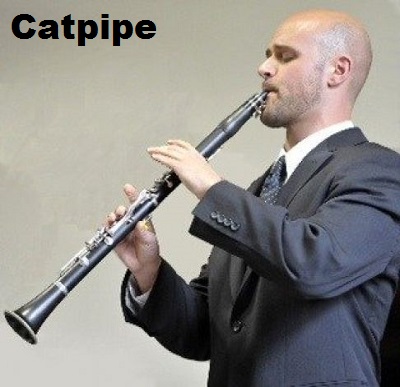
A friend sent me some of these, and I made up some more. My apologies to anyone who plays any of these instruments; actually I like all of them.
The "catpipe" and "duckpipe" were of course used as such by Sergei Prokofiev, and the bassoon could also sound like (with a nod to C. S. Lewis) a "toadpipe". ...And, come to think of it, there are a couple of other types of Twang Tables: the koto and its relatives come to mind.
An exploration of music and sound art in Seattle and surrounding areas, with an emphasis on the adventurous (along with some visual art, film, and other assorted variations on random themes)
Author Website: https://sites.google.com/view/stevenescribnerauthor
Music Website: https://sericscribner1.bandcamp.com/
Wednesday, October 7, 2015
Tuesday, September 29, 2015
Concert Review: Steve Peters’ “Canções Profundas (Deep Songs)” at Good Shepherd Center 9/25/15
“Canções Profundas (Deep Songs)” is a new evening-length work by Seattle composer Steve Peters. Inspired by research into his family history in the Azores, this evocative sonic poem explores themes of migration, diaspora, memory, identity and emotional/cultural ties to place.
A chain of nine volcanic islands in the mid-Atlantic, the Azores are an isolated region of Portugal and the western-most edge of Europe. American whaling ships began arriving in the 18th century, taking on Azorean men as crew; this began a long pattern of emigration and the establishment of Portuguese enclaves in New England, California, Hawaii, and Canada in which Azorean cultural traditions and contact with the archipelago have persisted."
- From Wayward Music Seattle
The Music:
Field Recordings and Ambient Sounds from the Azores, recorded by Steve Peters; instrumental music composed by Steve Peters
The Band:
Lesli Dalaba, trumpet
Beth Fleenor, clarinets
Paul Kikuchi, percussion
Naomi Siegel, trombone
Greg Sinibaldi, saxophone
Joshua Parmenter, additional electronic processing
Rafael Carvalho, viola da terra (Azorean guitar), recorded.
The music was played in the dark.
The beginning was an enigma of sound: percolating lava pits gurgled and led into a crescendo of sea-sounds. Saxophone and trombone blatted from behind and to the side, not really imitating the ocean noises and not really contrasting with them either; merely providing a man-made commentary. This in turn led to an uncanny soundscape of squeals and chirrups and nasal “ewww-ewww-ewwwws” like strangled wind instruments. I assumed this to be a birdcall, though it was more alien than avian and as bizarre as the Japanese kijibato pigeon, which I call the “repeater” and mentioned in a previous post. (After the performance, Steve Peters answered another audience member’s inquiry about it, that it was the call of the Cory’s shearwater, common in the Azores. He said the first time he heard it, at night, it scared the #:@!! out of him.)
Crickets and barnyard animal sounds provided a brief, overlapped interlude, leading to a sudden quiet and then the tolling of a bell. Now the music entered the world of human sounds; at first chanting and bells in church, then an electronic fantasy of modulating bell-tones and – eventually – recognizable brass bands. The latter met and mingled in an Ivesian cross-jumble, though the music they were playing was clearly from a European tradition. During this, an aspect of the performance came to fore: in the dark, we could see shadows of the players moving, but not exactly what they are doing or what sounds were linked with their movements. Paul Kikuchi was on the stage with percussion – a large gong hung behind him like a dim sun in space, and a shadowy bass drum sat to his right – he moved around and between them and appeared to be playing, but it was far from obvious exactly what parts of the ambience came from him (except for a loud gong roll during the most abstract section). This added a definite sense of mystery…
The marching bands receded into mysterious clicking. These were the songs of sperm whales, which the Azoreans (and Americans) used to hunt in their whaling ships, not the more familiar melodies of humpbacks. The band added quasi-melodic sputters that seemed to emerge from the sea-sounds behind the whales.
With the abrupt appearance of modal melodic material from the band, the piece entered its last section – or last three sections. Mr. Peters said that he intended this part to represent the people (and music) of one place in the world migrating to another place in the world: hence, melodies for clarinet, sax and trombone with ambient accompaniment from a processed Azorean guitar (as always, Ms. Fleenor’s clarinet was perfect here); then more sea-sounds leading to a chaos of (talking) voices, half-heard mechanical sounds, and squawks from the band; then a recap of the same melodies, slower and with birdsongs and bells in the background. Ambient processed guitar: fade to black. End. My reaction to this was that, once I knew what the “program” was, it was completely fitting with the story. However, when hearing it the first time, I thought that the piece could have ended after the first section of melodies, and that there was one too many movements. This could probably be a mental holdover from my earlier experience with Seattle Phonographers’ Union concerts (of which Mr. Peters is a member) – these are unplanned performances (improvisations, really) with sampled sound, and often they have more than one false ending. In that case, it adds to the fun and spontaneity; in this “composed” piece, however, I found it a little overdone. This is my one and only (and very slightly) negative comment; otherwise, “Canções Profundas (Deep Songs)” is a masterpiece by one of Seattle’s musical luminaries.
A chain of nine volcanic islands in the mid-Atlantic, the Azores are an isolated region of Portugal and the western-most edge of Europe. American whaling ships began arriving in the 18th century, taking on Azorean men as crew; this began a long pattern of emigration and the establishment of Portuguese enclaves in New England, California, Hawaii, and Canada in which Azorean cultural traditions and contact with the archipelago have persisted."
- From Wayward Music Seattle
The Music:
Field Recordings and Ambient Sounds from the Azores, recorded by Steve Peters; instrumental music composed by Steve Peters
The Band:
Lesli Dalaba, trumpet
Beth Fleenor, clarinets
Paul Kikuchi, percussion
Naomi Siegel, trombone
Greg Sinibaldi, saxophone
Joshua Parmenter, additional electronic processing
Rafael Carvalho, viola da terra (Azorean guitar), recorded.
The music was played in the dark.
The beginning was an enigma of sound: percolating lava pits gurgled and led into a crescendo of sea-sounds. Saxophone and trombone blatted from behind and to the side, not really imitating the ocean noises and not really contrasting with them either; merely providing a man-made commentary. This in turn led to an uncanny soundscape of squeals and chirrups and nasal “ewww-ewww-ewwwws” like strangled wind instruments. I assumed this to be a birdcall, though it was more alien than avian and as bizarre as the Japanese kijibato pigeon, which I call the “repeater” and mentioned in a previous post. (After the performance, Steve Peters answered another audience member’s inquiry about it, that it was the call of the Cory’s shearwater, common in the Azores. He said the first time he heard it, at night, it scared the #:@!! out of him.)
Crickets and barnyard animal sounds provided a brief, overlapped interlude, leading to a sudden quiet and then the tolling of a bell. Now the music entered the world of human sounds; at first chanting and bells in church, then an electronic fantasy of modulating bell-tones and – eventually – recognizable brass bands. The latter met and mingled in an Ivesian cross-jumble, though the music they were playing was clearly from a European tradition. During this, an aspect of the performance came to fore: in the dark, we could see shadows of the players moving, but not exactly what they are doing or what sounds were linked with their movements. Paul Kikuchi was on the stage with percussion – a large gong hung behind him like a dim sun in space, and a shadowy bass drum sat to his right – he moved around and between them and appeared to be playing, but it was far from obvious exactly what parts of the ambience came from him (except for a loud gong roll during the most abstract section). This added a definite sense of mystery…
The marching bands receded into mysterious clicking. These were the songs of sperm whales, which the Azoreans (and Americans) used to hunt in their whaling ships, not the more familiar melodies of humpbacks. The band added quasi-melodic sputters that seemed to emerge from the sea-sounds behind the whales.
With the abrupt appearance of modal melodic material from the band, the piece entered its last section – or last three sections. Mr. Peters said that he intended this part to represent the people (and music) of one place in the world migrating to another place in the world: hence, melodies for clarinet, sax and trombone with ambient accompaniment from a processed Azorean guitar (as always, Ms. Fleenor’s clarinet was perfect here); then more sea-sounds leading to a chaos of (talking) voices, half-heard mechanical sounds, and squawks from the band; then a recap of the same melodies, slower and with birdsongs and bells in the background. Ambient processed guitar: fade to black. End. My reaction to this was that, once I knew what the “program” was, it was completely fitting with the story. However, when hearing it the first time, I thought that the piece could have ended after the first section of melodies, and that there was one too many movements. This could probably be a mental holdover from my earlier experience with Seattle Phonographers’ Union concerts (of which Mr. Peters is a member) – these are unplanned performances (improvisations, really) with sampled sound, and often they have more than one false ending. In that case, it adds to the fun and spontaneity; in this “composed” piece, however, I found it a little overdone. This is my one and only (and very slightly) negative comment; otherwise, “Canções Profundas (Deep Songs)” is a masterpiece by one of Seattle’s musical luminaries.
Monday, September 21, 2015
Concert Review: John Luther Adams’ “Inuksuit” in the Park, Seattle, 9/19/2015
“Inuksuit” is an Inuit word for the roughly anthropomorphic piles of stones formerly left to direct travelers in that northern part of the world. This work by John Luther Adams was an attempt to make auditory inuksuit, an “evidence of human presence”; a pile of sounds upon an outdoor landscape.
We arrived on time at Seward Park, Seattle, for this outdoor event, and found that it wasn’t really ready yet. There were percussion stations scattered around the lawn behind the amphitheater; some were collections of drums, others racks of cymbals and gongs, still others random assemblages of glockenspiels, Tibetan singing bowls, and bright plastic vuvuzelas. Some were attended by percussionists dressed in black (MIB and WIB), but others seemed to have no one nearby.
We took a seat in the amphitheater, and waited. There were only a few people about, but gradually others gathered. At some point I realized that most of the percussionists had congregated by a small temporary stick sculpture about thirty feet away, and were beginning to blow through “megaphones” made of paper – producing the tiniest whisper of a sound. The piece was actually beginning, though at first it was indistinguishable from the sounds of the breeze.
Gradually they moved to their percussion stations, as the music became louder and more strident – sirens, honks and trombone-like howls began to sound from all directions. The first drum beat happened behind me, signaling a definite change to the next section. As more and more drums permeated the soundspace, we began to walk around and listen from different angles (as many, though not all, of the by now sizeable audience was doing). At one point nature synchronized itself to the music: as a particularly dramatic gong rang, a bald eagle appeared in the sky, seemed to survey the scene, and then (as the next gong rang) soared to elsewhere. The music progressed through thundering gongs and cymbals into delicate ringing reverberations, mostly from the glockenspiels – a myriad of wind-chimes all playing (if you listened closely) the same melodies, but scattered through time. By the quiet end, something of a sonic fade to white, many of the players had gathered again by the stick sculpture.
The effect of hearing this outdoors is one not easily forgotten. As opposed to in the concert hall, where music of this type is usually heard (whether “conventional” classical or “experimental”, like this), the sound was thinner, more scattered, yet more ambient. It seemed to be coming from all directions or perhaps out of the sky or the earth – undoubtedly Mr. Adam’s idea (he has commented that he wanted to make music that would awaken an environmental consciousness). The score consists of blocks of time, with each musician moving at his/her own pace, playing each part, but not necessarily synchronizing with the others. The result is a scattering of tones from all directions, with each part recalling others but recurring as part of an unpredictable continuum and development – rather like listening to sounds of nature.
John Luther Adams is a composer whose music is often inspired by nature in Alaska, where he lived from 1978 to 2014. Another one of his pieces, “Become Ocean”, has a connection with Seattle: commissioned by the Seattle Symphony, it won the Pulitzer Prize in 2014. It, however, is intended to be performed indoors in a standard concert hall setting.
*Another contemporary use of the ancient inuksuk sculptures: in Kim Stanley Robinson's sci-fi novel "2312", inuksuit (plural) have become a form of artistic expression on the planet Mercury as it is being colonized by humans – along with "goldsworthies" (from Andy Goldsworthy).
We arrived on time at Seward Park, Seattle, for this outdoor event, and found that it wasn’t really ready yet. There were percussion stations scattered around the lawn behind the amphitheater; some were collections of drums, others racks of cymbals and gongs, still others random assemblages of glockenspiels, Tibetan singing bowls, and bright plastic vuvuzelas. Some were attended by percussionists dressed in black (MIB and WIB), but others seemed to have no one nearby.
We took a seat in the amphitheater, and waited. There were only a few people about, but gradually others gathered. At some point I realized that most of the percussionists had congregated by a small temporary stick sculpture about thirty feet away, and were beginning to blow through “megaphones” made of paper – producing the tiniest whisper of a sound. The piece was actually beginning, though at first it was indistinguishable from the sounds of the breeze.
Gradually they moved to their percussion stations, as the music became louder and more strident – sirens, honks and trombone-like howls began to sound from all directions. The first drum beat happened behind me, signaling a definite change to the next section. As more and more drums permeated the soundspace, we began to walk around and listen from different angles (as many, though not all, of the by now sizeable audience was doing). At one point nature synchronized itself to the music: as a particularly dramatic gong rang, a bald eagle appeared in the sky, seemed to survey the scene, and then (as the next gong rang) soared to elsewhere. The music progressed through thundering gongs and cymbals into delicate ringing reverberations, mostly from the glockenspiels – a myriad of wind-chimes all playing (if you listened closely) the same melodies, but scattered through time. By the quiet end, something of a sonic fade to white, many of the players had gathered again by the stick sculpture.
The effect of hearing this outdoors is one not easily forgotten. As opposed to in the concert hall, where music of this type is usually heard (whether “conventional” classical or “experimental”, like this), the sound was thinner, more scattered, yet more ambient. It seemed to be coming from all directions or perhaps out of the sky or the earth – undoubtedly Mr. Adam’s idea (he has commented that he wanted to make music that would awaken an environmental consciousness). The score consists of blocks of time, with each musician moving at his/her own pace, playing each part, but not necessarily synchronizing with the others. The result is a scattering of tones from all directions, with each part recalling others but recurring as part of an unpredictable continuum and development – rather like listening to sounds of nature.
John Luther Adams is a composer whose music is often inspired by nature in Alaska, where he lived from 1978 to 2014. Another one of his pieces, “Become Ocean”, has a connection with Seattle: commissioned by the Seattle Symphony, it won the Pulitzer Prize in 2014. It, however, is intended to be performed indoors in a standard concert hall setting.
*Another contemporary use of the ancient inuksuk sculptures: in Kim Stanley Robinson's sci-fi novel "2312", inuksuit (plural) have become a form of artistic expression on the planet Mercury as it is being colonized by humans – along with "goldsworthies" (from Andy Goldsworthy).
Tuesday, September 1, 2015
A Disaster? (Maybe Not...)
Last Friday night (8/28/15), Keith Eisenbrey (composer, pianist, percussionist) and I (ditto) played a concert consisting of two relatively long pieces: Keith’s “Etudes d'execution imminent” (piano solo) and my “garbage symphony” called “Sounds, Found” (prerecorded sounds with found objects used as percussion).
What was startling about the concert wasn’t the music, though of course it was avant-garde. Keith’s piece in particular was very beautiful, with its spare, minimalist (not repetitive-minimalist) aesthetic and tendrils of melodies derived from mathematics.
What was startling about the concert wasn’t that few people showed up to listen: this is standard for the Wayward Music Series Concerts, which tend to be woefully under-attended.
What was startling was that, of the few people who came, there were far fewer by the end. So, as I commented to Keith, “Well, we are now officially avant-garde musicians. We have played a concert that cleared the hall.” (I did manage to clear a hall once before, at an open mike in California. I played as part of an unrehearsed folk music band that sang – or screeched – too loud and jarringly off-key. I guess we should have practiced a little first. Other than that, I have to go clear back to my days in Junior High School to remember a performance that tanked this badly.*)
When this occurs, it always leaves a question. Did they leave because the music was awful, like that folk band I just mentioned? (Hey, gimme a break! It was subtitled “a garbage symphony”!) Or, did they leave because the music was too innovative and too interesting, as happened famously to Stravinsky, Schoenberg, and Phillip Glass? Or, did they leave because the music was somehow both awful and too interesting, a sort of negative fusion of punk rock and classical/jazz? Since I composed the longer of the two pieces (and the one that seemed to cause most of the problem), I can’t really comment. I would hope that it was “too interesting” (I once had a radio DJ tell me that) and that a repeat performance would bring in more people who’d been frightened off the first time.
There is of course a third option: simply that the audience left because the music wasn’t quite what they wanted to hear, rather like expecting to hear Beethoven and getting The Pogues or vice-versa. Or that time I took a couple of the white cubes at the salad bar in a vegetarian restaurant, expecting tofu, and got feta cheese.
The music itself: Keith’s piece consisted of eight movements of various lengths, all fairly quiet and sparse. Background sound filtered in from outside, which he’d stated before that he didn’t mind – it adds to the ambience. In my opinion, the music wasn’t quite “ambient” enough for this; I tried to concentrate on the intellectual basis of the music but found myself distracted. However, I thought the composition itself was quite beautiful (and not really derivative of anything else I’d heard) and I’d like to hear it again. That description is a little vague, but I can’t really make more comments, having not really grasped the intent of the piece. At any rate, his part was definitely not the part of the concert that tanked...!
For my “garbage symphony”, Keith and I played (or more accurately, made noise with) our collections of pots and pans, plastic and glass bottles, CD storage racks, sticks (no stones), metal pipes, cardboard boxes and seashells – as well as a bunch of semi-instruments like a zoob-toob, a toy koto with the bridges removed, a broken Lao harp, and my “slab gong”. (The latter is a precarious contraption that always gets destroyed in performance – or at least ever since Neal Kosaly-Meyer accidentally wrecked one during a Seattle Composers Salon and I followed by deliberately smashing the other one. In this concert, the single slab gong was taken apart twice: the first time on accident [I put it back together during a later movement] and the second time on purpose.) Anyway, we improvised our parts, though there were instructions that I’d written as a “road map” to make sure we got to the end of each section at roughly the same time. Each section, as in a lot of my music, was delineated by a prerecorded track played over the house loudspeakers: recordings of skateboards, industrial air-conditioning units, wandering through a street fair, road construction, slapping wooden railings, airplanes, a performance of “Much Ado About Nothing”, street musicians, and a collection of other miscellaneous noise and music. That was the idea, of course, to “explore” the continuum from noise to sound to music.
Well, partially. Maybe mostly it was just to have a lot of fun bashing and whacking things.
And that was that. From a performer’s viewpoint there were moments of beauty in it, though its overall concept was perhaps a little dada/nihilist. There were quiet moments, of course, and, after I moved to the piano for the last two sections, it was supposed to end serenely. Not many stayed around to hear that part.
Maybe we’ll have to repeat the performance again and see what happens. If anything.
*About that junior high school performance (1970's):
It’s rather amusing when I tell it now… I had written a modernist-classical piano sonata that I entered in a state-wide composition contest, and I won. I thought that since my piece had won the contest, the kids at the school would like to hear it, so I played it in the talent show. After I finished, another boy asked me if I’d written that “song”. I answered that I had, and his response was to intone sarcastically, "…it figures." I was about to ask him what that was supposed to mean when I suddenly found myself surrounded by the two school bullies and their thugs, proclaiming that I should be punched in the face once for every note in the song. A teacher came over and broke this up before anything happened, but the teacher warned me that “I shouldn’t play such experimental music in the talent show”. Then, after school, one of my friends came over to my house and told me that I’d really messed up by playing something so “abstract” in the talent show, and all the other kids would hate me for it. Most of the other kids scoffed at the idea that it had won a contest when I told them... For the record, the piece was neither "experimental" nor “abstract” – it was simple folk-like melody, played exactly the same way five times, with a different accompaniment each time. Oh well – there’s no accounting for peoples’ perceptions.
Addendum 9/8/2015: A Listener's Reaction to the "Garbage Symphony":
From a Facebook message: "By now I presume you've read Keith's blog. I concur and feel most of what he says there, and was planning to write you after I read your Soundscroll, which seemed to express doubt and frustration over the event. I don't think either are warranted. It's hard to get people out for challenging stuff, and it's hard to get most people to stick around for work that requires stamina or re-adjustment. “Sounds, Found” is a tough and honest piece. Hearing it involves hearing that doesn't seek climaxes, high points or low points, and it involves having a high tolerance for disorderly mess. … [It] was a complete and full evening of music on its own. Though only about an hour, it was definitely a concentrated hour... I'm glad I was there. Your music is not like ANYBODY else's and it takes us places nobody else does. I absolutely look forward to hearing what you do next, and if you ever decide to program this piece again, I'll definitely be back for seconds." N
(He stayed for the whole performance.)
What was startling about the concert wasn’t the music, though of course it was avant-garde. Keith’s piece in particular was very beautiful, with its spare, minimalist (not repetitive-minimalist) aesthetic and tendrils of melodies derived from mathematics.
What was startling about the concert wasn’t that few people showed up to listen: this is standard for the Wayward Music Series Concerts, which tend to be woefully under-attended.
What was startling was that, of the few people who came, there were far fewer by the end. So, as I commented to Keith, “Well, we are now officially avant-garde musicians. We have played a concert that cleared the hall.” (I did manage to clear a hall once before, at an open mike in California. I played as part of an unrehearsed folk music band that sang – or screeched – too loud and jarringly off-key. I guess we should have practiced a little first. Other than that, I have to go clear back to my days in Junior High School to remember a performance that tanked this badly.*)
When this occurs, it always leaves a question. Did they leave because the music was awful, like that folk band I just mentioned? (Hey, gimme a break! It was subtitled “a garbage symphony”!) Or, did they leave because the music was too innovative and too interesting, as happened famously to Stravinsky, Schoenberg, and Phillip Glass? Or, did they leave because the music was somehow both awful and too interesting, a sort of negative fusion of punk rock and classical/jazz? Since I composed the longer of the two pieces (and the one that seemed to cause most of the problem), I can’t really comment. I would hope that it was “too interesting” (I once had a radio DJ tell me that) and that a repeat performance would bring in more people who’d been frightened off the first time.
There is of course a third option: simply that the audience left because the music wasn’t quite what they wanted to hear, rather like expecting to hear Beethoven and getting The Pogues or vice-versa. Or that time I took a couple of the white cubes at the salad bar in a vegetarian restaurant, expecting tofu, and got feta cheese.
The music itself: Keith’s piece consisted of eight movements of various lengths, all fairly quiet and sparse. Background sound filtered in from outside, which he’d stated before that he didn’t mind – it adds to the ambience. In my opinion, the music wasn’t quite “ambient” enough for this; I tried to concentrate on the intellectual basis of the music but found myself distracted. However, I thought the composition itself was quite beautiful (and not really derivative of anything else I’d heard) and I’d like to hear it again. That description is a little vague, but I can’t really make more comments, having not really grasped the intent of the piece. At any rate, his part was definitely not the part of the concert that tanked...!
For my “garbage symphony”, Keith and I played (or more accurately, made noise with) our collections of pots and pans, plastic and glass bottles, CD storage racks, sticks (no stones), metal pipes, cardboard boxes and seashells – as well as a bunch of semi-instruments like a zoob-toob, a toy koto with the bridges removed, a broken Lao harp, and my “slab gong”. (The latter is a precarious contraption that always gets destroyed in performance – or at least ever since Neal Kosaly-Meyer accidentally wrecked one during a Seattle Composers Salon and I followed by deliberately smashing the other one. In this concert, the single slab gong was taken apart twice: the first time on accident [I put it back together during a later movement] and the second time on purpose.) Anyway, we improvised our parts, though there were instructions that I’d written as a “road map” to make sure we got to the end of each section at roughly the same time. Each section, as in a lot of my music, was delineated by a prerecorded track played over the house loudspeakers: recordings of skateboards, industrial air-conditioning units, wandering through a street fair, road construction, slapping wooden railings, airplanes, a performance of “Much Ado About Nothing”, street musicians, and a collection of other miscellaneous noise and music. That was the idea, of course, to “explore” the continuum from noise to sound to music.
Well, partially. Maybe mostly it was just to have a lot of fun bashing and whacking things.
And that was that. From a performer’s viewpoint there were moments of beauty in it, though its overall concept was perhaps a little dada/nihilist. There were quiet moments, of course, and, after I moved to the piano for the last two sections, it was supposed to end serenely. Not many stayed around to hear that part.
Maybe we’ll have to repeat the performance again and see what happens. If anything.
*About that junior high school performance (1970's):
It’s rather amusing when I tell it now… I had written a modernist-classical piano sonata that I entered in a state-wide composition contest, and I won. I thought that since my piece had won the contest, the kids at the school would like to hear it, so I played it in the talent show. After I finished, another boy asked me if I’d written that “song”. I answered that I had, and his response was to intone sarcastically, "…it figures." I was about to ask him what that was supposed to mean when I suddenly found myself surrounded by the two school bullies and their thugs, proclaiming that I should be punched in the face once for every note in the song. A teacher came over and broke this up before anything happened, but the teacher warned me that “I shouldn’t play such experimental music in the talent show”. Then, after school, one of my friends came over to my house and told me that I’d really messed up by playing something so “abstract” in the talent show, and all the other kids would hate me for it. Most of the other kids scoffed at the idea that it had won a contest when I told them... For the record, the piece was neither "experimental" nor “abstract” – it was simple folk-like melody, played exactly the same way five times, with a different accompaniment each time. Oh well – there’s no accounting for peoples’ perceptions.
Addendum 9/8/2015: A Listener's Reaction to the "Garbage Symphony":
From a Facebook message: "By now I presume you've read Keith's blog. I concur and feel most of what he says there, and was planning to write you after I read your Soundscroll, which seemed to express doubt and frustration over the event. I don't think either are warranted. It's hard to get people out for challenging stuff, and it's hard to get most people to stick around for work that requires stamina or re-adjustment. “Sounds, Found” is a tough and honest piece. Hearing it involves hearing that doesn't seek climaxes, high points or low points, and it involves having a high tolerance for disorderly mess. … [It] was a complete and full evening of music on its own. Though only about an hour, it was definitely a concentrated hour... I'm glad I was there. Your music is not like ANYBODY else's and it takes us places nobody else does. I absolutely look forward to hearing what you do next, and if you ever decide to program this piece again, I'll definitely be back for seconds." N
(He stayed for the whole performance.)
Monday, August 3, 2015
Review: Improvised Benefit Concert for Paul Hoskin, 7/31/2015
“Veteran Seattle improviser, contrabass clarinetist and concert organizer Paul Hoskin is currently in the hospital with very serious ailments. He had planned to play a duo concert tonight with Arrington De Dionyso, so instead Nonsequitur is organizing a benefit concert to help him out, with many members of Seattle’s improvised music community participating. All artist fees and audience admissions will be donated to assist Paul in his recovery.” – Wayward Music Website
“What I’ve decided is that we’ll go basically in alphabetical order except for a few people who have to leave early, who will start. Every five minutes, a new person will come up. When the new person comes up, the person who’d been playing the previous five minutes can either stop and let them solo, or can decide to keep doing a duet with them. Likewise, when the next person comes up, the first person could still keep playing if they want or they can take a break and come back and play with someone else later. There will be no intermissions, it will be non-stop continuous hit music.” – Steve Peters, organizer of the concert (not an exact quote). [Applause]
Impressions of the Music
Wally Shoup (alto sax): Bluesy with spaces and variations.
Neil Welch (tenor sax and electronics): Beautiful atmospheric ambience; saxsamples with echoplex.
Christian Pinnock (trombone): Subterranean grunts and wails from the depths of the subconscious.
Arrington De Dionyso (contrabass clarinet): Heavy metal overtone growl-screeches against a backdrop of stark silence (and at first, Mr. Pinnock’s trombone). This was somewhat in the manner of Mr. Hoskin’s sonic explorations.
Stuart Dempster (bass trombone): Apocalyptic sounds, though quieter and more resigned than those of Mr. De Dionyso.
Beth Fleenor (clarinet): Continuing Mr. Dempster’s sound-world, though gradually evolving into the lyrical. Hints of Balkan music, though slowed. None of Ms. Fleenor’s signature vocal pyrotechnics since the “heavy metal” part of the concert had been earlier.
Sue Ann Harkey (guitar): All sounds derived from open strings; the guitar on the floor and played in the manner of the Chinese guqin (and later, hammer dulcimer). The hall was filled with peaceful reverberation.
Greg Kelley and Jim Knodle (trumpets): The “second movement” began with two solos, both of extreme silence punctuated by the quietest sounds possible on the trumpet – ordinarily a loud instrument of course, but here almost inaudible, whispered, wind-like.
Susie Kozawa (home-mades and objects): half-heard, half-forgotten lamentations from a lost civilization; then metallic echoes from a spring-gong that released a rainbow of harmonics when tipped away from the floor; then plastic percussion frog-croaks to accompany:
Carol Levin (harp): electric, with rhythmic delay and pentatonic suggestions of both Celtic and Chinese music (and a wah-wah pedal). Resurrected the tranquility of Ms. Harkey’s guitar.
At this point, several musicians came up in quick sequence. There were four on stage at one point. David Milford’s violin, played in the Indian (rather than more familiar European) manner continued the “world music” mood of Ms. Levin’s harp. A second harp, this one acoustic, was added by Monica Schley, in glissandi and guitar-like strumming. China Star brought in the soprano sax; avant-garde plunks and stutters added punctuation to what was already happening.
Slowly everyone cleared, leaving John Teske (string bass). Very quiet overtones led to double-bowing (with two bows).
Jenny Zeifel (clarinet): quasi-melodic fragments across all registers of the instrument brought the music to what at first seemed like a tranquil coda. But then, strange vibrations began to filter in from elsewhere. Several of the other wind instrument players (and Ms. Kozawa’s percussion) were joining in. They progressed slowly, trancelike, to the stage, and ended the concert in a flourish of noise and shifting chords.
The concert was recorded so that Mr. Hoskin can hear it. Latest news is that he is recovering, and I think he will like the recording.
“What I’ve decided is that we’ll go basically in alphabetical order except for a few people who have to leave early, who will start. Every five minutes, a new person will come up. When the new person comes up, the person who’d been playing the previous five minutes can either stop and let them solo, or can decide to keep doing a duet with them. Likewise, when the next person comes up, the first person could still keep playing if they want or they can take a break and come back and play with someone else later. There will be no intermissions, it will be non-stop continuous hit music.” – Steve Peters, organizer of the concert (not an exact quote). [Applause]
Impressions of the Music
Wally Shoup (alto sax): Bluesy with spaces and variations.
Neil Welch (tenor sax and electronics): Beautiful atmospheric ambience; saxsamples with echoplex.
Christian Pinnock (trombone): Subterranean grunts and wails from the depths of the subconscious.
Arrington De Dionyso (contrabass clarinet): Heavy metal overtone growl-screeches against a backdrop of stark silence (and at first, Mr. Pinnock’s trombone). This was somewhat in the manner of Mr. Hoskin’s sonic explorations.
Stuart Dempster (bass trombone): Apocalyptic sounds, though quieter and more resigned than those of Mr. De Dionyso.
Beth Fleenor (clarinet): Continuing Mr. Dempster’s sound-world, though gradually evolving into the lyrical. Hints of Balkan music, though slowed. None of Ms. Fleenor’s signature vocal pyrotechnics since the “heavy metal” part of the concert had been earlier.
Sue Ann Harkey (guitar): All sounds derived from open strings; the guitar on the floor and played in the manner of the Chinese guqin (and later, hammer dulcimer). The hall was filled with peaceful reverberation.
Greg Kelley and Jim Knodle (trumpets): The “second movement” began with two solos, both of extreme silence punctuated by the quietest sounds possible on the trumpet – ordinarily a loud instrument of course, but here almost inaudible, whispered, wind-like.
Susie Kozawa (home-mades and objects): half-heard, half-forgotten lamentations from a lost civilization; then metallic echoes from a spring-gong that released a rainbow of harmonics when tipped away from the floor; then plastic percussion frog-croaks to accompany:
Carol Levin (harp): electric, with rhythmic delay and pentatonic suggestions of both Celtic and Chinese music (and a wah-wah pedal). Resurrected the tranquility of Ms. Harkey’s guitar.
At this point, several musicians came up in quick sequence. There were four on stage at one point. David Milford’s violin, played in the Indian (rather than more familiar European) manner continued the “world music” mood of Ms. Levin’s harp. A second harp, this one acoustic, was added by Monica Schley, in glissandi and guitar-like strumming. China Star brought in the soprano sax; avant-garde plunks and stutters added punctuation to what was already happening.
Slowly everyone cleared, leaving John Teske (string bass). Very quiet overtones led to double-bowing (with two bows).
Jenny Zeifel (clarinet): quasi-melodic fragments across all registers of the instrument brought the music to what at first seemed like a tranquil coda. But then, strange vibrations began to filter in from elsewhere. Several of the other wind instrument players (and Ms. Kozawa’s percussion) were joining in. They progressed slowly, trancelike, to the stage, and ended the concert in a flourish of noise and shifting chords.
The concert was recorded so that Mr. Hoskin can hear it. Latest news is that he is recovering, and I think he will like the recording.
Thursday, July 23, 2015
K-T-R and other Stringed Instruments
This is a discussion that occurred on a linguistics page on Facebook. I thought musicians might be interested in it. I’ve changed writers’ names – actually I’ve given them fictional initials (except ME, which is, uh, me) – and provided explanations (in italics) for those unfamiliar with linguistics jargon.
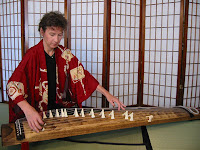
ME: Here's one that touches on two of my interests: linguistics and music. Has anyone else noticed the Eurasian preponderance of words for stringed instruments that have three consonants: a K or S (or a voiced derivative), a T, and an R. Guitar, sitar, santur, zither, kithara, cittern, to name a few. This looks like an example of widespread borrowing (the word went with the thing) but the dictionary etymologies usually suggest different origins. There are a few others that are somewhat similar, from outside of the main area where these words are found: krar and kora (both in Africa and missing the T) and koto (in Japan and missing the R). Are these earlier borrowings? Or is there some common root word here? (Nostraticists might suggest an answer, but I think it's too recent an invention for this to be likely.) Or all some of them coincidences? Other stringed instruments have names that are entirely different. ...And, here's a really weird one -- the word "string" in English begins with the same sequence, minus the vowels...
BC: Guitar, zither, kithara, and cittern are documented cognates. The other stuff just sounds like coincidence to me...
(Cognates: words that share a common origin in related languages, for example, “apple” in English and “Apfel” in German.)
CJ: What if the names describe how they sound, when I think of string instruments I think of k's and t's.... it must be something common, like the fact that most languages I've ran into have m for mother, and b, f, or p for father.
LG: Similar to violin, string bass, zither and harp. (The words sound like, or at least describe, the instrument's sound.)
KT: When you pick six common sounds (k, s, g, z, t, r), a concept, and a continent, and look in languages on that continent for words for that concept containing a couple of those sounds, you are very likely to find a number of them even with no borrowing.
As for cognacy, consider that the proto-language whose existence this suggestion entails would have existed far longer ago than the oldest proto-languages that we have firm evidence for (for example, Indo-European, which is probably about 6,000 years old). Now consider some facts about sound change and meaning change.
(Indo-European: a large family of related languages, including many in India, Europe, and places between, such as Iran [Persia].)
(Proto-language: the [extinct] language from which members of a language family descended.)
Sound change: consider the Proto-Indo-European sound *dʰ. One example of a root containing this sound was *dʰeh₁y, meaning 'suckle, nurse'. The first sound in words starting with that root is now /f/ in Italian (e.g., /fiʎo/), /θ/ in Greek (/θili/), was /d/ in English until these words dropped out of the language (/delu/, /deːon/), and has been completely lost in Spanish (/ixo/), to give a few examples. So in about 6,000 years, *dʰ turned into /f/, /θ/, /d/, and nothing—totally different sounds: three different places of articulation, voiced and voiceless, fricative and stop, and nothing whatsoever.
(The “weird symbols” stand for individual speech sounds, called phonemes. These symbols are used in the science of phonetics and not in any actual language. The asterisk before a word or symbol for a sound indicates that it has been reconstructed and is not in the language now. The paired slashes, before and after, indicate a word being written with symbols, not the way it is actually written in the language.)
Meaning change: that same root *dʰeh₁y has descendants in Romance languages meaning 'son/daughter,' in Greek 'nipple,' in Kurdish 'mother,' etc.
(Romance languages: Languages descended from Latin, an Indo-European language.)
If, as you suggest when you suggest that some of these words (other than the set already pointed out) may be cognate, there was some kind of root *{k,g,s,z}-{t,θ}-r in a language that is ancestral to all of the ones you mention—namely Japanese, an uncertain West African language, and Greek or Arabic depending where the guitar word originally came from—this word would have been used many, many years before Proto-Indo-European was around. Since it was around longer, you would expect it to have changed even more in both sound and meaning than that example Indo-European root did, and it would be pretty likely to have dropped out of the language entirely—words do this a lot (I don't think there's any evidence that the speakers of Proto-Indo-European, for example, had string instruments). In summary, if a root in a proto-language that old did survive into a number of geographically and linguistically distant modern languages, it would almost certainly not have recognizable similarities anymore in those languages.
Also, the kora seems to have been invented in the 16th century [according to online sources], so people would have had to hold onto the ancestor of the word "kora" for literally thousands of years, probably more than 10,000 years, before finally applying it to this new instrument. Similar situation for the koto, whose precursor instrument was first introduced to Japan from China in the 7th and 8th century [according to online sources].
DH: It looks like the examples you give fall into two classes: 1. Guitar, zither, kithara, cittern--from Greek kithara. 2. Sitar--loan from Old Persian. What the two have in common is that both contain a shared root meaning 'string,' which is apparently "tar" in Old Persian, and presumably something similar in PIE or other shared ancestor. It's worth noting that "psalter" is also in this group, with the Greek 'psallein' meaning "pluck". "Santur" might be a loan from this Greek word.
(“Loanword” and “borrowing” in linguistics refers to words moving from one language to another, for example, using the word “sushi” in English.)
(PIE = Proto-Indo-European)
EF: Yes as KT explained so well, it's PIE!
ME: Yeah, I thought it was too recent an invention to be entirely PIE or something even older (see my note about Nostratic, if it ever existed). "Krar", by the way, is Amharic, I think, and "santur" turns out to mean "hundred string(s)" in Old Persian.
KT: Most historical linguists reject the idea of a Nostratic family, fyi. I think the similarities among these words are coincidental, except the ones we already know are borrowings.
(Nostratic: A hypothetical language super-family including Indo-European and several other large families.)
ME: I looked up some lists of stringed instruments in the world, and I think I might have figured this out. There are three groups of words here. 1. Those obviously related to "guitar". 2. Others with the root word "tar", meaning "string", as mentioned above. These are all IE, of course. 3. Non-IE outliers: kora, kwitra, and krar in Africa, kantele in Finnland, and koto in Japan. These look like more ancient, and therefore more altered, forms. More likely, they are accidental resemblances though I should note that the African examples are in the traditionally Orthodox and Islamic areas of Africa (which are geographically closer to the homelands of Indo-European), and other words for stringed instruments in Africa and Asia (and Europe) sound completely different. I might propose an earlier borrowing for one or more of these, though Idon't know which ones.
JW: I wonder whether there is any true acoustic similarity between the names of string instruments and the sounds they produce, say, "s", "z", "c" for the continuous sounds, "k", "t" for the pizzicato or pinching of the strings. Maybe just a coincidence?!...
KT: Yeah, I think just coincidence. The problem is it's pretty easy to imagine an onomatopoetic relationship between any randomly selected segments and things (especially things that make noise).
ME: Here's one that touches on two of my interests: linguistics and music. Has anyone else noticed the Eurasian preponderance of words for stringed instruments that have three consonants: a K or S (or a voiced derivative), a T, and an R. Guitar, sitar, santur, zither, kithara, cittern, to name a few. This looks like an example of widespread borrowing (the word went with the thing) but the dictionary etymologies usually suggest different origins. There are a few others that are somewhat similar, from outside of the main area where these words are found: krar and kora (both in Africa and missing the T) and koto (in Japan and missing the R). Are these earlier borrowings? Or is there some common root word here? (Nostraticists might suggest an answer, but I think it's too recent an invention for this to be likely.) Or all some of them coincidences? Other stringed instruments have names that are entirely different. ...And, here's a really weird one -- the word "string" in English begins with the same sequence, minus the vowels...
BC: Guitar, zither, kithara, and cittern are documented cognates. The other stuff just sounds like coincidence to me...
(Cognates: words that share a common origin in related languages, for example, “apple” in English and “Apfel” in German.)
CJ: What if the names describe how they sound, when I think of string instruments I think of k's and t's.... it must be something common, like the fact that most languages I've ran into have m for mother, and b, f, or p for father.
LG: Similar to violin, string bass, zither and harp. (The words sound like, or at least describe, the instrument's sound.)
KT: When you pick six common sounds (k, s, g, z, t, r), a concept, and a continent, and look in languages on that continent for words for that concept containing a couple of those sounds, you are very likely to find a number of them even with no borrowing.
As for cognacy, consider that the proto-language whose existence this suggestion entails would have existed far longer ago than the oldest proto-languages that we have firm evidence for (for example, Indo-European, which is probably about 6,000 years old). Now consider some facts about sound change and meaning change.
(Indo-European: a large family of related languages, including many in India, Europe, and places between, such as Iran [Persia].)
(Proto-language: the [extinct] language from which members of a language family descended.)
Sound change: consider the Proto-Indo-European sound *dʰ. One example of a root containing this sound was *dʰeh₁y, meaning 'suckle, nurse'. The first sound in words starting with that root is now /f/ in Italian (e.g., /fiʎo/), /θ/ in Greek (/θili/), was /d/ in English until these words dropped out of the language (/delu/, /deːon/), and has been completely lost in Spanish (/ixo/), to give a few examples. So in about 6,000 years, *dʰ turned into /f/, /θ/, /d/, and nothing—totally different sounds: three different places of articulation, voiced and voiceless, fricative and stop, and nothing whatsoever.
(The “weird symbols” stand for individual speech sounds, called phonemes. These symbols are used in the science of phonetics and not in any actual language. The asterisk before a word or symbol for a sound indicates that it has been reconstructed and is not in the language now. The paired slashes, before and after, indicate a word being written with symbols, not the way it is actually written in the language.)
Meaning change: that same root *dʰeh₁y has descendants in Romance languages meaning 'son/daughter,' in Greek 'nipple,' in Kurdish 'mother,' etc.
(Romance languages: Languages descended from Latin, an Indo-European language.)
If, as you suggest when you suggest that some of these words (other than the set already pointed out) may be cognate, there was some kind of root *{k,g,s,z}-{t,θ}-r in a language that is ancestral to all of the ones you mention—namely Japanese, an uncertain West African language, and Greek or Arabic depending where the guitar word originally came from—this word would have been used many, many years before Proto-Indo-European was around. Since it was around longer, you would expect it to have changed even more in both sound and meaning than that example Indo-European root did, and it would be pretty likely to have dropped out of the language entirely—words do this a lot (I don't think there's any evidence that the speakers of Proto-Indo-European, for example, had string instruments). In summary, if a root in a proto-language that old did survive into a number of geographically and linguistically distant modern languages, it would almost certainly not have recognizable similarities anymore in those languages.
Also, the kora seems to have been invented in the 16th century [according to online sources], so people would have had to hold onto the ancestor of the word "kora" for literally thousands of years, probably more than 10,000 years, before finally applying it to this new instrument. Similar situation for the koto, whose precursor instrument was first introduced to Japan from China in the 7th and 8th century [according to online sources].
DH: It looks like the examples you give fall into two classes: 1. Guitar, zither, kithara, cittern--from Greek kithara. 2. Sitar--loan from Old Persian. What the two have in common is that both contain a shared root meaning 'string,' which is apparently "tar" in Old Persian, and presumably something similar in PIE or other shared ancestor. It's worth noting that "psalter" is also in this group, with the Greek 'psallein' meaning "pluck". "Santur" might be a loan from this Greek word.
(“Loanword” and “borrowing” in linguistics refers to words moving from one language to another, for example, using the word “sushi” in English.)
(PIE = Proto-Indo-European)
EF: Yes as KT explained so well, it's PIE!
ME: Yeah, I thought it was too recent an invention to be entirely PIE or something even older (see my note about Nostratic, if it ever existed). "Krar", by the way, is Amharic, I think, and "santur" turns out to mean "hundred string(s)" in Old Persian.
KT: Most historical linguists reject the idea of a Nostratic family, fyi. I think the similarities among these words are coincidental, except the ones we already know are borrowings.
(Nostratic: A hypothetical language super-family including Indo-European and several other large families.)
ME: I looked up some lists of stringed instruments in the world, and I think I might have figured this out. There are three groups of words here. 1. Those obviously related to "guitar". 2. Others with the root word "tar", meaning "string", as mentioned above. These are all IE, of course. 3. Non-IE outliers: kora, kwitra, and krar in Africa, kantele in Finnland, and koto in Japan. These look like more ancient, and therefore more altered, forms. More likely, they are accidental resemblances though I should note that the African examples are in the traditionally Orthodox and Islamic areas of Africa (which are geographically closer to the homelands of Indo-European), and other words for stringed instruments in Africa and Asia (and Europe) sound completely different. I might propose an earlier borrowing for one or more of these, though Idon't know which ones.
JW: I wonder whether there is any true acoustic similarity between the names of string instruments and the sounds they produce, say, "s", "z", "c" for the continuous sounds, "k", "t" for the pizzicato or pinching of the strings. Maybe just a coincidence?!...
KT: Yeah, I think just coincidence. The problem is it's pretty easy to imagine an onomatopoetic relationship between any randomly selected segments and things (especially things that make noise).
Monday, July 20, 2015
Retro Review: A Different German Music, Maybe Not So Different - Stockhausen's Piano Music on Vinyl
(This review was originally published, in a slightly shorter version, and as part of a series on "Krautrock"! - on Sit Down Listen Up.)
I think that when I was twelve or thirteen, my music teacher (composition and classical piano) pulled a fast one on me. One day I passed by his coffee table, as once a week, on my way to play the piano. Sitting on the coffee table that day was a two-record boxed album, the Complete Piano Music of Karlheinz Stockhausen. “Don’t ever listen to that. It’s absolute junk,” my teacher growled, and we went on with the piano lesson. Later, of course, I asked to borrow the album. He gave it to me with a snarl (and probably a wink), and I took it home and listened to it – and of course, since it had been denounced as garbage by someone who represented the Powers That Be, I loved it. My teacher never made another comment about it.
Eventually I bought my own copy (and later, the three CDs by a different pianist – including more pieces that hadn’t been written when the records came out). However, the LP set, though monophonic, still has more of the spirit of the mid-century avant-garde than the more recent recordings. The CDs are too slick: they don’t have the necessary roughness that one associates with the style.
The pieces have abstract titles following the avant-garde tradition, actually derived from classical titles such as “Symphony no. 3” and “Sonata for ‘cello and piano in A major, opus 6 number 4”. Stockhausen’s pieces are simply titled “Klavierstück” (“Piano Piece”) and numbered with Roman numerals. Since these titles don’t really mean anything, the listener is free to imagine whatever he wishes.
Side A of the first record consists of Pieces I through VIII, missing VI, which takes the entire “B” side. The first four are short studies in the “total serialist” style; every note is derived from a series of notes treated mathematically. These pieces are interesting enough in their own way, but (to those unfamiliar with the procedures in the style) can sound like just random notes. I like them mainly as a chaotic introduction from which the order in the rest of the pieces emerges. Piece V begins to group the mathematics-derived notes into clusters, and we catch evanescent glimpses of melodies and rhythms. These are scattered in VII, which counts as a “slow movement” and surrounds most notes with silence and imaginative reverberations from the piano itself – made by complex overlapping of various pedal techniques. VIII is interesting in that it is nearly the antithesis of both V and VII; here, “total serialism” returns, fiery, in loud clusters and dissonant chords.
Piece VI, the “B” side of the album, was recorded on a different piano. Musically it is a longer version of V, with shadows of other methods of organization (melodies, rhythms) underneath the avant-garde atonality. The difference in the piano, however, produces a completely different effect – there are harsher high notes and much louder overtones floating above the bass, which makes me wonder how the quieter VII would sound if played on this same piano.
Side A of the second record includes Pieces IX and XI. Piece IX is one of my favorites. If I may indulge the reader in an extended synesthetic metaphor, the piece is shaped like a fancy ornamental goldfish, though one with a fantail and an extraordinary number of fins. It begins with two long decrescendos on a single chord – an unusually “stable” moment for Stockhausen – (these are the two parts of the fantail). What follows is a long exposition that slowly unravels the chord into a serialist piece (this is the body of the imagined fish). Along the way, there are both some startlingly romantic, melodic gestures and some thick dissonance. The chord keeps reappearing in small moments of repetition, recalling the beginning (these are the fins, which resemble the showy fantail but are smaller). Finally there is a leap to the highest registers of the piano, where scintillating tones sound over an occasional bass pedal point – I’d like to say this is the head of the fish, but the image fails at this point and I’d say, rather, that it reminds me of scattered stars in a galaxy. It ends in freeform silence, the opposite of its beginning. The final two notes are not literally the same two as in VII, but sound similar and thus tie the two pieces together.
Piece XI is a chance piece; a set of composed fragments that may be played once or twice in any order, with the tempo and dynamics instructions coming at the end of each previous fragment. The amount of engagement with the score must make this piece fascinating to the performer; but as an audience member it’s always seemed more interesting in theory than in practice. Even in a style of music that often deliberately sounds random (even if it’s not), it seems to lack direction and coherence. In Kontasrsky’s performance, there are clusters of quick arrhythmic chords at the beginning, and then it merely seems to meander along never reaching the same level again. (However, I once remixed it with Ligeti’s “Atmospheres” and got some beautiful synchrony.)
The last on the album is Piece X. This is the sonic climax; a scarifying labyrinth of tone clusters (including “banging on the piano” – there is a wonderful Youtube parody of this part…!), rapid glissandi (played with gloves on the hands to avoid injury), tremolo, trills, and, slowly emerging from the chaos, melodic fragments (one was lifted by Takemitsu as part of an idée-fixe for his piece “For Away”) and – finally – restful silence. The piece, and this two-record album, ends with a sonic “fade to white”, though my copy is rather old and includes a fair amount of scratches and surface noise at this point.
Stockhausen couldn’t really go any further in the same direction as X and XI without too much strain on both the pianist and the listeners. Subsequent Piano Pieces (still titled the same way) are lighter, more melodic, and introduce the element of humor. Those, however, are not included in this set of records. Where music such as Piano Piece X did go is somewhat surprising: rock music.
American rock bands, it seems, have always been somewhat reluctant to drop the beat and engage in a little exploration of sound simply as sound (with the obvious exception of the Grateful Dead’s “space” improvisations). British (i.e. Pink Floyd) and European (such as “Krautrock” bands) have been more open to the idea. In a three-CD collection of early “lost tapes” by Can, there are a number of long instrumentals that go firmly atonal and explore the shape of the sound, much as in Stockhausen’s IX (remember the fish?) and X. The bassist, Holger Czukay, studied composition with Stockhausen. …And so, what goes round comes round: Stockhausen’s early Piano Pieces, in the “total serialist” avant-garde style, were probably intended as a rebellion against “normal” rhythmic and melodic development, but as the works proceed, a new kind of order emerges and crosses over to rock music, and thus is right back into “normal” aesthetics. The history of both types of music – “classical” and “popular” – is richer for it.
I think that when I was twelve or thirteen, my music teacher (composition and classical piano) pulled a fast one on me. One day I passed by his coffee table, as once a week, on my way to play the piano. Sitting on the coffee table that day was a two-record boxed album, the Complete Piano Music of Karlheinz Stockhausen. “Don’t ever listen to that. It’s absolute junk,” my teacher growled, and we went on with the piano lesson. Later, of course, I asked to borrow the album. He gave it to me with a snarl (and probably a wink), and I took it home and listened to it – and of course, since it had been denounced as garbage by someone who represented the Powers That Be, I loved it. My teacher never made another comment about it.
Eventually I bought my own copy (and later, the three CDs by a different pianist – including more pieces that hadn’t been written when the records came out). However, the LP set, though monophonic, still has more of the spirit of the mid-century avant-garde than the more recent recordings. The CDs are too slick: they don’t have the necessary roughness that one associates with the style.
The pieces have abstract titles following the avant-garde tradition, actually derived from classical titles such as “Symphony no. 3” and “Sonata for ‘cello and piano in A major, opus 6 number 4”. Stockhausen’s pieces are simply titled “Klavierstück” (“Piano Piece”) and numbered with Roman numerals. Since these titles don’t really mean anything, the listener is free to imagine whatever he wishes.
Side A of the first record consists of Pieces I through VIII, missing VI, which takes the entire “B” side. The first four are short studies in the “total serialist” style; every note is derived from a series of notes treated mathematically. These pieces are interesting enough in their own way, but (to those unfamiliar with the procedures in the style) can sound like just random notes. I like them mainly as a chaotic introduction from which the order in the rest of the pieces emerges. Piece V begins to group the mathematics-derived notes into clusters, and we catch evanescent glimpses of melodies and rhythms. These are scattered in VII, which counts as a “slow movement” and surrounds most notes with silence and imaginative reverberations from the piano itself – made by complex overlapping of various pedal techniques. VIII is interesting in that it is nearly the antithesis of both V and VII; here, “total serialism” returns, fiery, in loud clusters and dissonant chords.
Piece VI, the “B” side of the album, was recorded on a different piano. Musically it is a longer version of V, with shadows of other methods of organization (melodies, rhythms) underneath the avant-garde atonality. The difference in the piano, however, produces a completely different effect – there are harsher high notes and much louder overtones floating above the bass, which makes me wonder how the quieter VII would sound if played on this same piano.
Side A of the second record includes Pieces IX and XI. Piece IX is one of my favorites. If I may indulge the reader in an extended synesthetic metaphor, the piece is shaped like a fancy ornamental goldfish, though one with a fantail and an extraordinary number of fins. It begins with two long decrescendos on a single chord – an unusually “stable” moment for Stockhausen – (these are the two parts of the fantail). What follows is a long exposition that slowly unravels the chord into a serialist piece (this is the body of the imagined fish). Along the way, there are both some startlingly romantic, melodic gestures and some thick dissonance. The chord keeps reappearing in small moments of repetition, recalling the beginning (these are the fins, which resemble the showy fantail but are smaller). Finally there is a leap to the highest registers of the piano, where scintillating tones sound over an occasional bass pedal point – I’d like to say this is the head of the fish, but the image fails at this point and I’d say, rather, that it reminds me of scattered stars in a galaxy. It ends in freeform silence, the opposite of its beginning. The final two notes are not literally the same two as in VII, but sound similar and thus tie the two pieces together.
Piece XI is a chance piece; a set of composed fragments that may be played once or twice in any order, with the tempo and dynamics instructions coming at the end of each previous fragment. The amount of engagement with the score must make this piece fascinating to the performer; but as an audience member it’s always seemed more interesting in theory than in practice. Even in a style of music that often deliberately sounds random (even if it’s not), it seems to lack direction and coherence. In Kontasrsky’s performance, there are clusters of quick arrhythmic chords at the beginning, and then it merely seems to meander along never reaching the same level again. (However, I once remixed it with Ligeti’s “Atmospheres” and got some beautiful synchrony.)
The last on the album is Piece X. This is the sonic climax; a scarifying labyrinth of tone clusters (including “banging on the piano” – there is a wonderful Youtube parody of this part…!), rapid glissandi (played with gloves on the hands to avoid injury), tremolo, trills, and, slowly emerging from the chaos, melodic fragments (one was lifted by Takemitsu as part of an idée-fixe for his piece “For Away”) and – finally – restful silence. The piece, and this two-record album, ends with a sonic “fade to white”, though my copy is rather old and includes a fair amount of scratches and surface noise at this point.
Stockhausen couldn’t really go any further in the same direction as X and XI without too much strain on both the pianist and the listeners. Subsequent Piano Pieces (still titled the same way) are lighter, more melodic, and introduce the element of humor. Those, however, are not included in this set of records. Where music such as Piano Piece X did go is somewhat surprising: rock music.
American rock bands, it seems, have always been somewhat reluctant to drop the beat and engage in a little exploration of sound simply as sound (with the obvious exception of the Grateful Dead’s “space” improvisations). British (i.e. Pink Floyd) and European (such as “Krautrock” bands) have been more open to the idea. In a three-CD collection of early “lost tapes” by Can, there are a number of long instrumentals that go firmly atonal and explore the shape of the sound, much as in Stockhausen’s IX (remember the fish?) and X. The bassist, Holger Czukay, studied composition with Stockhausen. …And so, what goes round comes round: Stockhausen’s early Piano Pieces, in the “total serialist” avant-garde style, were probably intended as a rebellion against “normal” rhythmic and melodic development, but as the works proceed, a new kind of order emerges and crosses over to rock music, and thus is right back into “normal” aesthetics. The history of both types of music – “classical” and “popular” – is richer for it.
Multimedia Installation Reivew: Gabriella Denise Frank's "Ugly Me" at Jack Straw, Seattle
Walk in
Distorted selfies greet you with a smile,
A guffaw,
A bellylaugh
Fashion pictures on the other wall spell “UGLY”
Perfect plastic airbrushed clones
On the third wall,
reflective metallic material spells “ME”
A conversational voice hovers in the air,
Stories about cameraphobia.
This was the first installation I’ve seen where my first reaction was laughter. The distorted selfies are fun-house mirror projections with giant noses or big protruding teeth or two heads. They contrast with the fashion-magazine cut-outs on the other wall. Yet, aren’t they all distortions of reality? Doesn’t the beauty industry distort reality to sell us products? Isn’t it all really to get us to buy more?
Who needs rock and roll?
Who needs songs about saving your soul?
Plastic music, plastic food,
Cellophane tunes for that synthetic mood
You got your inspiration from a vending machine,
It's an audio starvation diet,
Mannequins on a shopping spree,
Who cares if you like it? - Buy it.
– Resurrection Band, “Elevator Muzik”
But this is more than just a critique of pop culture. The word “ME” on the third wall says it. Anyone who views the installation is “ME”, of course… So in the end, we are part of the culture that says beauty, and what's manufactured to show to others, is everything. In this installation, we take a step back and laugh at ourselves for such a ridiculous idea, and then move beyond it.
“UGLY ME is a multi-media sound installation that explores the interplay between appearance and self-worth through fashion photography, distorted selfies, and spoken prose. Twelve original works read by the author play as a backdrop to a series of comical personal images and large-scale typographic collage. Visitors are encouraged to listen, linger, and contribute their own selfies to the investigation.” – Jack Straw website. The installation runs through August 14th.
Distorted selfies greet you with a smile,
A guffaw,
A bellylaugh
Fashion pictures on the other wall spell “UGLY”
Perfect plastic airbrushed clones
On the third wall,
reflective metallic material spells “ME”
A conversational voice hovers in the air,
Stories about cameraphobia.
This was the first installation I’ve seen where my first reaction was laughter. The distorted selfies are fun-house mirror projections with giant noses or big protruding teeth or two heads. They contrast with the fashion-magazine cut-outs on the other wall. Yet, aren’t they all distortions of reality? Doesn’t the beauty industry distort reality to sell us products? Isn’t it all really to get us to buy more?
Who needs rock and roll?
Who needs songs about saving your soul?
Plastic music, plastic food,
Cellophane tunes for that synthetic mood
You got your inspiration from a vending machine,
It's an audio starvation diet,
Mannequins on a shopping spree,
Who cares if you like it? - Buy it.
– Resurrection Band, “Elevator Muzik”
But this is more than just a critique of pop culture. The word “ME” on the third wall says it. Anyone who views the installation is “ME”, of course… So in the end, we are part of the culture that says beauty, and what's manufactured to show to others, is everything. In this installation, we take a step back and laugh at ourselves for such a ridiculous idea, and then move beyond it.
“UGLY ME is a multi-media sound installation that explores the interplay between appearance and self-worth through fashion photography, distorted selfies, and spoken prose. Twelve original works read by the author play as a backdrop to a series of comical personal images and large-scale typographic collage. Visitors are encouraged to listen, linger, and contribute their own selfies to the investigation.” – Jack Straw website. The installation runs through August 14th.
Thursday, July 16, 2015
Word(less) Music
(Unlike most of my blog posts, this one isn’t a review of a concert or an album.)
I'm assuming that other people have experienced the weird psycho-musical phenomenon that I'm about to relate, and that there's a name for it. It's probably somehow related either to synesthesia, mondegreens, having a “song stuck in your head”, or some combination.
Here’s the set up. I must have been nine or ten years old. The radio was on at home, to a classical station. Dohnanyi’s “Variations on a Nursery Tune” came on. At some point, I began singing along with the words. “…Under the apple tree, under the apple tree…”
“What do those words have to do with ‘Variations on a Nursery Tune’?” asked my mom, quizzically.
I answered, “I don’t know, but that’s the words.” I thought to myself, why would the words relate to the title if the composer didn’t want them to? (Or, why would they have to relate to “Twinkle twinkle little star”, the nursery tune on which the piece was based?) I don’t remember her response, but when I listened more closely, I realized that that, of course, this was an instrumental piece, for piano and orchestra. There was no singing. So where had the words come from?
A couple of years later, I had forgotten all about it, and it happened again. I was at a symphony pops concert with some family friends. The orchestra was playing “On the Beautiful Blue Danube”. I don’t think I’d actually heard the second theme before then, because when it started (after the more famous part), I nearly folded over with hysterical laughter. All I could do was gasp between spasmodic giggles. The words were so ridiculous! …But nobody else seemed to think that the crazy rhyme was as funny as I did.
It turns out again, of course, that there isn’t any rhyme – but I clearly heard, “lumpkin pumpkin pie / it’s a lumpkin pumpkin pie / yes a lumpkin pumpkin pie / and it’s lumpy all over / all the way up high”. There was no way for me not to notice it – those words were (and are) as intrinsic to the music as its instrumentation, tempo, and rhythm. If I listened carefully, concentrating on the instruments, I could try to ignore them; but even so the rhyme buzzes away in the background.
Once, another (even loopier) version of the same suddenly appeared. The Danube happened to come on a classical radio station, and suddenly: “lumpf gallumpf galai / it’s a lumpf gallumpf galai / yes a lumpf gallumpf galai / and it’s flopping all over / really makes me cry.” In the half-second that followed, I mumbled, “huh!?”, blurted out “They changed the words!”, then, “What the @&!! is a lumpf gallai!?”, and finally, was glad that there was nobody else at home to hear me. Now, when I hear the piece, I wait to see which version it’s going to be... There hasn’t been a third one.
(Anyone who’s wondering about “hearing voices” at this point needn’t. I don’t actually hear anyone singing the words – the words are merely there, as part of the music, in the same way that the notes are there.)
There are a small number of purely instrumental pieces where my brain stubbornly insists that there are words – these “lyrics” are usually nonsense, as the above examples, and I hear them as plainly as the instrumental parts (or even more so). I don’t notice that they actually aren’t there until I think about it. The finale of the Nielsen Third has “high above the hill…” (why “above” rather than “upon” is one of those mysteries that goes with this phenomenon); Copland’s “Appalachian Spring” contains a descending scale that sings “selus unta crobita”, pure nonsense that sounds like it might mean something in Latin but probably doesn’t. And speaking of foreign languages, here’s the strangest part: this involuntary mental trick isn’t limited to the sounds or combinations of sounds that can occur in English (obviously, my native language). There’s part of Harry Partch’s “Castor and Pollux” where a plucked string clearly sings out “nyairf-nyoi”, with the Y’s as a consonants as they might occur in Russian. When I first heard this piece, I was unaware that this combination of consonants was possible (it never occurs in English at the beginning of a word, and I was twelve or thirteen years old and didn’t know any foreign languages or anything about linguistics) – but I clearly heard it and struggled to write it down or explain it to others. (Of course this Partch example might just be an extreme case of onomatopoeia. But then again, I’d always pronounced “thirteen” and “fourteen” with a "foreign" sound that doesn't exist in English either, the Japanese double T. It made it easier for me to learn Japanese pronunciation later…!)
This bizarre mental gymnastics seems to be limited to orchestral music – and Harry Partch – I’ve never noticed it in chamber music or jazz or other types of instrumentals. Of course it doesn’t happen in rock or rap or pop because those already have words.
So what of it? Is this something that only happens to me? Has anyone else had this experience? Is there a name for it? Comments and commentary are welcome, as are suggestions that I seek professional help.
As the bumper sticker proclaims: You’re just jealous because the voices talk to me.
I'm assuming that other people have experienced the weird psycho-musical phenomenon that I'm about to relate, and that there's a name for it. It's probably somehow related either to synesthesia, mondegreens, having a “song stuck in your head”, or some combination.
Here’s the set up. I must have been nine or ten years old. The radio was on at home, to a classical station. Dohnanyi’s “Variations on a Nursery Tune” came on. At some point, I began singing along with the words. “…Under the apple tree, under the apple tree…”
“What do those words have to do with ‘Variations on a Nursery Tune’?” asked my mom, quizzically.
I answered, “I don’t know, but that’s the words.” I thought to myself, why would the words relate to the title if the composer didn’t want them to? (Or, why would they have to relate to “Twinkle twinkle little star”, the nursery tune on which the piece was based?) I don’t remember her response, but when I listened more closely, I realized that that, of course, this was an instrumental piece, for piano and orchestra. There was no singing. So where had the words come from?
A couple of years later, I had forgotten all about it, and it happened again. I was at a symphony pops concert with some family friends. The orchestra was playing “On the Beautiful Blue Danube”. I don’t think I’d actually heard the second theme before then, because when it started (after the more famous part), I nearly folded over with hysterical laughter. All I could do was gasp between spasmodic giggles. The words were so ridiculous! …But nobody else seemed to think that the crazy rhyme was as funny as I did.
It turns out again, of course, that there isn’t any rhyme – but I clearly heard, “lumpkin pumpkin pie / it’s a lumpkin pumpkin pie / yes a lumpkin pumpkin pie / and it’s lumpy all over / all the way up high”. There was no way for me not to notice it – those words were (and are) as intrinsic to the music as its instrumentation, tempo, and rhythm. If I listened carefully, concentrating on the instruments, I could try to ignore them; but even so the rhyme buzzes away in the background.
Once, another (even loopier) version of the same suddenly appeared. The Danube happened to come on a classical radio station, and suddenly: “lumpf gallumpf galai / it’s a lumpf gallumpf galai / yes a lumpf gallumpf galai / and it’s flopping all over / really makes me cry.” In the half-second that followed, I mumbled, “huh!?”, blurted out “They changed the words!”, then, “What the @&!! is a lumpf gallai!?”, and finally, was glad that there was nobody else at home to hear me. Now, when I hear the piece, I wait to see which version it’s going to be... There hasn’t been a third one.
(Anyone who’s wondering about “hearing voices” at this point needn’t. I don’t actually hear anyone singing the words – the words are merely there, as part of the music, in the same way that the notes are there.)
There are a small number of purely instrumental pieces where my brain stubbornly insists that there are words – these “lyrics” are usually nonsense, as the above examples, and I hear them as plainly as the instrumental parts (or even more so). I don’t notice that they actually aren’t there until I think about it. The finale of the Nielsen Third has “high above the hill…” (why “above” rather than “upon” is one of those mysteries that goes with this phenomenon); Copland’s “Appalachian Spring” contains a descending scale that sings “selus unta crobita”, pure nonsense that sounds like it might mean something in Latin but probably doesn’t. And speaking of foreign languages, here’s the strangest part: this involuntary mental trick isn’t limited to the sounds or combinations of sounds that can occur in English (obviously, my native language). There’s part of Harry Partch’s “Castor and Pollux” where a plucked string clearly sings out “nyairf-nyoi”, with the Y’s as a consonants as they might occur in Russian. When I first heard this piece, I was unaware that this combination of consonants was possible (it never occurs in English at the beginning of a word, and I was twelve or thirteen years old and didn’t know any foreign languages or anything about linguistics) – but I clearly heard it and struggled to write it down or explain it to others. (Of course this Partch example might just be an extreme case of onomatopoeia. But then again, I’d always pronounced “thirteen” and “fourteen” with a "foreign" sound that doesn't exist in English either, the Japanese double T. It made it easier for me to learn Japanese pronunciation later…!)
This bizarre mental gymnastics seems to be limited to orchestral music – and Harry Partch – I’ve never noticed it in chamber music or jazz or other types of instrumentals. Of course it doesn’t happen in rock or rap or pop because those already have words.
So what of it? Is this something that only happens to me? Has anyone else had this experience? Is there a name for it? Comments and commentary are welcome, as are suggestions that I seek professional help.
As the bumper sticker proclaims: You’re just jealous because the voices talk to me.
Tuesday, July 14, 2015
Seattle Composers Salon, 7/10/2015
“The Seattle Composers’ Salon fosters the development, performance and appreciation of new music by regional composers and performers. At bi-monthly, informal presentations, the Salon features finished works, previews, and works in progress. Composers, performers, and audience members gather in a casual setting that allows for experimentation and discussion.”
First up: Keith’s piano pieces. Or, piano piece. This was a set of very short pieces (the shortest was about thirty seconds) intended to follow after “One” by Keith’s former music teacher – this was “Another”. The six pieces had evocative titles and hypertext:
(Sphinxes can appear most anywhere) – chords.
(Scarabs love to scuttle among the sphinxes) – three scuttles of notes, very very very short.
(Pools stay put) – beautiful, seemingly immobile, languid sounds.
(Potions can be mixed together, bit to bit or batch to batch)
(All options remain open) – these two sections acted as the “classical” development section.
(Smoke is where it ends) – gradually dissipates into the atmosphere.
(As an alternative, try not filling the clavichord with ping-pong balls.)
Next up: The continuation of the mythological trio by Nadia Kadrevis. This is an interesting concept, where the instruments take on the rolls of invented mythological figures (as I once imagined a symphonic-rock version of Tolkien’s “Music of the Ainur”). Here, an angular, modal melody kept reappearing, though the three instruments often used it as a springboard into their own material. It was quite pretty, and the soprano sax (though unfortunately getting out of tune near the end) inevitably recalled Paul Winter and Oregon (the band). The third and last installment will be in a future Salon.
After the introduction (and stage reconfiguration): the next installment of my “garbage piece”. Part one: traffic and yelling in the street, and clang and clatter from pots, lids, sticks, cardboard boxes, and zoob-toobs. I’m afraid that I gave the wrong impression about this, saying that it was a reflection of political noise but containing samples of Pentecostal street preachers. I was not saying that they are supplying the noise. Sometimes they do, but more often they rail against it. The noise is actually coming from all directions in the U.S. government right now. Part two: more traffic, giving way to children playing, a high-school performance of Shakespeare’s “Much Ado about Nothing”, a 78-record of vintage big-band jazz, an indie-rock band, and bells and reverberations at St. Mark’s Cathedral. All of this was recorded on a single summer evening three years ago. Anyway, following fragmentary instructions, Keith Eisnebrey and I played a scattering of miscellaneous objects as percussion. These “found object” parts create random rhythms that gradually synch up (or not) to the jazz and rock. An audience member asked about the relationship of the recorded sound to the objects on stage: there really isn’t any. This piece is merely about the differences and similarities of noise, sound, and music.
There will be a full performance of this "garbage symphony" at 8:00 on August 28th, at the Chapel Performance Space at Good Shepherd Center, 4649 Sunnyside Ave N, Seattle, WA 98103. Keith and I will play the found percussion, and Keith will also play a piano set.
Lastly, Kam Morrill presented a piano trio (violin, cello, piano) in three movements. Minimalism in the manner of Steve Reich gradually opened up into neo-classical. There was a beautiful pizzicato section; a symphonic gesture that recalled the Tchaikovsky 4 or the Mahler 2. The middle, slow, movement developed a single long melodic line, stretching it to the breaking point (I was reminded again of a symphony, the Bruckner 7) and then abruptly resolved in a different direction. The dance-like, syncopated finale was an unexpected merger of Ginastera and, again, Steve Riech: Latin-inspired dance rhythms were crosscut with other Latin-inspired dance rhythms a smooth harmonic language in open fourths, fifths and major seconds. Despite these disparate influences, the piece presented a coherent and sonorous whole that seemed much shorter than its fifteen minutes.
First up: Keith’s piano pieces. Or, piano piece. This was a set of very short pieces (the shortest was about thirty seconds) intended to follow after “One” by Keith’s former music teacher – this was “Another”. The six pieces had evocative titles and hypertext:
(Sphinxes can appear most anywhere) – chords.
(Scarabs love to scuttle among the sphinxes) – three scuttles of notes, very very very short.
(Pools stay put) – beautiful, seemingly immobile, languid sounds.
(Potions can be mixed together, bit to bit or batch to batch)
(All options remain open) – these two sections acted as the “classical” development section.
(Smoke is where it ends) – gradually dissipates into the atmosphere.
(As an alternative, try not filling the clavichord with ping-pong balls.)
Next up: The continuation of the mythological trio by Nadia Kadrevis. This is an interesting concept, where the instruments take on the rolls of invented mythological figures (as I once imagined a symphonic-rock version of Tolkien’s “Music of the Ainur”). Here, an angular, modal melody kept reappearing, though the three instruments often used it as a springboard into their own material. It was quite pretty, and the soprano sax (though unfortunately getting out of tune near the end) inevitably recalled Paul Winter and Oregon (the band). The third and last installment will be in a future Salon.
After the introduction (and stage reconfiguration): the next installment of my “garbage piece”. Part one: traffic and yelling in the street, and clang and clatter from pots, lids, sticks, cardboard boxes, and zoob-toobs. I’m afraid that I gave the wrong impression about this, saying that it was a reflection of political noise but containing samples of Pentecostal street preachers. I was not saying that they are supplying the noise. Sometimes they do, but more often they rail against it. The noise is actually coming from all directions in the U.S. government right now. Part two: more traffic, giving way to children playing, a high-school performance of Shakespeare’s “Much Ado about Nothing”, a 78-record of vintage big-band jazz, an indie-rock band, and bells and reverberations at St. Mark’s Cathedral. All of this was recorded on a single summer evening three years ago. Anyway, following fragmentary instructions, Keith Eisnebrey and I played a scattering of miscellaneous objects as percussion. These “found object” parts create random rhythms that gradually synch up (or not) to the jazz and rock. An audience member asked about the relationship of the recorded sound to the objects on stage: there really isn’t any. This piece is merely about the differences and similarities of noise, sound, and music.
There will be a full performance of this "garbage symphony" at 8:00 on August 28th, at the Chapel Performance Space at Good Shepherd Center, 4649 Sunnyside Ave N, Seattle, WA 98103. Keith and I will play the found percussion, and Keith will also play a piano set.
Lastly, Kam Morrill presented a piano trio (violin, cello, piano) in three movements. Minimalism in the manner of Steve Reich gradually opened up into neo-classical. There was a beautiful pizzicato section; a symphonic gesture that recalled the Tchaikovsky 4 or the Mahler 2. The middle, slow, movement developed a single long melodic line, stretching it to the breaking point (I was reminded again of a symphony, the Bruckner 7) and then abruptly resolved in a different direction. The dance-like, syncopated finale was an unexpected merger of Ginastera and, again, Steve Riech: Latin-inspired dance rhythms were crosscut with other Latin-inspired dance rhythms a smooth harmonic language in open fourths, fifths and major seconds. Despite these disparate influences, the piece presented a coherent and sonorous whole that seemed much shorter than its fifteen minutes.
Sunday, May 31, 2015
Waywords and Meansigns: Finnegans Reawakening as Music
(This review was originally published, in a slightly shorter version, on Sit Down Listen Up: One Album.)
Now this is an interesting idea: the “whole wholume” of James Joyce’s “Finnegan’s Wake” set to music by various musicians, not as a set of songs or an opera but as a single day-long composition. I’ve listened to about two-thirds of it so far, and it promises to be something greater than the sum of its parts. It is available for free download or streaming audio at Waywords and Meansigns.
For those unfamiliar with the novel, FW is an epic (some would say impenetrable) stream-of-consciousness dream narrative with the barest thread of a plot. A man, H. C. Earwicker, or just HCE, is sleeping. In his dream, he becomes a landscape on which is reenacted the fall of man, symbolized by Humpty Dumpty’s fall and the fall of Tim Finnegan from a ladder. Later in the dream, Earwicker commits an uncertain crime, and is put on trial. Anna Livia, or ALP (probably Earwicker’s wife in his non-sleeping life), presents a letter which will maybe exonerate him; but the letter is either lost in a chicken coop or just unreadable, and is mocked instead. The dream then shifts to three other characters, either Earwicker’s children or fragments of his own psyche (or both): the lowlife Shem the Penman, the heroic Shaun the Postman (aka Juan and Yawn), and the flighty Issy (aka Izzy, Lizzy, and Tizzy). These three regress to their childhood – and while growing up again, Shaun proves to be Earwicker himself. The meaning of “wake” shifts from Tim Finnegan’s funeral to the idea of “waking up” or resurrection, and (though the last monologue is given to Anna), Earwicker awakens and the novel abruptly cuts off – or loops back around to the beginning.
This unresolved fragment is hardly a storyline for a novel. (To be fair, the book is actually much more complex and has literally hundreds of minor characters who float in and out of the dream.) But it isn’t really about plot; it’s not really “about” anything. The interest comes in Joyce’s use of language: the entire tome is a vast puzzle on wordplay, shifting (and very complex) symbolism, and dream imagery.
In this recorded version of chapter one, interest is also created by the music and the readings. Acoustic, Irish-tinged repetitive minimalism (mostly on a mandolin) accompanies the first part; this later gives way (during the “Mutt and Jute” conversation) to electronic hums and whistles, and then more subtle harpsichord and scratchy strings (for the Prankquean sequence), then “retro” synthesizers (in the Japanese pentatonic scale) and Indonesian kacape. Though James Joyce was Irish, the voices don’t have a particularly Irish accent but they do sound European – adding, perhaps, another international layer to the already multifaceted text and music.
This works well with FW, of course, with its fractured stream-of-(un)consciousness. The music becomes another layer of the dream. …But I could imagine this as a new type of literature, made for and disseminated on the internet. Musicians and authors could work together, producing words with music that are not “songs” but something closer to films (but without the visual element!). There are precedents, of course. John Cage’s “Indeterminacy” (with David Tudor) certainly counts. I myself have occasionally read a poem or a chapter of a book that I’d written, at the Hugo House (Seattle), with music that I had composed specifically for the background. (I am also still trying to gather musicians to make a recorded version of the “Shervanya Nocturnal Music” that appears in my novel “Tond”.) I had thought of this type of activity, however, as a continuation of the live improvised music accompanying “Beat” poetry and thus perhaps a form of non-rhyming rap – I hadn’t thought of producing an extended composition that goes with (or is part of) an entire novel.
The second section (Book 1 Chapter 2) didn’t at first seem to be “music” to me, but simply an actor reading an audiobook. My opinion changed about two-thirds of the way through, where the “Ballad of Persse O’Reilly” begins – ambient synthesizers trail in from somewhere, unnoticeable at first, and then other voices (all spoken by the same actor) appear. As the ballad itself proceeds, with music partially provided by Mr. Joyce (there is a page of “sheet music” in the novel), it becomes something of a commentary on a nonsensical Irish song sounding as if in the middle of a Broadway musical. The spoken section at the beginning was merely an extended introduction to this.
The trial scene (Book 1 Chapter 3) is accompanied by alt-rock and circus music – perhaps a confirmation of the parody in this scene. Joyce, like Lewis Carroll in “Alice’s Adventures Underground”, was pointing out the absurdity of the court system of the time.
The least satisfying part so far (to me) is the long chapter which contains the “Mookse and Gripes” sequence. This is one of my favorite parts of the book, with its captivating surrealist imagery ripped right from our subconscious: the weirdly macho, armor-encrusted Mookse; the scruffy Gripes (sitting in a tree, made of grapes, and apparently fermenting as the narrative proceeds); their enigmatic but weirdly perfect insults to each other (“Uskybeak! Ungulant! Uvuloid!”); the shimmering cloud-girl watching them from above (she rains into the river after they depart); the “tears of dusk”; the woman “of no appearance with chills at her feet”, and so on. All very interesting, but the problem occurs with the narrator. He renders the entire chapter as the Mookse might, in both a snooty “posh” accent and quasi-drunken slur (with crowd sounds in the background), and it’s difficult to distinguish the characters – the pompous, professorial poohbah who pontificates the parable is particularly problematic to pin down. This could be a meta-comment on the Wake itself; as in most dreams, characters morph and mutate into one another – but in this audio version, it’s simply less interesting.
More successful are the character sketch chapters. Book 1 Chapter 5, a satire on Anna’s letter becomes, at some point, satire on the Book of Kells (Medieval Irish calligraphy) and then Finnegans Wake itself. The music to this section is a series of drones, gradually becoming a Celtic “slow air” and then an Indian raga, and it is very beautiful. The description of Shem the Penman and his ramshackle mansion is likewise delivered over minimalist string quartet music that v e r y slowly emerges from seemingly endless drones. In this case the voice is electronically slowed (slightly) and lowered (considerably), fitting for the effect of the dream. The last chapter of Book 1 is gossip about Anna, accompanied again by alt rock and circus music (and some freeform improvisation); this is a lively and pointed commentary on the ubiquity but immorality of wagging tongues.
Book 2, chapter 1 is the central part of the novel, and the beginning of the densest dream-language. This is presented as a triptych. The opening and closing sections are almost hip-hop, with sections of a heavy beat and samples from pop and rock (“…another one bites the dust…”, “call me maybe…”) and the Ride of the Valkyries. The middle section is rendered as Beatnik poetry (with a slight “Punk” edge) over jazz improvisations and cross-cut with fragments from probably more than fifty recordings of various types of music. The dream has expanded its borders into other times and places. Other chapters of Book 2 are treated similarly except for the “Nightlessons”. This is forty-plus pages of the gobbledygook that the adult worlds of history and mathematics must seem like to children, with equally incomprehensible footnotes by the three kids, some of which (the footnotes) are supposed to sound “intelligent”. Most of this chapter is sung by a single female voice, a capella – a masterstroke by the musician, Liz Longo; one thinks of it as Anna singing the lessons to her children.
I have not heard all of the rest of it yet. Obviously, the extreme length is an impediment to sitting down and giving one’s full attention to listening to this for any particular amount of time. The question arises: to what extent is this an “album”? To what extent is this even “music”? My answer to first question is perhaps obvious: It’s an “album” in that it’s a set of musical “numbers” that occur in a particular order and were intended to be heard (at least once) together; and it is (like the greatest “albums”) more than the sum of its parts. Most “albums”, of course, are between thirty minutes and an hour, appear on one or more recorded media, and can be listened to at one sitting. But there are much longer examples. Double albums such as the Beatles’ “White Album” are of course a little longer but still can be listened to at one sitting if one makes the time. The same with symphonies – I hear these as “albums” intended to be played live (though of course they can be found recorded too); again, most are between thirty minutes and an hour, but some are much longer. The Mahler Third, Bruckner Fifth, and Shostakovich Seventh are all around ninety minutes in length. Operas and musicals are longer still (these, at least in performance, have a visual element, but are again found recorded – music only) – the Mother of All is Wagner’s “Ring” – and here the idea stretches as to what can be experienced at one time. Sound installations and conceptual pieces such as John Cage’s “To Be Played As Slowly As Possible” are the longest of all – these can last for months, or years, or even centuries. (I myself have done a two-month installation.) Of course no one can listen to the whole of one of these; they are more an immersive experience that one can be a part of for as long (or short) as one wishes. But they are “albums” in that they are (sets of, not necessarily) musical “numbers” that are intended to be played together and are greater than the sum of their parts.
The second question, “Is it music?”, is to me at least, more subjective. On one level it’s meta-music: “Finnegan’s Wake” (with the apostrophe) is the title of an Irish ballad, the story of Tim Finnegan’s fall (and resurrection) – referenced in Joyce’s novel. The novel contains other musical references as well. On another level, it’s a discussion of the differences and similarities between music and speech: because much of the fragmented style of writing is not understandable on a literal level, the reader sometimes has to be content to listen to its melody, almost as one listens to the sound of a foreign language as music.
Dismissing all naïve, cultural-based ideas such as “music has a beat and chords”, my music teacher when I was in middle school defined music as “organized sound expressing emotion”. I would change it slightly to “sound, other than speech, made on purpose, as expression”. By either definition, this rendition of Finnegans Wake is music as much as it a reading of the novel. It joins musical compositions basedon the Wake, by John Cage, Stephen Albert, Toru Takemitsu, Benjamin Boretz, Witold Lutoslawki, Harry Partch, Samuel Barber, and scores of others (including a musico-dramatic “work in progress” version by my friend Neal Kosaly-Meyer – reviewed last December in this blog). What else it is, is up to the individual listener.
Now this is an interesting idea: the “whole wholume” of James Joyce’s “Finnegan’s Wake” set to music by various musicians, not as a set of songs or an opera but as a single day-long composition. I’ve listened to about two-thirds of it so far, and it promises to be something greater than the sum of its parts. It is available for free download or streaming audio at Waywords and Meansigns.
For those unfamiliar with the novel, FW is an epic (some would say impenetrable) stream-of-consciousness dream narrative with the barest thread of a plot. A man, H. C. Earwicker, or just HCE, is sleeping. In his dream, he becomes a landscape on which is reenacted the fall of man, symbolized by Humpty Dumpty’s fall and the fall of Tim Finnegan from a ladder. Later in the dream, Earwicker commits an uncertain crime, and is put on trial. Anna Livia, or ALP (probably Earwicker’s wife in his non-sleeping life), presents a letter which will maybe exonerate him; but the letter is either lost in a chicken coop or just unreadable, and is mocked instead. The dream then shifts to three other characters, either Earwicker’s children or fragments of his own psyche (or both): the lowlife Shem the Penman, the heroic Shaun the Postman (aka Juan and Yawn), and the flighty Issy (aka Izzy, Lizzy, and Tizzy). These three regress to their childhood – and while growing up again, Shaun proves to be Earwicker himself. The meaning of “wake” shifts from Tim Finnegan’s funeral to the idea of “waking up” or resurrection, and (though the last monologue is given to Anna), Earwicker awakens and the novel abruptly cuts off – or loops back around to the beginning.
This unresolved fragment is hardly a storyline for a novel. (To be fair, the book is actually much more complex and has literally hundreds of minor characters who float in and out of the dream.) But it isn’t really about plot; it’s not really “about” anything. The interest comes in Joyce’s use of language: the entire tome is a vast puzzle on wordplay, shifting (and very complex) symbolism, and dream imagery.
In this recorded version of chapter one, interest is also created by the music and the readings. Acoustic, Irish-tinged repetitive minimalism (mostly on a mandolin) accompanies the first part; this later gives way (during the “Mutt and Jute” conversation) to electronic hums and whistles, and then more subtle harpsichord and scratchy strings (for the Prankquean sequence), then “retro” synthesizers (in the Japanese pentatonic scale) and Indonesian kacape. Though James Joyce was Irish, the voices don’t have a particularly Irish accent but they do sound European – adding, perhaps, another international layer to the already multifaceted text and music.
This works well with FW, of course, with its fractured stream-of-(un)consciousness. The music becomes another layer of the dream. …But I could imagine this as a new type of literature, made for and disseminated on the internet. Musicians and authors could work together, producing words with music that are not “songs” but something closer to films (but without the visual element!). There are precedents, of course. John Cage’s “Indeterminacy” (with David Tudor) certainly counts. I myself have occasionally read a poem or a chapter of a book that I’d written, at the Hugo House (Seattle), with music that I had composed specifically for the background. (I am also still trying to gather musicians to make a recorded version of the “Shervanya Nocturnal Music” that appears in my novel “Tond”.) I had thought of this type of activity, however, as a continuation of the live improvised music accompanying “Beat” poetry and thus perhaps a form of non-rhyming rap – I hadn’t thought of producing an extended composition that goes with (or is part of) an entire novel.
The second section (Book 1 Chapter 2) didn’t at first seem to be “music” to me, but simply an actor reading an audiobook. My opinion changed about two-thirds of the way through, where the “Ballad of Persse O’Reilly” begins – ambient synthesizers trail in from somewhere, unnoticeable at first, and then other voices (all spoken by the same actor) appear. As the ballad itself proceeds, with music partially provided by Mr. Joyce (there is a page of “sheet music” in the novel), it becomes something of a commentary on a nonsensical Irish song sounding as if in the middle of a Broadway musical. The spoken section at the beginning was merely an extended introduction to this.
The trial scene (Book 1 Chapter 3) is accompanied by alt-rock and circus music – perhaps a confirmation of the parody in this scene. Joyce, like Lewis Carroll in “Alice’s Adventures Underground”, was pointing out the absurdity of the court system of the time.
The least satisfying part so far (to me) is the long chapter which contains the “Mookse and Gripes” sequence. This is one of my favorite parts of the book, with its captivating surrealist imagery ripped right from our subconscious: the weirdly macho, armor-encrusted Mookse; the scruffy Gripes (sitting in a tree, made of grapes, and apparently fermenting as the narrative proceeds); their enigmatic but weirdly perfect insults to each other (“Uskybeak! Ungulant! Uvuloid!”); the shimmering cloud-girl watching them from above (she rains into the river after they depart); the “tears of dusk”; the woman “of no appearance with chills at her feet”, and so on. All very interesting, but the problem occurs with the narrator. He renders the entire chapter as the Mookse might, in both a snooty “posh” accent and quasi-drunken slur (with crowd sounds in the background), and it’s difficult to distinguish the characters – the pompous, professorial poohbah who pontificates the parable is particularly problematic to pin down. This could be a meta-comment on the Wake itself; as in most dreams, characters morph and mutate into one another – but in this audio version, it’s simply less interesting.
More successful are the character sketch chapters. Book 1 Chapter 5, a satire on Anna’s letter becomes, at some point, satire on the Book of Kells (Medieval Irish calligraphy) and then Finnegans Wake itself. The music to this section is a series of drones, gradually becoming a Celtic “slow air” and then an Indian raga, and it is very beautiful. The description of Shem the Penman and his ramshackle mansion is likewise delivered over minimalist string quartet music that v e r y slowly emerges from seemingly endless drones. In this case the voice is electronically slowed (slightly) and lowered (considerably), fitting for the effect of the dream. The last chapter of Book 1 is gossip about Anna, accompanied again by alt rock and circus music (and some freeform improvisation); this is a lively and pointed commentary on the ubiquity but immorality of wagging tongues.
Book 2, chapter 1 is the central part of the novel, and the beginning of the densest dream-language. This is presented as a triptych. The opening and closing sections are almost hip-hop, with sections of a heavy beat and samples from pop and rock (“…another one bites the dust…”, “call me maybe…”) and the Ride of the Valkyries. The middle section is rendered as Beatnik poetry (with a slight “Punk” edge) over jazz improvisations and cross-cut with fragments from probably more than fifty recordings of various types of music. The dream has expanded its borders into other times and places. Other chapters of Book 2 are treated similarly except for the “Nightlessons”. This is forty-plus pages of the gobbledygook that the adult worlds of history and mathematics must seem like to children, with equally incomprehensible footnotes by the three kids, some of which (the footnotes) are supposed to sound “intelligent”. Most of this chapter is sung by a single female voice, a capella – a masterstroke by the musician, Liz Longo; one thinks of it as Anna singing the lessons to her children.
I have not heard all of the rest of it yet. Obviously, the extreme length is an impediment to sitting down and giving one’s full attention to listening to this for any particular amount of time. The question arises: to what extent is this an “album”? To what extent is this even “music”? My answer to first question is perhaps obvious: It’s an “album” in that it’s a set of musical “numbers” that occur in a particular order and were intended to be heard (at least once) together; and it is (like the greatest “albums”) more than the sum of its parts. Most “albums”, of course, are between thirty minutes and an hour, appear on one or more recorded media, and can be listened to at one sitting. But there are much longer examples. Double albums such as the Beatles’ “White Album” are of course a little longer but still can be listened to at one sitting if one makes the time. The same with symphonies – I hear these as “albums” intended to be played live (though of course they can be found recorded too); again, most are between thirty minutes and an hour, but some are much longer. The Mahler Third, Bruckner Fifth, and Shostakovich Seventh are all around ninety minutes in length. Operas and musicals are longer still (these, at least in performance, have a visual element, but are again found recorded – music only) – the Mother of All is Wagner’s “Ring” – and here the idea stretches as to what can be experienced at one time. Sound installations and conceptual pieces such as John Cage’s “To Be Played As Slowly As Possible” are the longest of all – these can last for months, or years, or even centuries. (I myself have done a two-month installation.) Of course no one can listen to the whole of one of these; they are more an immersive experience that one can be a part of for as long (or short) as one wishes. But they are “albums” in that they are (sets of, not necessarily) musical “numbers” that are intended to be played together and are greater than the sum of their parts.
The second question, “Is it music?”, is to me at least, more subjective. On one level it’s meta-music: “Finnegan’s Wake” (with the apostrophe) is the title of an Irish ballad, the story of Tim Finnegan’s fall (and resurrection) – referenced in Joyce’s novel. The novel contains other musical references as well. On another level, it’s a discussion of the differences and similarities between music and speech: because much of the fragmented style of writing is not understandable on a literal level, the reader sometimes has to be content to listen to its melody, almost as one listens to the sound of a foreign language as music.
Dismissing all naïve, cultural-based ideas such as “music has a beat and chords”, my music teacher when I was in middle school defined music as “organized sound expressing emotion”. I would change it slightly to “sound, other than speech, made on purpose, as expression”. By either definition, this rendition of Finnegans Wake is music as much as it a reading of the novel. It joins musical compositions basedon the Wake, by John Cage, Stephen Albert, Toru Takemitsu, Benjamin Boretz, Witold Lutoslawki, Harry Partch, Samuel Barber, and scores of others (including a musico-dramatic “work in progress” version by my friend Neal Kosaly-Meyer – reviewed last December in this blog). What else it is, is up to the individual listener.
Wednesday, May 27, 2015
Concert Review: Harry Partch at the University of Washington, 5/26/2015
This was the second concert presented by the UW Harry Partch project (I missed the first). As I walked in, I saw the famous one-of-a-kind instruments on the stage. Some of them were a lot larger than I had expected (and one, the “surrogate kithara”, was a lot smaller). Other people came in and filled up the seats; unexpectedly for “experimental” music, the hall was full to capacity.
For those unfamiliar, Harry Partch (1901 - 1974) was an American musical iconoclast who invented a 43-pitch per octave microtonal scale (based on extensions of ancient Greek concepts), wrote music in it, and invented an “orchestra” of instruments to play it. Most of these instruments are either percussion or plectra (plucked strings). The collection of instruments has resided at various places in the U.S., and is now in the University of Washington, Seattle.
Charles Corey, director of the project, introduced the concert. He stated that there would be a short film first, of Harry Partch himself introducing his home-made instruments. Then there would be the concert itself, played mostly by UW students, then a round-table discussion with questions from the audience.
The film began. They projected it on a curtain (with obvious folds and flaws), not on a screen – and several times at the beginning it (the movie) froze or skipped around. Finally it went blank altogether. Pause for a couple of minutes, then reboot the computer (or boot up another one) and retry. This time it worked. Comment from the audience: “Hey, that theme (the fanfare the computer plays while turning on) isn’t Partch – it’s in a tempered scale!” In the movie, Mr. Partch talked about and played several of his instruments, then played random cuts from “Daphne of the Dunes”. The sound quality wasn’t particularly great, as a lot of early Partch recordings; but it was a suitable (if rather fragmented) intro to the music for those who weren’t familiar with it.
The concert began with the famous “Two Studies on Ancient Greek Scales”, for bass marimba (played by Kaley Eaton) and and harmonic canon (the latter is a variation on a koto, though with many more strings much closer together – played by Josh Archibald-Seiffer). The sound was much richer than it has been on recordings. The bass marimba is extremely resonant.
“Two Psalms” followed. “The Lord is My Shepherd (Psalm 23)” was, to me at least, just a voice intoning the text without a particularly interesting accompaniment; but “By the Rivers of Babylon (Psalm 137)” was a more extended chamber movement. The bass-baritone (Jeff Bowen) intoned the first few verses in the same manner as in “Psalm 23”, becoming progressively expressive as the Psalmist lamented the Hebrews’ captivity in Babylon. Coming to “How can I sing the Lord’s song?”, the instruments took over, building to a heart-rendering climax for the brief return of the vocalist. Instruments included the adapted viola, chromelodeon (adapted reed organ, played by Anna Stachurska) and kithara (played by Jeff Boven and then Jacob Sundstrom). The latter instrument is much larger than its ancient Greek prototype: the player has to stand on a riser behind it to play its several banks of strings arranged in chords.
Next, there was an excerpt from “And on the seventh day petals fell in Petaluma”. This is a high-spirited instrumental allegro, far different from the introspective “Psalms”. Huck Hodge and Greg Sinibaldi played it with aplomb on the diamond marimba and surrogate kithara (the latter is so named because it plays in the same manner of the kithara but is smaller and easier to play – it resembles a pedal-steel guitar with two banks of strings).
Back to the introspections. The three excerpts from “Eleven Intrusions” were written just after WWII, with memories of the Great Depression, and embody the despair and anxiety of those periods. “The Crane” is particularly mournful, while “The Waterfall” seems at first a happy little tune but soon takes on darker hues as the vocalist chastises crowds for seeking the “pool of oblivion”. Josh Archibald-Seiffer sang; Luke Morse played the adapted guitar (which has an extra brace on the back besides its adapted tuning) and Declan Sullivan played the diamond marimba.
Probably the most crowd-pleasing piece on the program, “O Frabjous Day!” is a setting of the great humorous poem “Jabberwocky” by Lewis Carroll. Kaley Eaton (harmonic cannon – seemingly amplified) and Isaac Anderson (bass marimba) accompanied with folk-like rhythmic drones and catchy, even rhythms, while Charles Corey sang the poem in a tuneful declamatory style. The humor of the nonsense poem was enhanced by Partch’s cheery setting.
The last piece also included humor, provided in part by the Mazda marimba played by Andrew Angeli. This is one of Partch’s zaniest instruments. The sight of a percussionist using mallets on what looks like a table full of light bulbs is in itself subtly hilarious, and when the timbre is added (it really sounds like percussive burps), all bets are off. The boos (as in “play the boos” – bamboo marimba, played by Declan Sullivan) – a stack of bamboo segments strapped together – is only slightly less madcap. The interesting thing is, though, that this second excerpt from “Petals fell in Petaluma” is perfectly serious music, though it is another happy allegro. As in several of Partch’s other works, the humor and the seriousness merged into a seamless whole.
Several members of Partch’s original ensemble were present for the round-table discussion. Some of their comments:
“What we saw at the beginning of the concert tonight (the film starting and restarting) wasn’t Partch – it was classic Cagean chance!”
“When we were rehearsing some of Partch’s music in his original ensemble, he would often say something to the effect of, ‘hey, you’re singing it wrong – it’s not a semitone, it’s supposed to be three-fourths of a semitone…!’”
“Symphony orchestra players play in just intonation. The ‘cellos and basses form the bass line, and then the other orchestra members have to subconsciously adjust, in microtones, to stay in tune.”
“Patch often composed in a way that was explored by Bach: continuous variation. He’d take one idea, spin it out as far as it would go, and then take another idea, and spin it out as far as it would go.” I commented that this was a similar technique (also) to Indian ragas.
“Partch’s music has three periods. First, he wrote art songs (like what was most of the program tonight). This was his lied-in period, pardon the pun. Then he wrote ‘Americana’ based on hobo trips and the like. Lastly, he wrote extended theater pieces.”
“Partch often said his music was ‘corporeal’ in that it involved graceful movements while playing. Also the players had to sing and dance – a very ancient concept.”
“Partch was looking to the future of music by looking into its deep past.”
“After practicing in one of Partch’s early ensembles, everything I heard on the way home – the wind, my car’s tires on the road – became music.”
“The fact that these students could learn this music in just a few weeks, and perform it so well, proves that Partch was a great composer – the music flows well, and just makes sense the way that good music does.”
For those unfamiliar, Harry Partch (1901 - 1974) was an American musical iconoclast who invented a 43-pitch per octave microtonal scale (based on extensions of ancient Greek concepts), wrote music in it, and invented an “orchestra” of instruments to play it. Most of these instruments are either percussion or plectra (plucked strings). The collection of instruments has resided at various places in the U.S., and is now in the University of Washington, Seattle.
Charles Corey, director of the project, introduced the concert. He stated that there would be a short film first, of Harry Partch himself introducing his home-made instruments. Then there would be the concert itself, played mostly by UW students, then a round-table discussion with questions from the audience.
The film began. They projected it on a curtain (with obvious folds and flaws), not on a screen – and several times at the beginning it (the movie) froze or skipped around. Finally it went blank altogether. Pause for a couple of minutes, then reboot the computer (or boot up another one) and retry. This time it worked. Comment from the audience: “Hey, that theme (the fanfare the computer plays while turning on) isn’t Partch – it’s in a tempered scale!” In the movie, Mr. Partch talked about and played several of his instruments, then played random cuts from “Daphne of the Dunes”. The sound quality wasn’t particularly great, as a lot of early Partch recordings; but it was a suitable (if rather fragmented) intro to the music for those who weren’t familiar with it.
The concert began with the famous “Two Studies on Ancient Greek Scales”, for bass marimba (played by Kaley Eaton) and and harmonic canon (the latter is a variation on a koto, though with many more strings much closer together – played by Josh Archibald-Seiffer). The sound was much richer than it has been on recordings. The bass marimba is extremely resonant.
“Two Psalms” followed. “The Lord is My Shepherd (Psalm 23)” was, to me at least, just a voice intoning the text without a particularly interesting accompaniment; but “By the Rivers of Babylon (Psalm 137)” was a more extended chamber movement. The bass-baritone (Jeff Bowen) intoned the first few verses in the same manner as in “Psalm 23”, becoming progressively expressive as the Psalmist lamented the Hebrews’ captivity in Babylon. Coming to “How can I sing the Lord’s song?”, the instruments took over, building to a heart-rendering climax for the brief return of the vocalist. Instruments included the adapted viola, chromelodeon (adapted reed organ, played by Anna Stachurska) and kithara (played by Jeff Boven and then Jacob Sundstrom). The latter instrument is much larger than its ancient Greek prototype: the player has to stand on a riser behind it to play its several banks of strings arranged in chords.
Next, there was an excerpt from “And on the seventh day petals fell in Petaluma”. This is a high-spirited instrumental allegro, far different from the introspective “Psalms”. Huck Hodge and Greg Sinibaldi played it with aplomb on the diamond marimba and surrogate kithara (the latter is so named because it plays in the same manner of the kithara but is smaller and easier to play – it resembles a pedal-steel guitar with two banks of strings).
Back to the introspections. The three excerpts from “Eleven Intrusions” were written just after WWII, with memories of the Great Depression, and embody the despair and anxiety of those periods. “The Crane” is particularly mournful, while “The Waterfall” seems at first a happy little tune but soon takes on darker hues as the vocalist chastises crowds for seeking the “pool of oblivion”. Josh Archibald-Seiffer sang; Luke Morse played the adapted guitar (which has an extra brace on the back besides its adapted tuning) and Declan Sullivan played the diamond marimba.
Probably the most crowd-pleasing piece on the program, “O Frabjous Day!” is a setting of the great humorous poem “Jabberwocky” by Lewis Carroll. Kaley Eaton (harmonic cannon – seemingly amplified) and Isaac Anderson (bass marimba) accompanied with folk-like rhythmic drones and catchy, even rhythms, while Charles Corey sang the poem in a tuneful declamatory style. The humor of the nonsense poem was enhanced by Partch’s cheery setting.
The last piece also included humor, provided in part by the Mazda marimba played by Andrew Angeli. This is one of Partch’s zaniest instruments. The sight of a percussionist using mallets on what looks like a table full of light bulbs is in itself subtly hilarious, and when the timbre is added (it really sounds like percussive burps), all bets are off. The boos (as in “play the boos” – bamboo marimba, played by Declan Sullivan) – a stack of bamboo segments strapped together – is only slightly less madcap. The interesting thing is, though, that this second excerpt from “Petals fell in Petaluma” is perfectly serious music, though it is another happy allegro. As in several of Partch’s other works, the humor and the seriousness merged into a seamless whole.
Several members of Partch’s original ensemble were present for the round-table discussion. Some of their comments:
“What we saw at the beginning of the concert tonight (the film starting and restarting) wasn’t Partch – it was classic Cagean chance!”
“When we were rehearsing some of Partch’s music in his original ensemble, he would often say something to the effect of, ‘hey, you’re singing it wrong – it’s not a semitone, it’s supposed to be three-fourths of a semitone…!’”
“Symphony orchestra players play in just intonation. The ‘cellos and basses form the bass line, and then the other orchestra members have to subconsciously adjust, in microtones, to stay in tune.”
“Patch often composed in a way that was explored by Bach: continuous variation. He’d take one idea, spin it out as far as it would go, and then take another idea, and spin it out as far as it would go.” I commented that this was a similar technique (also) to Indian ragas.
“Partch’s music has three periods. First, he wrote art songs (like what was most of the program tonight). This was his lied-in period, pardon the pun. Then he wrote ‘Americana’ based on hobo trips and the like. Lastly, he wrote extended theater pieces.”
“Partch often said his music was ‘corporeal’ in that it involved graceful movements while playing. Also the players had to sing and dance – a very ancient concept.”
“Partch was looking to the future of music by looking into its deep past.”
“After practicing in one of Partch’s early ensembles, everything I heard on the way home – the wind, my car’s tires on the road – became music.”
“The fact that these students could learn this music in just a few weeks, and perform it so well, proves that Partch was a great composer – the music flows well, and just makes sense the way that good music does.”
Saturday, May 23, 2015
The 12th Century in the 21st: Medieval Women's Choir perform Hildegard's "Ordo Virtutm" at St. James, Seattle
Their angelic voices echoed in the vast cathedral, while bells and mysterious instruments sounded, seemingly from everywhere at once. I could see them singing and playing there, in the intersection of the cross-shaped building – but I heard them from all directions. Such is the acoustics of St. James Cathedral in Seattle.
I had heard a performance of Hildegard von Bingen’s “Ordo Virtutum” once before, several decades ago, and at that time I’d bought the recording of the work by Sequentia (then on vinyl, now on CD and probably vinyl again). The recording had never had the same effect as the live performance, and at this concert last Friday I was able to discern why. Music such as this demands the ambient surround-sound delivered by yawning spaces in immense stone and wood buildings.
Ordo Virtutm is an example of an ancient genre of music known as, well, an “ordo”; somewhere between an opera and an extended morality lesson. Archetypal characters (representing Biblical personages or concepts such as “humility” and “an individual soul”) sing and chant as a bare story line leisurely unfolds. Hildegard’s Ordo is one of the earliest still-extant examples of the genre, and perhaps the closest to its roots in Gregorian chant – though there are some extreme differences in the music which place it as a thoroughly individual conception. The melodies flow, freeform, seemingly uninterested in either rhythm or conventional phrasing. Instruments (harps and early versions of violins) accompany, either heterophonically or as drones. Bells ring at key moments, sometimes multiplying into swarms of chiming tones (one instrument was a set of small hand bells strapped to a rotating wheel). Harmony actually appears at times, centuries before the concept of “chords” – Hildegard seems to have perceived it as a special effect, saved for the most dramatic moments.
The story is a simple one. A soul approaches heaven, guided forward by the Virtues (Knowledge of God, Faith, Fear of God, Hope, Obedience, Victory, Humility, Charity, Castity). A rough voice calls from behind her (not singing, and accompanied by rattling percussion); it is the devil, tempting her to abandon her journey. This she does, briefly, but finds her new direction unsatisfying, and lets the Virtues show her the way to heaven again. The devil vows to fight her, but Victory swoops down and binds him up, and the soul makes her way to heaven.
Such a simple story line, of course, is made more interesting (and dramatic) by the music. Exactly how it would have been performed during Hildegard’s time is not certain. This Seattle group did it with medieval costumes, though lighting effects enhanced both the celestial world of the Virtues and the demonic world of the devil. They played and sung the music enthusiastically, sweetly, and dramatically, despite two missed cues by the percussionists. The overall effect was beautiful, and the story still resonates – proving that this was not only a work for its time but for the ages.
I had heard a performance of Hildegard von Bingen’s “Ordo Virtutum” once before, several decades ago, and at that time I’d bought the recording of the work by Sequentia (then on vinyl, now on CD and probably vinyl again). The recording had never had the same effect as the live performance, and at this concert last Friday I was able to discern why. Music such as this demands the ambient surround-sound delivered by yawning spaces in immense stone and wood buildings.
Ordo Virtutm is an example of an ancient genre of music known as, well, an “ordo”; somewhere between an opera and an extended morality lesson. Archetypal characters (representing Biblical personages or concepts such as “humility” and “an individual soul”) sing and chant as a bare story line leisurely unfolds. Hildegard’s Ordo is one of the earliest still-extant examples of the genre, and perhaps the closest to its roots in Gregorian chant – though there are some extreme differences in the music which place it as a thoroughly individual conception. The melodies flow, freeform, seemingly uninterested in either rhythm or conventional phrasing. Instruments (harps and early versions of violins) accompany, either heterophonically or as drones. Bells ring at key moments, sometimes multiplying into swarms of chiming tones (one instrument was a set of small hand bells strapped to a rotating wheel). Harmony actually appears at times, centuries before the concept of “chords” – Hildegard seems to have perceived it as a special effect, saved for the most dramatic moments.
The story is a simple one. A soul approaches heaven, guided forward by the Virtues (Knowledge of God, Faith, Fear of God, Hope, Obedience, Victory, Humility, Charity, Castity). A rough voice calls from behind her (not singing, and accompanied by rattling percussion); it is the devil, tempting her to abandon her journey. This she does, briefly, but finds her new direction unsatisfying, and lets the Virtues show her the way to heaven again. The devil vows to fight her, but Victory swoops down and binds him up, and the soul makes her way to heaven.
Such a simple story line, of course, is made more interesting (and dramatic) by the music. Exactly how it would have been performed during Hildegard’s time is not certain. This Seattle group did it with medieval costumes, though lighting effects enhanced both the celestial world of the Virtues and the demonic world of the devil. They played and sung the music enthusiastically, sweetly, and dramatically, despite two missed cues by the percussionists. The overall effect was beautiful, and the story still resonates – proving that this was not only a work for its time but for the ages.
Wednesday, May 13, 2015
Seattle Composers Salon, 5/8/2015
"The Seattle Composers’ Salon fosters the development, performance and appreciation of new music by regional composers and performers. At bi-monthly, informal presentations, the Salon features finished works, previews, and works in progress."
First up: Centaurus X-3 by Matthew James Briggs. Violin (played by Candace Chin) and percussion (played by the composer) created this mysterious soundscape, over prerecorded ambient electronics (made of signals from the Centaurus pulsar and other NASA recordings, slightly scrambled). The violin was also electric; not particularly amplified but enhanced by an extremely long delay. As in much of Matthes’s music, there was an Indonesian influence in the middle, faster section. The interest, however, was mostly in the interactions between the instruments in the slower movements, particularly the slow build-up in the first movement. During the Q and A session after the performance, an audience member asked what the piece would have been like without the electronics. The composer’s comments agreed with my idea: it would be a different piece. Some of the same notes, yes, but definitely a different piece.
Second: Toad Song by Jessi Harvey. The text was by the composer’s sister, about a toad that had lived in the yard of the house they’d lived in as children. The song was from the point of view of the toad. “You have written a great children’s book, and the music is the illustrations,” commented an audience member. Musically, the piece was created from fragments of ascending chromatic scales (sung by the soprano) and amphibian sounds made by the ‘cello; these interacted with more conventional melodic fragments to create longer and more complex ideas.
Third: Two trios by Ian McKnight, both for two flutes and ‘cello. The first, with alto flute, described the life cycle of the mythical phoenix – dying in agony of flames, memorialized by a Gregorian-chant melody, and then returning to life and flying into the sky. I heard none of this in the actual music. The sounds of the alto flute was too pretty and the music was not dissonant enough to suggest something burning up while dying (or perhaps I just associate the alto flute too much with Paul Horn’s Taj Mahal music); the “Gregorian” melody didn’t sound particularly chantlike, and the end wasn’t particularly “happier” than the rest of it. None of these are negative comments, however – I like that the piece suggested the story in a more impressionistic manner, rather than in-your-face Hollywood-style obviousness. A second listening would probably reveal the understated emotions that I half-missed the first time. The second (much shorter) trio was an Irish jig with variations, playing on the 3 against 4 ambiguity suggested by the 6/8 meter.
Finally, two untitled piano pieces (with dancer) by Michael Owcharuk and Karin Stevens. Here, two art-forms fused. The composer and dancer (Karin) stated beforehand that they’d worked on the material together, and intended it to be a collaborative project. Either would have worked by itself, though together they created an audio/visual world based on two types of movement (of sounds, and gestures). The piano music was basically jazz but with a neoclassical feel, the dance was “modern” but again with hints of a classical tradition. There was no particular storyline other than the interest in movement.
First up: Centaurus X-3 by Matthew James Briggs. Violin (played by Candace Chin) and percussion (played by the composer) created this mysterious soundscape, over prerecorded ambient electronics (made of signals from the Centaurus pulsar and other NASA recordings, slightly scrambled). The violin was also electric; not particularly amplified but enhanced by an extremely long delay. As in much of Matthes’s music, there was an Indonesian influence in the middle, faster section. The interest, however, was mostly in the interactions between the instruments in the slower movements, particularly the slow build-up in the first movement. During the Q and A session after the performance, an audience member asked what the piece would have been like without the electronics. The composer’s comments agreed with my idea: it would be a different piece. Some of the same notes, yes, but definitely a different piece.
Second: Toad Song by Jessi Harvey. The text was by the composer’s sister, about a toad that had lived in the yard of the house they’d lived in as children. The song was from the point of view of the toad. “You have written a great children’s book, and the music is the illustrations,” commented an audience member. Musically, the piece was created from fragments of ascending chromatic scales (sung by the soprano) and amphibian sounds made by the ‘cello; these interacted with more conventional melodic fragments to create longer and more complex ideas.
Third: Two trios by Ian McKnight, both for two flutes and ‘cello. The first, with alto flute, described the life cycle of the mythical phoenix – dying in agony of flames, memorialized by a Gregorian-chant melody, and then returning to life and flying into the sky. I heard none of this in the actual music. The sounds of the alto flute was too pretty and the music was not dissonant enough to suggest something burning up while dying (or perhaps I just associate the alto flute too much with Paul Horn’s Taj Mahal music); the “Gregorian” melody didn’t sound particularly chantlike, and the end wasn’t particularly “happier” than the rest of it. None of these are negative comments, however – I like that the piece suggested the story in a more impressionistic manner, rather than in-your-face Hollywood-style obviousness. A second listening would probably reveal the understated emotions that I half-missed the first time. The second (much shorter) trio was an Irish jig with variations, playing on the 3 against 4 ambiguity suggested by the 6/8 meter.
Finally, two untitled piano pieces (with dancer) by Michael Owcharuk and Karin Stevens. Here, two art-forms fused. The composer and dancer (Karin) stated beforehand that they’d worked on the material together, and intended it to be a collaborative project. Either would have worked by itself, though together they created an audio/visual world based on two types of movement (of sounds, and gestures). The piano music was basically jazz but with a neoclassical feel, the dance was “modern” but again with hints of a classical tradition. There was no particular storyline other than the interest in movement.
Subscribe to:
Posts (Atom)